

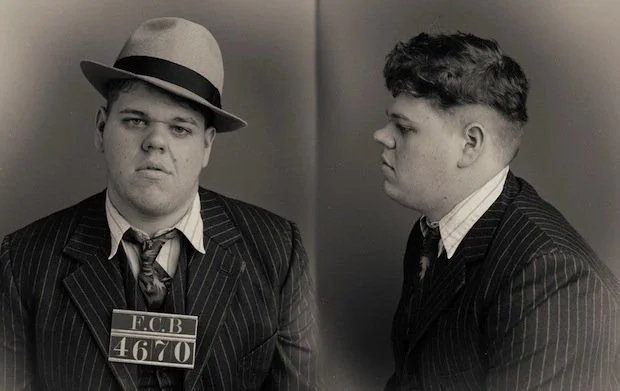
30 For Timber
Johnny Oakes, whose mob monicker was “Timber” was in Dutch. The finger was put on him for speaking out of turn to his twist. The mob decided that, for safety’s sake, Timber must go riding. Skivers and Skats drew the job of sneezing Timber and chopping him down. Skivers and Skats were rambling down the drag when they I.Cd. Timber pushing pills in a pill-joint. They curbed the boiler and rambled into the pill-joint with their roscoes in their coat kicks and fronted Timber. They officed him out to the boiler and as soon as he hit the boiler they cleaned him of his protection. Skivers took the wheel and Skats acted as cover on Timber. Then they high-balled to the timbers and stopped and made Timber get out. Skats said, “This is curtains for you, Timber.” Timber asked why he was riding. He was then infoed that his chatter to his twist about his capers was 30 for him, and the rest of the mob said 40. Skivers said, “We’ll give you a break for your agate and let you play rabbit. If you make it, why 40; if not, it’s 30. When I give you the office scram, and we will let you make 100 before chopping. That is your only out.” Timber was given the office and scrammed for his agate, but the wipers got into action and chopped him down. 30 for Timber.
The Argot of the Underworld by David W. Maurer; American Speech, 1931
Bonus: Glossary of Harlem slang appended to Maxwell Bodenheim’s novel, Naked on Roller Skates (1930)
acecray outcray: putting the ace on the bottom of the deck, where the dealer can abstract it
bah-bah: negligible object
cake-slashing: assault and mayhem
century: hundred dollars
chippy: dissolute girl
chivvy: unpleasant odor
clip your tongue: be silent
cram the paper: cheat at cards
cut your chops: mind your own business
five hard: a fist, a punch
frill: girl, woman
glued their traps: remained silent
going to the timbers: retreating
grand: thousand dollars
grease it: pay bribe money, or blackmail
hamburger down: take it easy
hock your skin: make a difficult promise
hootch: liquor
hotsprat: trivial but agreeable entertainment
in the hole: out of money
lame your foot: deprive you of assistance
leathered: kicked unfairly
lippy chaser: a negro who prefers whites
payman, a: a cadet
pinktail: white person
scrub: face
slide them into concrete: eject them to the sidewalk
spreadeagle: to knock down
stick it: capture something
stick-stick: defeated by previous capture
stretch: jail term
three-nine: sexual variant
thumb: use the thumb to displace cards in a poker-game
trip his muscle: over-reach himself
wraps, or skins, or strips: dollars

William Attaway’s Hobo Novel
“Day O! Day O! Daylight come and me wanna go home.” Most Americans would immediately recognize Harry Belafonte’s “Banana Boat Song,” with its rhyming, rhythmic language and the irresistible calypso beat. “Come Mr. Tally man tally me banana…” Yet the creative genius behind the popular Jamaican singer is little known beyond a small academic circle. A close friend of Belafonte, African American writer William Attaway wrote the lyrics to this classic and others, compiled in his Calypso Song Book of 1957. “Day O is based on the traditional work songs of the gangs who load the banana boats in the harbor at Trinidad,” Attaway explains in the liner notes of Belafonte’s 1956 album Calypso. “The men come to work with the evening star and continue through the night. They long for daybreak when they will be able to return to their homes. All their wishful thinking is expressed in the lead singer’s plaintive cry: ‘Day O, Day O…. The lonely men and the cry in the night spill overtones of symbolism which are universal.” Attaway spent a long and varied career giving voice, in a range of literary and popular genres, to “the lonely men” whose labor puts food on our tables and keeps our industries running. He is best known for his 1941 novel Blood on the Forge, which chronicles the African American Great Migration and labor strife in the Pennsylvania steel mills.But perhaps Attaway’s most powerful expression of the loneliness of the agricultural worker is his first novella—out of print and neglected by scholars—a hobo narrative called Let Me Breathe Thunder.
Attaway’s interest in the poor and outcast began not with his own experience of poverty, but with his youthful rejection of bourgeois values that prompted him to follow an unconventional path. Attaway was born in Greenville, Mississippi in 1911, and migrated as a child to Chicago. His father, a physician, and his mother, a teacher, desired better opportunities for their children outside of the Jim Crow South, and encouraged their son to pursue a career in medicine. While his older sister, Ruth, met their parents’ expectations by studying hard and becoming a successful Broadway actress, William bristled under the constraints of his middle-class upbringing. He frequently skipped classes during high school, and fared little better at the University of Illinois—except for his course in creative writing.