

Human Dialect Cocktails
White girls trying to sing like black girls is not a new phenomenon in pop music. A century and more ago, a less polite and sensitive time, such white performers were called “coon shouters.” They were in many ways the female equivalent of minstrels, and some began their careers in blackface. They sang what white folks took to be blues and jazz and rag; they belted and moaned and shimmied; they exuded raw desire and humor, and generally performed in ways white folks thought black folks did. Just as the first minstrels, primarily of Irish or German descent, passed the form down to mostly Jewish ones by the 1900s, coon shouters of the twentieth century tended to be Jewish. It was entry-level schtick, especially for those who in one way or another didn’t conform to contemporary standards of stage pulchritude.
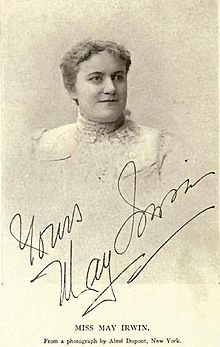
May Irwin was one of the first coon shouters, and helped set a pattern followed by many others. Born Ada Campbell near Toronto in 1862, she was large and fleshy even by expansive Victorian standards, with a milk-and-roses complexion that showed her Irish heritage. She and her sister Georgia, who took the stage name Flo Irwin, became a singing sensation at Tony Pastor’s variety theater in the mid-1870s. They split up in the 1880s, and May went on to belt out coon songs both in blackface and not. “The Bully Song,” her biggest hit, begins: “Have yo’ heard about dat bully dat’s just come to town/ He’s round among de niggers a-layin’ their bodies down.” She performed it in a Broadway musical review of 1895, The Widow Jones, which also included a lingering kiss with her co-star. Thomas Edison caught the show and got the stars to come to his studio, where he filmed The Kiss. The first recorded osculation in American cinema, it’s only twenty seconds long and they actually talk and giggle more than they kiss, but it was denounced anyway by moralists who were already seeing film as a tool of the devil. Like many coon shouters after her, Irwin was as noted for her comic skills as for her singing and her sexy scandals.

John Ericsson, Ornery Inventor
When the Civil War started, much of the small and antiquated U.S. Navy was in dry dock at Norfolk’s Gosport Navy Yard, which was now behind enemy lines. Rather than let the Confederates seize the ships, the commander scuttled and burned them on his way out. Among the charred wrecks was the Merrimac, which had been a big, sleek steam-and-sail frigate bristling with forty guns. Originally its name was spelled “Merrimack” for the New England river, but it somehow lost the k. The Confederates conceived a bold plan to refloat her, repair her, and sheath her hull in iron, with a massive battering ram fitted to the prow, to create a “floating battery.” She would make everything in the Union navy obsolete.
But the Confederacy was very deficient in the sort of iron works and workers who could pull this off, southern states having always depended on the industrialized north for such projects. It would be almost a year before the dreadnought was ready to fight. This gave the Union ample time to come up with a response. Reluctantly, Washington turned to a brilliant, sometimes fanatical and often quarrelsome designer and inventor in New York City, John Ericsson.
He was born in Sweden in 1803, son of a mining engineer who recognized him as a prodigy early on. By twenty-three Ericsson was in London, the roaring heart of the Industrial Revolution, inventing and designing a variety of machines. He moved to New York City at the end of the 1830s, settling in today’s Tribeca in a townhouse on Beach Street, most of which is now called Ericsson Place. In 1843 the U.S. Navy launched the Princeton, a revolutionary new warship Ericsson designed with a coal-fired steam engine, a rotary screw propeller, and a gun that could launch a 225-pound shell five miles with deadly accuracy. In February 1844 the navy was proudly showing it off to President John Tyler and some four hundred dignitaries when an innovative new cannon – not of Ericsson’s design – exploded, killing the secretaries of state and the navy, a couple of sailors, and one of Tyler’s slaves. The President and his bride-to-be Julia Gardiner (of Gardiner’s Island at the forked tip of Long Island) narrowly escaped destruction. The Navy laid the blame on Ericsson, and he spent the next several years in courtrooms trying to clear his name, while also suing infringers of his propeller patent. It all turned him into an infamously ornery cuss.
Anarchists-Bandits
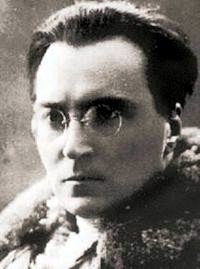
On January 23, 1909 two anarchist illegalists carried out a robbery at a factory on Chestnut Road in Tottenham, in the course of which two people were killed, including a policeman. Amid their flight both anarchists shot themselves rather than surrender, one of them fatally. This event -– popularly known as the Tottenham Outrage – prefigured the 1911 Siege of Sidney Street and the crime spree of the French Bonnot Gang, where all of the participants were anarchists, and all of them bandits.
Last week the dailies related in detail a tragic incident of the social struggle. In the suburbs of London (in Tottenham) two of our Russian comrades attacked the accountant of a factory and, pursued by the crowd and the police, held out in a desperate struggle, the mere recounting of which is enough to make one shiver…
After almost two hours of resistance, having exhausted their munitions and wounded 22 people, three of them mortally, they reserved their final bullets for themselves. One, our comrade Joseph Lapidus (the brother of the terrorist Stryge, killed in Paris in the Vincennes woods in 1906) killed himself; the other was captured, having been seriously wounded.
Words seem powerless to express admiration or condemnation before their ferocious heroism. Lips are still; the pen isn’t strong enough, sonorous enough.
Nevertheless, in our ranks there will be the timorous and the fearful who will disavow their act. But we, for our part, insist on loudly affirming our solidarity.
We are proud to have had among us men like Duval, Pini, and Jacob[1]. We today insist on saying loudly and clearly: The London “bandits” were our people!
Cherry Bombs
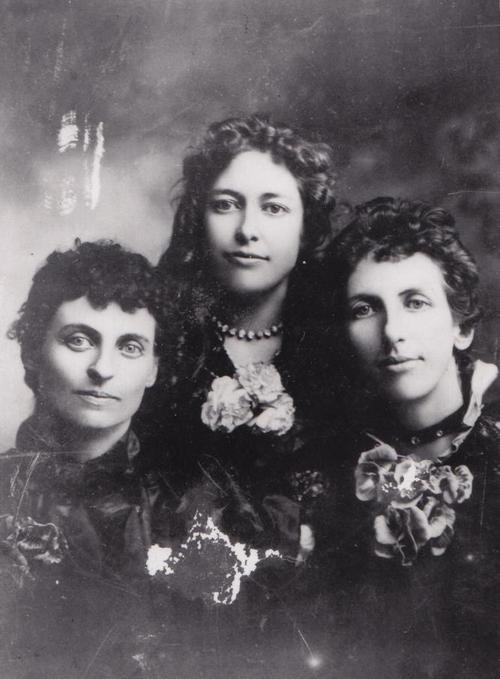
Following the death of their parents and the desertion of their two brothers in the early 1890s, the five sisters of the Cherry family—Ellie, Lizzie, Addie, Jessie and Effie—found it impossible to maintain the family’s small and arid Iowa farm. In need of money and wanting to take a trip to Chicago, in 1893 the sisters decided to take a cue from Andy Hardy and put on a show.
Having been raised strict fundamentalists, the sisters wrote a few melodramatic sketches, a few patriotic and religious numbers, rehearsed a dance number or two, and prepared a couple recitations, which they then put together into a full show which they performed in a local hall for an audience made up of their neighbors.
Laughter in Hell
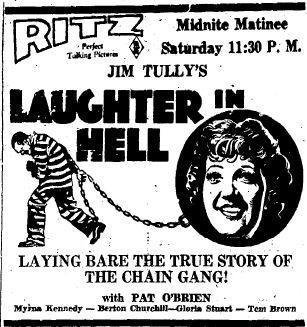
Long assumed to be lost, Laughter in Hell has been disinterred from the Universal vaults, still potent and pungent. This quick and dirty, 70-minute tour of man’s (and woman’s) inhumanity to man had a re-premiere at San Francisco’s majestic Castro Theatre during the 2013 Noir City festival, in a setting of gilded Corinthian columns and elegant rococo murals. It will be screened again on February 26 as part of Film Forum’s series devoted to the year 1933, on a triple bill with 20,000 Years in Sing Sing and Rowland Brown’s lurid, terrific Blood Money. This program ought to come with a health warning, or perhaps with William Carlos Williams’s famous admonition to readers of “Howl”:
“Hold back the edges of your gowns, Ladies, we are going through hell.”
Lagerhead Quinlavan
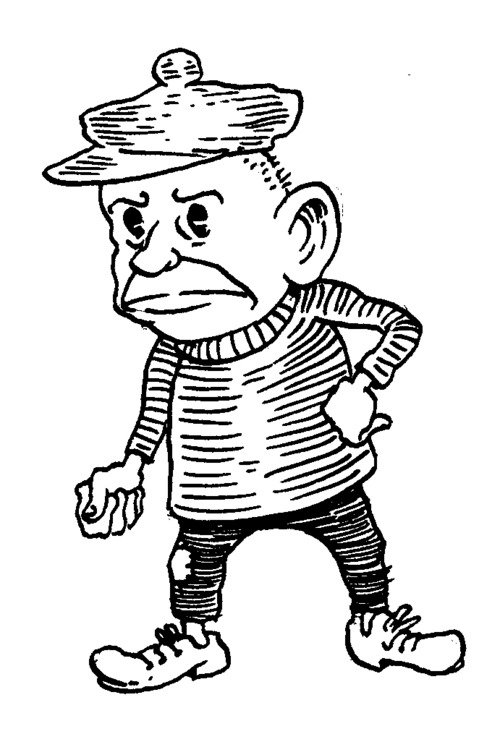
When he was a lad in the tough Yorkville section of Manhattan, Jimmy Cagney ran with a group of poor slum kids sporting nicknames like “Picky,” “Lagerhead” and “Specs.” One of them, Pete Heslin, was nicknamed “Bootah” on account of the over-sized boots he wore. Bootah used to prove how tough he was by hanging off rooftops by his fingertips. Later, he proved how tough he was by becoming a drug addict and killing an off-duty cop during an armed robbery. In 1927, he was sent to Sing Sing and died in the electric chair. Any resemblance between Bootah and Cagney’s portrayal of Rocky Sullivan in Angels with Dirty Faces is purely intentional.
by Jim Knipfel
Drawing by Tony Millionaire
Excerpted from Daniel Riccuito’s The Depression Alphabet Primer
The Creeping Eye
But art and love are a matter of mouths open in cinnabar, of blackness and redness turned to velvet by assiduous grinding, of understanding the colors that benefit from being rubbed softly one into the other: the least that the practice will make you is skillful: beyond which there’s originality… This is all in Cennini’s handbook for painters, as well as the strict instruction that we must always take pleasure from our work.
— Ali Smith, How to Be Both
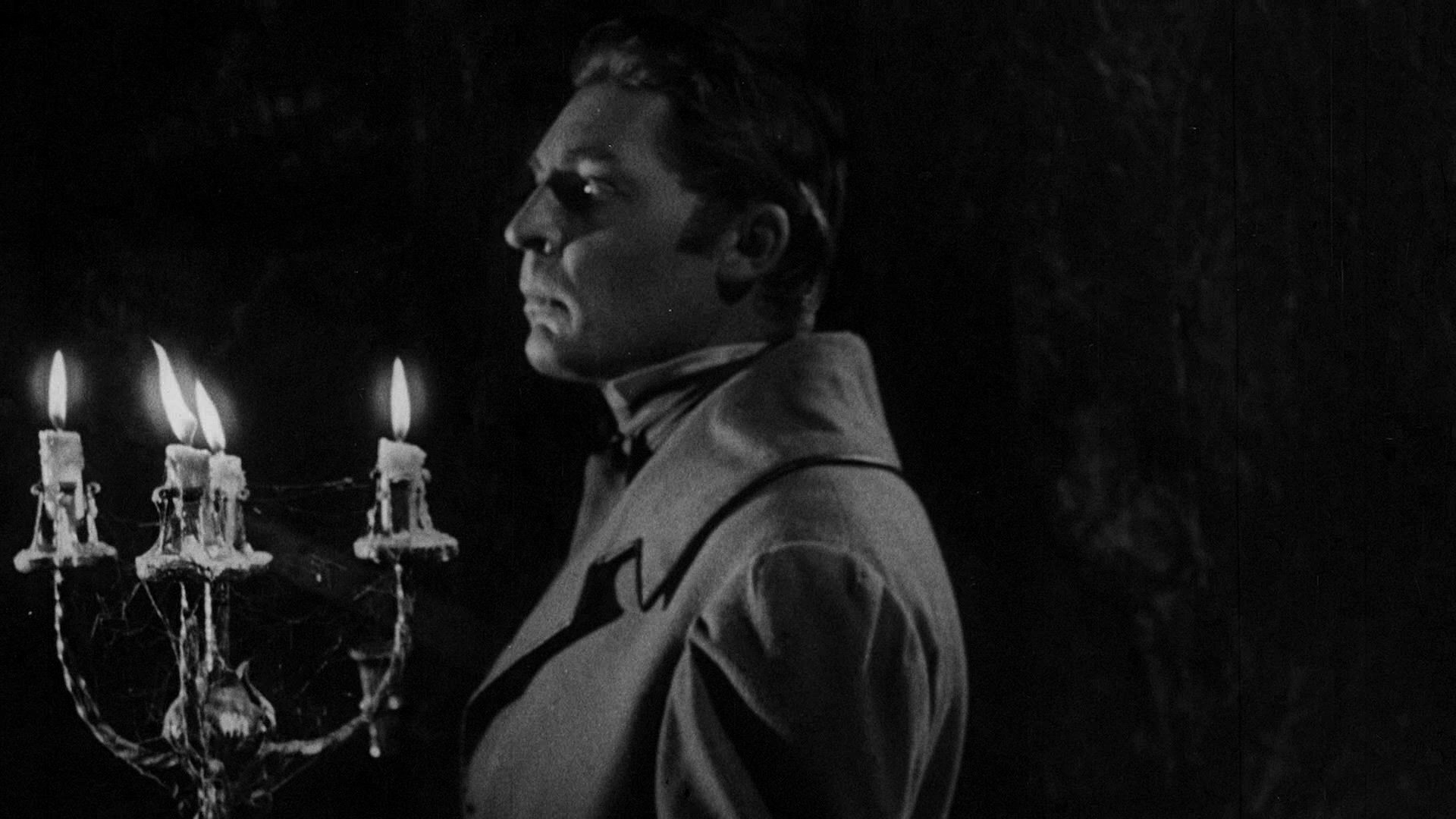
Georges Rivière is haughty. Like he smelled something bad. The script?
Here, in 1964’s Castle of Blood, playing a penurious dandy silly enough to spend the night in a haunted castle on a bet, Rivière seems to think aloofness will be all the protection he needs. It won’t be! Indeed, only one thing can save the film’s leading man from the visual shibboleths of a dying genre, and that’s the cameraman.

Who Are These Boxcar Boys and Girls?
Looking back at it, it seems to me that I was blown here and there like a dead leaf whipped about by the autumn winds…
Jack Black – his middle name was Chisel.
A bleak background! Crowded with robberies, burglaries, and thefts too numerous to recall. All manner of crimes against property. Arrests, trials, acquittals, convictions, escapes. Penitentiaries! There may even lurk an old corpse, compounding the endless felonies we know about, quietly decomposing in some hectic corner of life on the run. Poetic to imagine that when Jack’s memoir appears in 1926, the blood of his anonymous victim cries out, like a harbinger of doom. You Can’t Win – millions would need convincing.

Summer of ‘32
In the year of Our Lord, 1924, a bill passed by the United States Congress, then signed into law by President Calvin Coolidge, granted veterans of the First World War “Adjusted Service Certificates”. It was thought a good idea. The certificates were, essentially, souvenirs; warrants of recognition for honorable duty in the defense of these United States that could, if the bearer so chose, be redeemed for a fistful of cold, hard cash after a maturation period of twenty years. It was a bonus, in other words; the kind one always receives in grateful tribute from one’s employer for any job worth doing done well. In less than a decade, however, the unfiltered reality of Capitalism, American Style, soon dawned on everyone, and as a result the country found itself plunged into the sort of full-scale economic depression no one makes movies about anymore.
In June of 1932, some 15,000 veterans from across the nation – carrying with them their wives, their children and greater or lesser degrees of desperation – gathered as one in Washington, D.C. to petition that same United States Congress to enact legislation that would in effect force the War Department to do away with the maturation cycle and cough up the bonuses … now. Sponsored enthusiastically by the great Texas populist Wright Patman (who, some 40 years thereafter, would conduct the earliest Congressional inquiries into the abyss of mendacity that was Richard Nixon’s 1972 Presidential campaign), the bill sailed through the House, then struck a reef in the Senate where, by its very nature, it was pronounced Dead On Arrival. In the meantime the petitioners, assuming style and title of The Bonus Expeditionary Forces, dug themselves in along the banks of the Anacostia River for the long haul, constructing a vast encampment of makeshift housing that announced to everyone with eyesight that The Bonus Marchers had no intention of leaving the nation’s capitol without seeing their grievances redressed; just like it says in the Constitution. In honor of Washington’s Chief Executive, they called these do-it-yourself cities Hoovervilles.Within a month’s time, President Herbert Hoover, unflattered by the honor and recognizing that the “depleted federal treasury” line really wasn’t fooling anybody, asked the marchers to please go back where they came from. Congress suddenly snapped into action and kicked loose just enough money for carfare, and some of the marchers did take flight. But when the sweeping generosity of Washington’s gesture failed to enchant the majority, the always-relaible D.C. Police were sent in to break some heads, while newspapers began the standard cycle of dark speculation on the presence of Anarchists, Communists and other “foreign radicals” in sinister control of Bonus Marcher ranks. The protest, despite the weight of this harassment, endured. On July 28, requesting that “all humanity consistent with the due execution of this order” be used, President Hoover asked Army Chief of Staff, Gen. Douglas MacArthur to clear out the Hoovervilles and send everybody home. And, with all consistent humanity, that’s what he did.
Bringing to bear the full might of the US Army’s 3rd Cavalry from Fort Myer, Virginia, and the 12th Infantry Regiment out of Fort Howard, Maryland, Gen. MacArthur unleashed an unremitting mandate from the US Capitol in the form of tear gas, unsheathed bayonets and plain, ordinary firepower. When it ended and the fires went out, over 1,000 marchers … and their wives … and their kids … were injured, four were dead, and the Anacostia flats – once all the Hooverville lumber had been carted away – resembled nothing less than a battlefield aftermath from that Civil War which suddenly must have seemed a lot closer in time to some Americans than it had just two months prior.
R.I.P. Mr. B.I.G. (1923-2023)
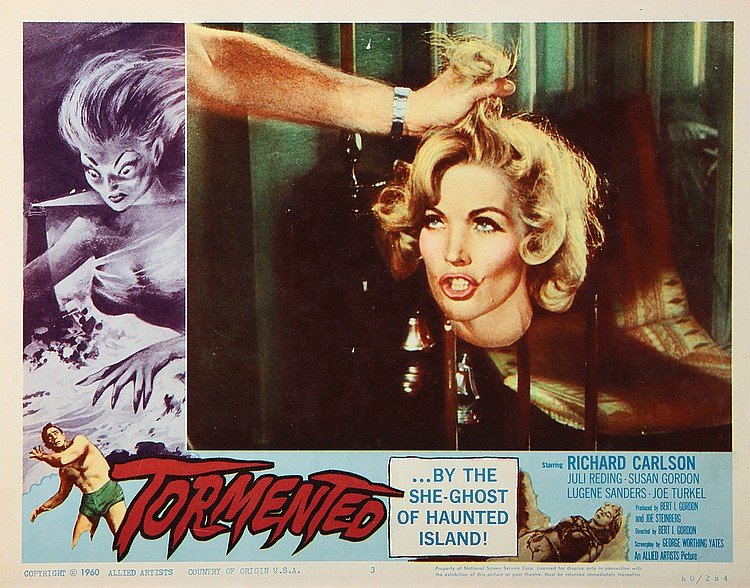
In the mid-1950s, American theaters were awash in giant monster pictures, fuels by out fear of the A-bomb and the as-yet-unknown side effects of radiation exposure. People were itching to see mass destruction take on a comprehensible, mythical form—a form which could, by films end, be contained and destroyed leaving the world safe once again.

Burn Down the Tuileries
Paris Commune, 1871
Père Duchêne was fucking happy to see that Badinguet I[1] was torn down.
But dammit, that’s not all.
It’s only the beginning.
There’s more work to be done.
And it’s not work we’re lacking.
Fuck no!

Smoke
In 1935, a then-thirteen year-old high school dropout named Frank Cuthbert was arrested in Los Angeles after stealing a revolver. He was sentenced to three years in a notorious reform school in Ione, California.
Shortly after being placed in the reformatory’s version of solitary confinement, Cuthbert ran away, and immediately undertook a bit of a one-man crime spree, robbing several jewelry stores before making the mistake of driving a stolen car across state lines. When he was taken into custody this time, he was sentenced to three years in the federal penitentiary in Springfield, Missouri. Once his sentence at the federal pen was up, he was then transferred to San Quentin on other charges, and was eventually released shortly before turning twenty-one.
After being sprung from Quentin, Cuthbert played it more or less straight, taking on a number of odd jobs around Los Angeles. He at turns worked as a ranch hand, a lumberjack, and a truck driver, along with trying his hand at boxing.
As the story goes, in 1943 Alan Ladd spied a tall and strikingly handsome young man riding a horse through the Los Angeles hills. The two chatted a bit, and Ladd mentioned the encounter to his wife at the time, agent Sue Carol. Carol in turn recommended Cuthbert take a screen test at 20th Century Fox. The test went well enough, and shortly afterward he began appearing in small, uncredited roles in a smattering of forgettable films, usually playing soldiers.