
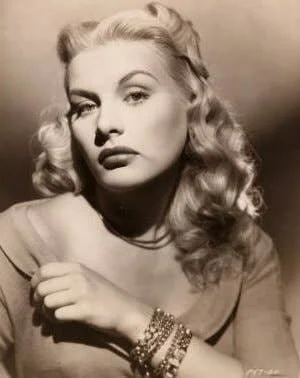
The James Cagney crime film Kiss Tomorrow Goodbye (1950) begins in court, where a heavy-handed prosecutor is hammering home the evil of a gang of criminals who are on trial. He starts by zeroing in on a beautiful blond with a wide, mobile face, the kind of face the camera loves. “Holiday Carleton…murderess,” the prosecutor says. The blond reacts subtly to this, her generous mouth downturned, her rather cruel-looking eyebrows drawn slightly back in apprehension. This is the face of someone who is always wondering just how much they can get away with. It is the face of Barbara Payton, a 23-year-old actress who is being given her big break in this movie, which was produced by Cagney’s brother William, who was so taken with Payton that he put her under personal contract.
There is a flashback where we see Cagney’s Ralph making an escape from a chain gang, and then a few more scenes before we come to his first major scene with Payton’s Holiday, who has been drawn into his life of crime. She is Virginia Mayo-ish physically, but there’s a large slice of Claire Trevor in her cutting, insistent voice. It’s clear that this sexy blond can act, and as Holiday yells at Ralph and defends herself, Cagney sits in a chair and reacts to Payton in that super-deep and responsive way he has when he listens extra-closely to other players. Payton’s Holiday keeps saying that she is a “good girl” who never did anything wrong before, but Cagney tells her, “It takes only once, you know,” because he has her number. He sees the devils lurking underneath her cool blond looks.
Cagney is clearly intrigued by Payton in this scene, as if on one level his character is judging and manipulating her character and on another level Cagney himself is thinking, “Huh…just what is going on with you, girlie?” (That’s a question people are still asking about Payton.) Finally Payton’s Holiday can take no more pressure and she throws a knife at Ralph’s neck. It just nicks him behind the ear, but she has made her point, and there is a great deal of suspense as he slowly looks at her and then gets up to clean the wound off in the bathroom. She approaches him from behind, and then he takes a towel and starts whacking her with it hard, an unusual sort of punishment response that ends when she bursts into tears and puts her head on his shoulder.
This is a complex push-and-pull sort of scene, and it is topped later on by a second scene in Kiss Tomorrow Goodbye where Payton’s hot-tempered Holiday throws a pot of coffee at Cagney’s Ralph, who is casually eating a banana, and he just ducks and asks for more. “I like my coffee in a cup,” he teases, and then she throws a cup at him. And then he says he likes cream, and Holiday hurls the creamer at him. And then he says he likes sugar, too, and Holiday pitches the sugar bowl at him. And then they both burst into laughter and kiss on a couch.
No other actress ever went at it with Cagney in such a 50-50 and satisfying fashion as Payton does in Kiss Tomorrow Goodbye, and it’s a shame that a good part of the film’s narrative is wasted on good girl Margaret Dobson (Helena Carter), a naive brunette heiress with a prissy voice. It’s as if the movie is afraid of Payton, though it does give her the whole ending, where her lovely Nordic face is all twisted with ugly and mean-spirited vengeance as she snarls the title and plugs two bullets into Cagney.
Kiss Tomorrow Goodbye was Payton’s brief moment in the sun, and she fell down hard after that and awfully fast. She played with Gary Cooper in Dallas (1950) and Gregory Peck in Only the Valiant (1951), where her looks and her talent seem somehow diminished already, or tranquilized. Payton was hardly a believable Southern belle in Drums in the Deep South (1951), and by the end of that year her reckless behavior off-screen and open sexual promiscuity led to a serious scandal. Her lack of caution exposed the hypocrisy of the Hollywood sexual meat market for starlets, and also the ugliness of that system. Two actors were fighting for her affections, smooth Franchot Tone and shady Tom Neal, and they got into a physical brawl so vicious that Tone wound up in the hospital in serious condition. Payton couldn’t decide between them; she visited Tone in the hospital with liquor and briefly married him, but she went back to Neal a month or so later. Everything with her went quick, and everything wound up in a rare sort of mess.
Payton was born Barbara Lee Redfield in Cloquet, Minnesota. Both of her parents were serious alcoholics, and Payton was a serious drinker herself throughout much of her brief life. Once in Hollywood in the late 1940s, she got a part as an alluring cigarette girl in Trapped (1949), and she also settled into a serious affair with the married Bob Hope, who set her up in a nice apartment but broke things off with her when she demanded more money from him.
Payton is one of those people who seemed to be playing out a kind of film noir with her own life, but in circumstances that soon grew far more sordid than anything an American movie could show or even suggest in the 1950s. She used sex to get ahead in Hollywood, but she was also a sexual compulsive whose behavior was affected by her drinking. It’s one thing to indulge yourself with Gary Cooper or Guy Madison if you are a beautiful blond and making a movie with them, but Payton was indiscriminate sexually, and this pointed to deeper sources of disturbance, that thing that made Cagney so intrigued but also disconcerted by her in their first big scene in Kiss Tomorrow Goodbye.
After the Tone-Neal scandal, Payton took a part in Bride of the Gorilla (1951), where she is zombie-ish, and then did a cash-in noir in Britain called Bad Blonde (1953), where she also seemed a bit zombie-like, distant, abstracted, except in the early scenes where she sexually leers at a good-looking boxer (Tony Wright). This removal of hers could be seen as suggesting the sociopathic character she is playing in Bad Blonde, and it is nearly comic, but not quite.
She starred opposite the objectionable Sonny Tufts in Run for the Hills (1953) and then played with her bad romance boyfriend Neal in a color western, The Great Jesse James Raid (1953). Her last movie was Edgar Ulmer’s Murder Is My Beat (1955), where she says, “I only drink when I’m happy,” and her broadened, troubling face is by turns helpless, disgusted, and dazed.
After that there was a long Hollywood Babylon-style decline so seamy and nasty that it nearly beggars belief. She got in trouble for writing bad checks, and by the early 1960s she had put on considerable weight. Payton gradually started working as a prostitute, servicing clients in front of an open window in her room above a bar, and she was arrested for prostitution on Sunset Boulevard. When she was offered the chance to detox, Payton said, “I’d rather drink and die.” (In one of her British films, the science fiction story Four Sided Triangle {1953}, she says, “I didn’t ask to be born. So I have a right to die.”)
During her brief heyday in Hollywood, Payton had earned $10,000 a week, but now she was turning five-dollar tricks for a pimp who beat her and knocked out some of her teeth. One john stabbed her, and she needed 38 stitches from her stomach to her thigh to close the wound, and this made the newspapers. “Some filthy drunk got mad at me when I wouldn’t do what he wanted,” she told them. This led to an offer to write an “as told to” autobiography campily titled I Am Not Ashamed. The ghostwriter of this book, Leo Guild, said that Payton wanted to be paid in red wine, and she had a deluded idea that the memoir would put her back in the running as an actress in Hollywood.
Here’s the intro to I Am Not Ashamed, which was published in 1963: “I went out with every big male star in town. They wanted my body and I needed their names for success. There was my picture on the front pages of every paper in the country… Today I live in a rat-infested apartment with not a bean to my name and I drink too much rosé wine. I don’t like what the scale tells me. The little money I do accumulate to pay the rent comes from old residuals, poetry and favors to men. Does it all sound depressing to you? Queasy? Well, I’m not ashamed.”
Robert Aldrich did give Payton a bit part in 4 for Texas (1963), but after that there was more drinking until she finally moved back in with her parents in 1967 in San Diego, where she died of heart and liver failure at the age of 39. Aside from Frances Farmer, there isn’t any other player who got so far in the movies and then fell lower than Payton, and there is a link between them.
Jessica Lange, a big-boned blond who was also born in the small town of Cloquet, Minnesota, was given Payton’s memoir I Am Not Ashamed by Jack Nicholson to prepare her for her own break-out part, Cora in The Postman Always Rings Twice (1981), a James M. Cain story that Payton briefly toured in as a play with Tom Neal in the early 1950s to take advantage of their notoriety. And then Lange played Farmer in a 1982 film that sealed her reputation as one of our finest and most dangerous actresses.
Kiss Tomorrow Goodbye: The Barbara Payton Story, a painstakingly researched biography of Payton by John O’Dowd, was published in 2007, and it set the record on her as straight as it is ever going to be. This book had the participation and blessing of Payton’s son, John Lee Payton, who clearly wants to give some measure of dignity to his mother, or at least recognize her humanity. In the book, her son told O’Dowd, “My mother bore me, raised me and formed me forever. Please don’t take that away from her. It is, in fact, all we have.”
But there is something more. There is Payton’s performance with Cagney in Kiss Tomorrow Goodbye, where she goes toe-to-toe with this great actor in a way that suggests how much she could have achieved if she hadn’t been so bent on becoming a virtuoso of self-destruction. Her downfall will always be the more colorful copy, but she really is good in Kiss Tomorrow Goodbye; she had her moment. Let’s not take that away from her.
by Dan Callahan