
Barbara Steele’s Arabesque
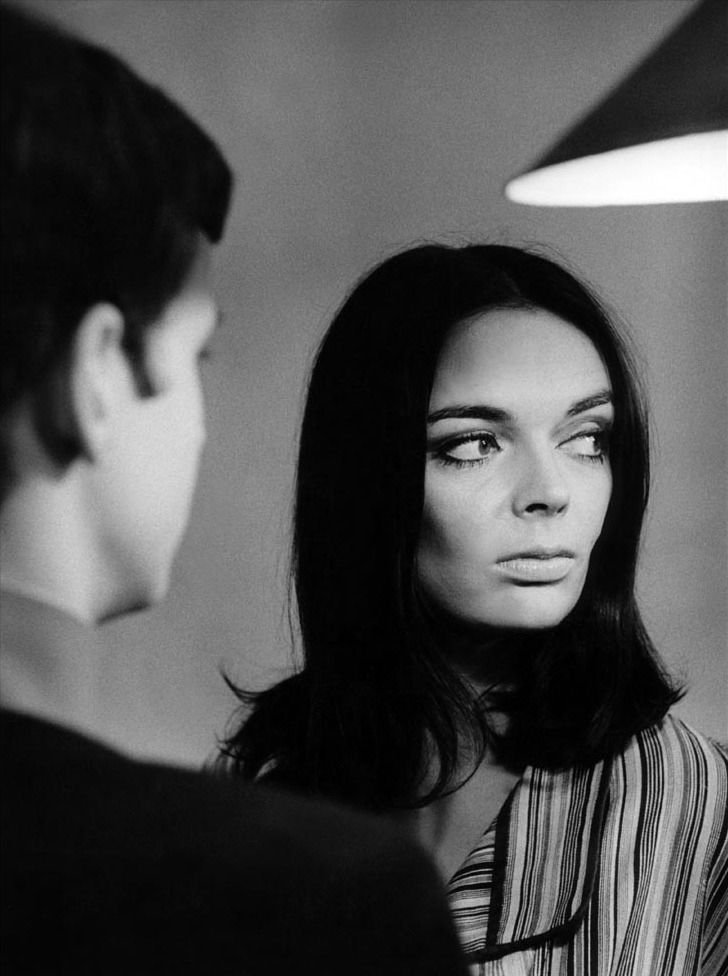
“You are a closet, a big closet, with intricate Elizabethan locks made of brass.
“The inside is lined with baize so that nothing can be heard, a place where Mozart rehearsals are held.”
Who talks that way? I never know what to expect from telephone imagist, Barbara Steele. Over the hiss and crackle of our weak connection, she might predict my future or cast some witchy spell — minus any noticeable segue, she once declared, “Flying at night, Danielle, is like being a sperm again.”
Her origin story, since every goddess must have one, includes her first supplicants.
But more about huddled masses, seventeen million of my peasant Italian ancestors, later on…
By the Sixties new waves were crashing everywhere at such a rough-and-tumble pace that few could surf them from screen to magical screen. The frisson of La Nouvelle Vague should be appreciated within a tempest of plurality that shook Hollywood, whose producers, trained in the relative stasis of studio-system majesty, were being tossed willy-nilly on the backs of Italian, British and German breakers. And, emerging from this unpredicted deluge of international currents, spawning endlessly exploitive countercurrents, came Barbara Steele, a castaway or, as she herself puts it, “an unwilling immigrant” to the heart of Hollywood-land where she unhappily resides today.
If Steele’s personal opera, from laughter to rage and back, appeals to my “Italo-Americano” (her word) taste for the dramatic, then it also conjures the beautiful… eerie feeling that I have just reached 1960s Rome on my ancient landline. My Goddess, you see, remains a prisoner of her proudest memory, Fellini’s 8½, compared to which her horror films — The Long Hair of Death, An Angel for Satan, Terror-Creatures from the Grave — essentially amount to the gothic flop house of movie yore. I witnessed Steele’s eyes, axioms of cinema, emit pain and fury when she finally confessed to me (once and only once): “I was made for horror.”
Followed by laughter equating with a thousand stilettos pointed inward.
Making her Italian screen debut in Black Sunday in August 1960, Barbara Steele glowered into Mario Bava’s lens, and at that pivotal moment in cinema’s manic history something shone forth so ancient that even the most devout heretic experienced inchoate shivers of remorse. The mod summertime of the new decade was arrested, plunged backward, whereupon a strange, atavistic transformation occurred: the audience, pious enough to register shock at the intended effects, was nevertheless unprepared to confront the triumph of alchemy and necromancy over mere sackcloth and ashes. Shamefaced in the dark like Catholic schoolchildren remembering all they had been taught, the audience stared back at Steele’s eyes — a pair of druid’s eggs, bestowing true and everlasting illumination, as opposed to religion’s metaphorical kind — and shuddered inwardly at things no mere mortal could comprehend.
If Black Sunday is a summation of spiritual and physical dread, it’s because Steele is everyone in this dream-bauble… everyone and everywhere, an all-consuming autumnal atmosphere. Which, of course, provides Mario Bava with something truly rare — a face and mien as unsettling as horror films always claim to be and almost never are. The devastation she leaves behind, her anarchic displacement, which has nothing to do with conventional notions of performance or “good acting,” is hard to describe. And here Bava earns his label of genius through compositional meaning — amid the groundswells of fog, lifeless trees and gloomy dungeons, Steele is an absence impossibly concretized in penumbras and voids. She is a force of nature never to be repeated.
But precisely what kind of “object” are we dealing with in Barbara Steele? Of course, the answer is partly grounded in Steele’s unique physical equipment — and here I’ll risk the cliché “otherworldly” to describe her famous emerald eyes. As if sparked to life by silent-film magician Segundo de Chomon, the supreme master of hand-tinted illusionism. Peculiar even within the context of gothic tales served up on celluloid, her eyes flash at us from well beyond the Gothic’s allotted time and place in history. Occasionally like a Victorian child molded from pellucid porcelain, and sometimes a skull with fleshy lips, eyes open and deep like two pits into the infinite. When the cameras are trained on her, they are not passive receivers recording visual information but deadly carbon-arc projectors probing the psychic crawlspaces where skittering impulses dwell.
There are eyes that photograph as soulful, as opposed to merely expressive — allowing the onlooker a glimpse into the funnel end of eternity. Think Robert Mitchum and Humphrey Bogart, whose eyes simultaneously invite and repel inquiry into the unwritten histories behind them. If the eyes are the windows of the soul, great movie stars are defenestrating their spirit essence right down the lens. Joan Crawford could scrub bathtubs merely by glancing at them. And that wonk-eyed Siamese sex cat, Karen Black, worried us with her revelation that some lazy eyes are less lazy than others.
Then there is Barbara Steele, whose famed peepers hint at the corrosive void that has replaced her soul. They offer a brief glimpse at the corrupted flesh beneath an unblemished alabaster encasement. Steele photographs like an imperious statue inwardly cursing all those who gaze upon it, as if some monument to classicism were startled into bitter sentience, or unwanted Keatsian fever. Her marble-white flesh remains an aesthetic plea for the proscenium arch's return to drama, and her columnar bearing and soaring height fused her to the monochrome of director Mario Bava's cursed pasteboard castles. This was the monster wrought by Italian genre horror: a theatrical form of the archaic. A wraith howling at a paper moon.
Italian cameramen and Steele’s face were an unexpected 1960s marriage. A brazen collision that would herald the new thespic truth that, from this moment forward, the art of acting was in how you responded to light, and how light responded to you. Expressionism has a way of achieving transcendence without much caring about the lines it crosses; and Steele is nothing if not a natural, even physiognomic case of lived expressionism: you don’t need askew sets or painted shadows with a face like that. If, instead of expressing emotion through the decor, or through refined acting or method-school angst, you were going to do it just by being an exquisite and uncanny human sculpture positioning yourself just so, you needed a look that contained contradictions, complexity, confusion, a different madhouse of passion from every angle.
Nearly seventy years have passed since she played an avenging witch in Black Sunday, but no matter how stubbornly the diva refuses to claim her title as Italy’s reigning Scream Queen, the aura of dry ice and stage blood lingers in the cinematic unconscious, trailing her in gory wreaths. Before the opening credits roll, priestly authority figures intone their denunciations of the witch: their patriarchal power seems distinctly unattractive compared to the emotional display from Steele, who, unlike the rest, is acting like a proper Italian. (It’s not personal pain that matters in these moments, but the channeling of a much larger agony.) Final Impenitence finds its voice as the heavens crash around her:
“Go ahead,” she thunders, “tie me down to the stake, but you will never escape my hunger, nor that of Satan!”
Melting through the period trappings is an affect that is “Sixties” to the point of hysteria. Motion pictures are the original sin, a violation against the real. And Steele knows it, too. Very rarely do actors display such awareness of the implications of their craft (and its limitless) power to condition us. She rises and falls on an ethical seesaw, willfully, defiantly imperfect. Her undead temptress expresses the same hyperbolic agonies as the icons of saints.
The id of Irony made flesh, she is an instinctive shape-shifter who can summon a steely, almost self-parodic Vaudeville act of her own presumptive star power (Elizabeth I, by way of Norma Desmond); lashing out wildly against other women like a blind man with a pistol — the word ‘hate’ fluorescing, dancing on chapped lips into telephone dada. Steele-speech is composed of startling word-images, piled giddily on top of one another, evoking the landscape around her L.A. home — “coyotes come down the hill like perfect ghosts, walking like Nijinsky.” The Adriatic: “all wonderful two thousand year old blonde stones — breathing light — like an old cathedral — every cell in my body receives this landscape like a blind man.” Paris: “every encounter is like a little love affair… including the dogs…” Croatia: “nocturnal medieval eels, swimming in the skull-infested Roman fortress, under the full moon in the inky sea.”
Now, my twenty-year friendship with Barbara bars me from the precincts of critical appreciation. That, however, is a very small price to pay for the love, synchronicity and fear joining her passions with my own: mysticism, magic, serendipity, our shared fatalistic worldview — and, yes, I adore her endlessly spirited and spiraling arabesque — nobody spins such startling word-images as Barbara Steele.
She practically never sends emails, but after our first serious personal battle, I received the lushest (and most cherished) apology imaginable. She writes: “I must have offended you deeply, I am so sorry, this is not my intention — just pretend I threw a frying pan at you and after that all is forgiven. I HATE your silence, I have become co-dependent on your voice, your laughter and your beautiful expressive writing, don’t be Sicilian and hold a grudge forever until all the goats in the village are murdered, please….”
What a ride. In the course of a conversation about something thoroughly innocuous — miscellaneous home repair, let’s say, or weather in Los Angeles, or something equally drowsy — she’ll slide, right before you know it, into alien syntax. Suddenly we’re discussing a marriageable chair made from Van Gogh sunlight, then the hordes of damp, obese, bikini-clad horror fans that haunt the autograph shows. She’s rushing off later to an event dubbed Crypticon Seattle, or some such extraordinary thing. Why, only yesterday she archly characterized the looming trauma of the event as “moving into a Dianne Arbus weekend.”
It’s downright incongruous. Not the event, really, or even her presence at it (though when you think about it, there is that). No. It’s the whole universe summoned by the totality of this woman’s life through just a few minutes’ gab: the high culture allusions (Arbus, Van Gogh) slamming up against the sweat-soaked, panting cheapness of her destination; as if all of it laid bare particular facts concerning the last century. But then, this essential incongruity has always embraced Barbara Steele. In Europe — unlike the United States, where certain lines of division are observed more devoutly than we care to admit — the boundaries between high and low culture, art and trash, are not so much permeable as they are wholly non-existent.
If Federico Fellini could pop for the price of a dazzling cameo in 8½, chances were that a Mario Bava or a Riccardo Freda could afford you as lead in a still-forbidding gothic chiller or, later, a candy-colored giallo. In other corners of the globe, ours for instance, a career arc like that would be viewed rather askance, a garden variety one-way journey to the skids or, worse, American-International Pictures. Barbara Steele was different. Always. She could leap like a ballerina out of Nightmare Castle and into Young Törless; or from The Ghost into L'Armata Brancaleone. “Barbara, you never had an agent — so, were you pursuing roles on your own?”
Without pause or hesitation, she responds. “I was pursuing lunch and sex.”
As she gets older, Barbara deflects such questions more boldly and bawdily.
The fact is that she hates movies even more than Los Angeles — i.e., “That neutered cake!” — again, the caveat being Federico Fellini and her soft spot for the memories he inspires. British cinema didn’t know what to do with her. Italy had ideas. The memory of arriving in Rome, “where everyone is singing an aria,” is still strong: “Here I am, English, and I felt I’d been born in the wrong place and the wrong temperature. And the moment I got to Italy it was like coming back to the essential womb…”
“Fellini always claimed he never went to the movies,” she says, “so I do not know if he ever saw Black Sunday; what I do know is that my friend, the director Gillo Pontecorvo, told me he went one day on a hot afternoon to a tiny cinema in Trastevere that was deserted except for one person who was sitting in the back row — Fellini. I always wondered if the name Princess Asa in Black Sunday was related to the Magician in 8½, calling out ‘Asa nisi masa.’”
If Fellini’s ‘Asa’ was incantatory language for ‘Steele’, then banal distinctions separating genre horror from capital ‘A’ cinematic Art simply wither to nothing. Where auteurism once stood now rises a single human fulcrum balancing Black Sunday and 8½ — indisputable exemplars of presumptively distant worlds connected through an incongruous innocence. 8½ remains a living, black-and-white testament to the notion that Steele will forever be — in critic Raymond Durgnat’s shorthand for that now iconic moment when her smile beamed from beneath a black wavy-brimmed hat — “a modern girl.”
Careening from one via to another at harrowing, white-knuckle speed, Fellini was once heard to lament that “Some neo-realists seem to think that they cannot make a film unless they have a man in old clothes in front of the camera.” George Bluestone, recording these words for the pages of Film Culture in 1957, was sitting in the literal passenger seat of that ideal metaphor for 20th century ebullience — post-war expertise; a precision machine hurtling through ancient Roman streets past graffiti-scrawled churches proudly bearing the hammer and sickle; that famous Black Chevy like Odysseus’s ship skirting Scylla (the Vatican) and its equally dogmatic Charybdis (the Party), because at that velocity, anything could and did make sense.
Italy’s post-war economic “miracle” was foisted in large measure by a self-neutering Communist Party, which laid down its revolutionary arms in exchange for seats in the government, at which point the mass shuffle-boarding of the southern poverty class began: seventeen million Italian souls — more than a third of the national population — would pay for “Il Boom” on northern assembly lines. Was Fellini’s Chevrolet some symbolic body-on-frame housing for America’s Marshall Plan, the economic engine driving oppression with such propulsive force?
Steele ascribes mystical powers to herself, Fellini and the city that gave birth to her career. Rome, after all, is the land of Bernini’s The Ecstasy of Saint Teresa, Apollo and Daphne — marble-cum-flesh, even as flesh itself gives way to forms that leave the viewer in terrified awe. “The incredible thing is I had this psychic kind of foreknowledge that I was going to meet Fellini,” she recalls, still wondering at the strangeness. “When I was in Rome I told everyone: ‘Oh, I’m here to work with Federico.’ But I was like everybody else, I went into casting and I sat in one of those chairs. All of Rome was there, every dwarf, hooker and child was outside.”
*
I was living on the beach in a little shack in Malibu in the early seventies with my young son. Storms would arrive with wild power on the Pacific — nothing pacific about this ocean. The whales would migrate north ten feet from my house, like wonderful hulls covered in barnacles, “a whale swam by my house today, nine hours pregnant…” (Pablo Neruda)
The Santa Ana winds blew at over 100 miles per hour, with the ferocity of hell. We always waited for the Fires, the endless fires, Los Angeles weather is the weather of catastrophe, of apocalypse, the intensity off the Santa Ana winds affects the entire quality of life in LA, it shows us how close to the edge we are... The fires arrive like Dante's Inferno…
All the animals started to come down from the mountains and cross the pacific coast highway to get to the beach. Wolves, hedge-hogs, coyotes, deer, rabbits horses, donkeys, foxes, wild dogs, pigs, a sky-full of parrots.
… Three years later, one beautiful Spring morning, I decided to take a walk in the Serra retreat, with Jonathan. All of the buildings were burnt rubble, except for the occasional fireplace. Everything was covered in blazing bougainvillea. This was a Carlos Castaneda landscape. I sat on a rock while Jonathan explored the rubble of a burnt-out house. Suddenly, he comes running towards me with a book in his open hands. “Mommy, mommy, look at this,” he says. The book is as frail as moth-wings, having been out in the elements for several years. I opened the book –— it is in Italian. I start to read the book and I see it is a transcribed conversation between Fellini and me.
This book is about 8 ½. I take it home. And the next morning, my old friend Gore Vidal calls me from Rome. “Hello, Barbara”, I have a surprise for you”… Here is Federico," and he passes him the phone.
Fellini — “Barberini” (his name for me), he says, “When are you coming to Rome? I want to see you.” “ Well this is amazing, I reply, because I’m leaving for France tomorrow.” “Well, please”, he says, “come on to Rome and we’ll have lunch at Cinecitta when you get here.”
I arrive at Cinecitta — a time capsule — he is preparing to make Casanova. “Barberini, I have this wonderful role for you, of a Venetian alchemist who cures men of their impotency with bells, potions and songs.” Then he says… “something between a witch and an empress” — I was enthralled. They sent me straight to costumes, and designed these fabulous outfits with enormous headdresses. We were due to start shooting in 3 months. At lunch, he suddenly says to me — "What do you think of Donald Sutherland’s wrists?” — Donald Sutherland was cast as Casanova.
I replied, “I don’t know… I’ve never considered his wrists!” And then I say... “Why are you making this film on Casanova anyway? He is so wounded and empty, and so unlike your fierce life-force.”
Three months into the shoot, a whole chunk of the footage of the movie was stolen from the vault at Cinecitta, along with some footage of Pasolini’s. This caused an uproar. The production immediately stopped for the next three months and they eliminated the entire Venetian sequence that I was in.
*
In the late Eighties, she would find herself surrounded by the ghosts and barbed wire that cling to her psyche to this day. Immediately after producing Paramount’s War and Remembrance, an extremely popular mini-series, she burned every stitch of the clothing she’d worn inside the gates of Auschwitz. I was therefore unsurprised when, last week, my friend shouted: “How could such cruelty be allowed… Now?!”
Having no answers, I left her to contemplate Holocausts past and present in solitude.
Steele’s generation of bombed-out Brits witnessed presumptively adamantine laws created to seal WWII in memory, while keeping the nightmare from rising again. That Western democracies have openly declared their ghouls' burlesque in Gaza is, to her way of thinking, well, unthinkable. All the screen can offer us are references, allusions of the kind that Alain Resnais sought to distill in his 1956 indictment against genocide, Night and Fog. Steele talks compulsively about annihilation.
“I feel it on a molecular level,” she says, drawing out ‘feel’ like a linguistic tendril.
*
I was filming in Austria on Halloween night in the ancient mining town of Eisenstadt, the film Tief Oben. We had great steaming wooden vats of hot red wine for everybody to keep them going. It was arctic weather, snowing fiercely when the director suddenly asked all the extras to be naked other than their boots and the little mining lamps on their heads. Naturally they refused. At which point the director tore off his own clothes in a rage as a challenge… and was the lone white freezing body in the dark night.
In the middle of this frenzied rebellion, I decided to walk home alone. The local villagers had made little paper boats that they sent down the river set alight, a ritual of remembrance for their dead relatives…
Suddenly a dozen motorbikes came roaring by with everyone on them dressed as skeletons. They got off their bikes and started to dance around me in a circle holding hands — then they mounted their motorized steeds and took off into the night making unearthly shrieks and whistles…
I continued walking on in this medieval village surrounded by ghosts…
by Daniel Riccuito