
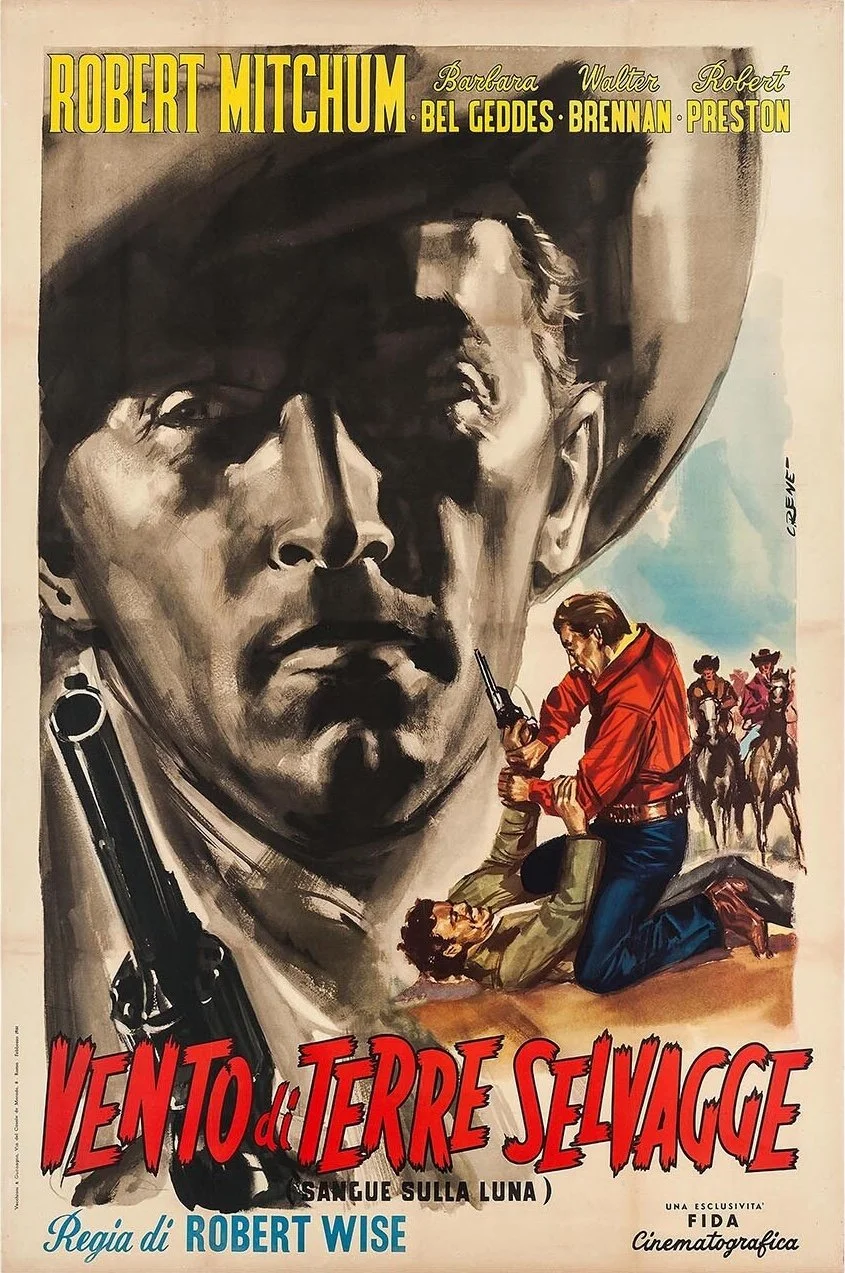
“The beauty of that man. He’s so still. He’s moving. And yet he’s not moving.” –Lee Marvin on Robert Mitchum
All cloudy skies and discouraging words, the range in Robert Wise’s Blood on the Moon (1949) is a place where no one can feel safely at home. The film opens on a dismal panorama of rain pounding a formless landscape, blotting out the horizon. Robert Mitchum comes riding alone, head down, rain dripping off his hat, stopping to gaze dejectedly over a dark valley.
If any one actor embodies the very notion of the “noir western,” it is Mitchum. Before he distilled the noir ethos with his world-weary pessimism and cool insolence, Mitchum started his career as a heavy in the amiable, low-budget Hopalong Cassidy series, earning “$100 a week and all the horse manure I could carry home,” he later recalled. After seven films with Cassidy—parts he described as “a lot of beard, very little dialogue”—Mitchum signed a contract with RKO, and the studio tried him out as a clean-cut cowboy hero in two Zane Gray westerns, Nevada (1944)and West of the Pecos (1945). He was wasted on these cardboard good guys and boy’s-adventure stories, which had no use for his undercurrents of melancholy, disaffection and skepticism. The first film to fully express his persona as the eternal outsider was Raoul Walsh’s seminal noir western, Pursued (1947), which cast him as a displaced foundling followed through life by the black cloud of his mysterious past.
As befitting a man who arrived in California aboard a freight train, and who never stopped identifying himself as a hobo, Mitchum was the movies’ quintessential drifter. He played all kinds of itinerants: exiles escaping criminal pasts, globe-trotting marines, roaming preachers, nomadic sheepherders, travelers on the rodeo circuit. He had hit the road at 15, driven not by an unhappy home or dire poverty but simply by the restless urge to wander, to taste the sweet anguish of loneliness far from hearth and home. In his memoir, Them Ornery Mitchum Boys, John Mitchum wrote that he initially saw his older brother Bob’s penchant for “running off” as a weakness of character, but came to admire the way he “simply released himself from emotional bondage.” Mitchum himself said that he had “been in a constant motion of escape my entire life.”
In Blood on the Moon he plays Jim Garry, a man with nothing: no home, no family, no job. In the opening scene his few possessions are destroyed by stampeding cattle as he sits miserably drying his wet, mud-caked boots by a small fire. This is the truth of the cowboy life. (When co-star Walter Brennan saw Mitchum in his elegantly rugged costume, he declared, “That is the goddamndest realest cowboy I’ve ever seen!”) Down on his luck after watching his own herd die of fever, Garry has been summoned by an old trail-herding partner to be cut in on a big deal. He doesn’t know that he’s being hired for his gun, or that the friend who sent for him is scheming to steal another man’s herd through a back-handed deal with a crooked government agent for the local Indian reservation. Walking into this charged situation as a stranger, he’s immediately greeted with hostile suspicion by both sides in a range war, and he counters evasively, refusing to take sides or reveal his true nature. Keeping to himself a lifetime of bad breaks and worse choices, Jim Garry gives the film a sad, uncertain, jaded heart. Mitchum never once smiles; the closest he comes is when Jim says that a murderous brawl with his erstwhile friend was “a pleasure.”
That friend is Tate Riling (Robert Preston), a shameless, smirking con man who lies to local farmers to get them on his side and seduces his enemy’s daughter into betraying her own father. Garry gets the picture but goes along without enthusiasm; he doesn’t like being a mercenary, and is acutely aware of the contempt he now inspires in decent people, but accepts it quietly. He is what Mitchum called himself in real life, “a patient cynic.” Watching on the sidelines, he’s riveting in his immobility. When he moves, it’s with weighted, lazy power. In one scene he confronts a gunfighter and walks toward him across the wide Main Street. All he has to do is walk, with his inimitable panther tread, and the other guy knows he’s outclassed and slinks away.
Jim is drawn to the feisty, outspoken daughter of the man Riling is trying to swindle (Barbara Bel Geddes—she and Mitchum meet cute by emptying their rifles at each other), but he’s motivated even more by growing disgust at Riling. “I’ve seen dogs wouldn’t claim you for a son,” he declares, setting off a savage brawl in which Mitchum and Preston hurl punches, chairs and bottles at each either as they wrestle, lurch and crash around an empty barroom in near-total darkness. The darkness and slashing gleams of light come courtesy of DP Nicholas Musuraca, who pioneered noir cinematography in Stranger on the Third Floor (1940) and diversified it in Out of the Past. Here he brings his mastery of shadows to the range, flooding much of the movie in an enveloping gloom that obscures actions and identities. For contrast, there is a gorgeous sequence of pursuit through a snowbound pass, with paths slicing through white drifts and across glittering plains. There is a shootout in a dense pine forest at night, with figures moving almost invisibly through the faintly glimmering boughs.
With its dirty deals, government corruption, romantic betrayal, mean thugs, gloomy bars, and its broke, lonely hero pondering whether or not to throw away his honor, Blood on the Moon’s story could be translated to any grimy, gang-ridden city. The film grows more conventional as it goes along, but the genre staples are well-handled, and there are powerful scenes like the one where Garry goes to tell Walter Brennan’s character that his son has been killed, and must endure the old man’s stricken, dry-eyed accusation. Mitchum’s reserve, detachment and neutrality are so attractive that it’s easy to ignore how they can turn into a wholesale abdication of moral responsibility. Under noir’s probing skepticism, the western hero’s stoic reticence becomes unhealthy passivity, his righteous determination becomes obsessive vindictiveness. The west’s promises of unbounded freedom and opportunity dwindle and close, the way once open grazing lands become bitter battle-grounds. Almost unseen in the film, yet key to its central crime, are the Indians confined to their reservation, while white men fight amongst themselves over the money to be made by feeding captive mouths. This land’s economy is dirtier than the muck of its cow-trampled pastures.
by Imogen Sara Smith