
Not many actors paid their dues for as long and as hard as Boris Karloff did. Born William Henry Pratt near London in 1887, he was the self-described black sheep of his family (both of his parents were Anglo-Indian). In a photo at age three-and-a-half, he already looks alarmed by something, or by someone.
Pratt traveled to America to become an actor and changed his name so as not to embarrass his family. He played on stage in stock and learned through make-up how to become any character he wanted to be, much as Lon Chaney did. In between plays—and later in between films in the 1920s when he was slotted into many small and usually villainous roles—Karloff had to sometimes work as a day laborer or ditch-digger, which meant that he had problems with his back when he was an older man.
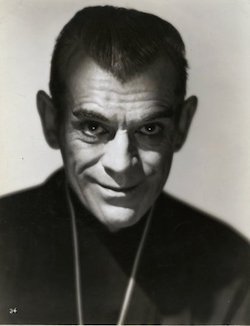
His 1920s villains were usually of Arab or Indian extraction, and his staring eyes and molded features lent themselves to glowering wickedness. Karloff very often didn’t get enough to eat in these years, which added to his impression of aesthetic gauntness. As a mesmerist in The Bells (1926), his best part in silent pictures, Karloff does mesmerize with abrupt gestures that he somehow slows down even before we have taken them in. Just watch the way he manages a very false slow smile, moving the corners of his mouth up and then tossing the smile contemptuously away. This shows an actor in tune with what the camera needs, and what it needed from him was menace.
What made Karloff such a distinctive screen player was the slow, lingering way he moved through space, which created its own atmosphere of dread. In Howard Hawks’s The Criminal Code (1931), which he had played in on stage, he is a convict named Ned Galloway, a man bent on revenging himself on the stool pigeon who got him sent back to prison just for taking a drink. Karloff has a way of suspending his words here—creating a whole little protective world around them—but it is the slowness of his movements that really makes the strongest impression.
Stealing up on the stool pigeon, Karloff approaches this man with slow and almost slow motion physical grace. The man turns and sees him and gives a start, and Karloff gives his own little start, as if to say, “You’re done for, and you must accept it.” There’s something almost tender about the way Karloff does that, something lyric and inevitable, like a movement out of a Martha Graham dance.
It is this skill in silent movement that would come to the fore in the part that finally made Karloff a star at age 44, the creature or monster in James Whale’s Frankenstein (1931). The creature was given the brain of a murderer, yet he is new born, innocent, and untouched. Karloff always gave make-up artist Jack Pierce much credit for the look of the creature, but he himself suggested the heavy eyelids.
Karloff had to make the full imaginative leap into the creature’s point of view in Frankenstein, and he chooses to portray him as a very poetic figure. Lon Chaney, who was supposed to play the part before his untimely death, would almost certainly have been far harsher in the role, far more the re-animated man with a murderer’s brain, whereas Karloff’s later partner and rival Bela Lugosi, who had made such a hit earlier in the year for Universal as Dracula, would have been scary as the creature, maybe, but never touching (Lugosi actually turned the role down).
Karloff has an essentially gentle, dreamy sensibility, and he emphasizes the pure yearning of the creature, the way he reaches out for light and smiles when Little Maria (Marilyn Harris) gives him a flower. What happens next with Little Maria is the stuff of child nightmares, a scene that was almost always cut but now stands in most release prints: Karloff’s creature throws her into the water of a lake after he runs out of flowers to throw. The murder of Little Maria is only mitigated by the uncomprehending way the creature reacts when he tries and fails to understand what he has done to his little friend.
Karloff’s creature has anger, but it never seems to be the anger from the past life of the murderer’s brain in his head; it is always the anger at what he sees in the world and how he is treated, and it was Karloff who decided to play him this way. “The Monster was inarticulate, helpless and tragic, but I owe everything to him,” Karloff said. “He’s my best friend.” Karloff would remain the fastidious, colorful silk thread winding through the coarse, itchy fabric of the horror genre, and he stayed with it through many incarnations and revivals.
He played a twitchy gangster for Hawks in Scarface (1932), and there his acting seems a bit old-fashioned and external, a mark of the stock theaters he’d played in as a younger man. Karloff is given a big build-up in the credits of Whale’s The Old Dark House (1932) and top billing, with a title card trumpeting his “great versatility,” but he was limited by his looks and demeanor.
It’s hard to imagine Karloff playing something like Alec in David Lean’s Brief Encounter (1945), or anything so romantically straightforward. In The Old Dark House, Karloff is a drunken and mute brute of a butler with a lech for Gloria Stuart, a straight man in a semi-spoof for the first of many times to come, and he brings some genuine menace and fear to the screen in between the campy laughs of that film.
He was billed as just “Karloff” now, like “Garbo.” He played The Mummy (1932), an Egyptian man buried alive and still seeking his love, and this was a feat of make-up and his slow vocal delivery. Over at MGM in The Mask of Fu Manchu (1932), Karloff is forced into a camp mode himself, for there is no other way to play the absurd and racist script of that film. “Boris was a fine actor, a professional who never condescended to his often unworthy material,” wrote his on-screen daughter in that movie, Myrna Loy, in her 1987 memoir.
After scads of work for years (he had 15 credits in 1931 and nine in 1932), Karloff slowed down and went back to England for the first time in decades, where he was reunited with his family and made one picture there, The Ghoul (1933). He made several movies with Lugosi, including Edgar Ulmer’s The Black Cat (1934), and there was no feeling of rivalry between them, at least from Karloff’s side. His films with Lugosi could get pretty gruesome, with characters skinned alive and vindictive plastic surgery and other things to bring about the shudders and the heebie-jeebies.
“Poor old Bela, it was a strange thing,” said Karloff of his screen partner in an interview in 1964 for Films in Review. “He was really a shy, sensitive, talented man who had a fine career on the classical stage in Europe. But he made a fatal mistake. He never took the trouble to learn our language…He had real problems with his speech, and difficulty interpreting his lines.” Karloff was aware when his films were poor, whereas Lugosi didn’t seem to be, which makes Lugosi a lesser actor than Karloff but also somehow scarier because of this lack of awareness.
Karloff was a religious fanatic in John Ford’s The Lost Patrol (1934) and an anti-Semite in The House of Rothschild (1934) with George Arliss, but the public clamored to see him in more horror. He returned to the creature in The Bride of Frankenstein (1935), where he went deeper into the Monster’s conflict between self-protective and even outright malicious urges and a vulnerable reaching out for beauty and love, and friendship. “Alone bad…friend good,” the creature says here, after being befriended by a blind hermit. (Karloff didn’t think the creature should talk, but he was persuaded otherwise.) Karloff’s creature even sheds a tear after deciding to blow everyone up because he has been rejected by his hissing bride (Elsa Lanchester).
Censorship helped to bring an end to the first cycle of horror movies, and so budgets for Karloff films plunged while he played many a mad scientist, his intensity and trouper’s belief rarely wavering in the grind of similar and often threadbare material. He tread a fine line between threat and camp threat, and few players can equal Karloff for pure stamina. Surely he must have sighed sometimes as he got script after script along the same lines, so that it is difficult to tell one of these films from another.
Karloff was reduced to appearing at the poverty row studio Monogram by 1938 but returned to his creature one last time in Son of Frankenstein (1939). He was a man who “looked like Boris Karloff” in the comedy Arsenic and Old Lace for years on Broadway and missed out on the film version because he was still playing it on stage.
Even his patience had some limits. He was scornful of the monster mash House of Frankenstein (1944), and he was vocal about the fact that producer Val Lewton subsequently saved his soul as a performer in a series of low budget, intelligent movies beginning with The Body Snatcher (1945), where he dug up graves himself as once Dr. Frankenstein had dug him up. Lewton allowed Karloff to play three-dimensional people rather than the cardboard cutouts he had gotten used to, and he responded expressively, with lots of careful, poetic character shadings.
There were some changes of pace after World War II for Karloff. He steals Douglas Sirk’s noir Lured (1947) in his reel as a demented and embittered fashion designer, which stands out in his career for its sheer unexpectedness. This film showed his skill at being slightly funny and also fully menacing all at once, which he also needed for the awkwardly titled Abbott and Costello Meet the Killer, Boris Karloff (1949). Karloff often had better luck with parts on stage than in movies in his later years, scoring as Captain Hook opposite Jean Arthur in Peter Pan and winning a Tony nomination for his work in The Lark, which starred Julie Harris as Joan of Arc.
On TV, Karloff had his own anthology series and also played Kurtz in a 1958 adaptation of Conrad’s Heart of Darkness for Playhouse 90, realistically and stirringly shuddering about the horror he has seen, and he was the voice of the Grinch in the much-replayed animated special How the Grinch Stole Christmas.
A TV program called Shock Theater re-ran Karloff’s old horror films, and this brought him into the nightmares of Baby Boomers who are still scared by the thought of what happens to Little Maria, or by The Mummy. His program pictures became a staple on television, for they featured those baleful eyes and the hypnotic, soothing voice that could send late-night TV watchers off to sleep sure of a nightmare or two involving the supposedly dead and the supposedly living.
Karloff was in very ill health in his last years, but he still liked to work, finding himself in some campy horrors for producer Roger Corman that co-starred Vincent Price, Peter Lorre, and a young Jack Nicholson. The gravity of his face and voice were undiminished by time or poor assignments, and he brought some human dignity and feeling to nearly everything he did.
Karloff played a vampire for Mario Bava in Black Sabbath (1964), and then he was given an affectionate and knowing swan song by the young cinephile director Peter Bogdanovich in Targets (1968), where he played Orlok, a retiring star of horror films. “Do I have to say such bad things about myself?” he asked Bogdanovich, fully aware that Orlok was based on his own image. Bogdanovich reassured him that audiences would disagree when Orlok calls himself a relic, but Karloff wasn’t so sure. He is maybe a little uncomfortable with the meta aspects of that film, but he was a good sport about it.
“He really was a gentle soul,” said his only daughter Sara for a TV documentary. “I don’t think he scared anybody, not in real life.” Karloff was a very generous man and very loath to have that talked about (look at the horrified way he reacts when something generous he had done was mentioned on the This Is Your Life show in the late 1950s). By the time he was finished, he had 207 credits, some of which were only being released after his reported death. Surely some real life mad scientist somewhere might one day re-animate him for us.
by Dan Callahan