
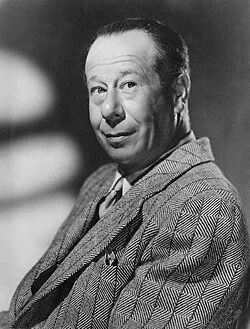
In 1910, a boisterous, charismatic, and very funny15 year-old named Irving Lahrheim dropped out of high school in New York to join a burlesque comedy troupe. Everything about him was large, from his body to his personality. Combine that with his round face and flat features, his exaggerated accent, his pronounced lisp, and his broad, theatrical gestures, he was a presence ready-made for comedy—especially the kind of loud, obvious comedy that could hold a drunken, rowdy audience’s attention in between the strippers. Shortening his name to Bert Lahr, over the next 15 years he came to earn top billing around the Columbia Burlesque Circuit thanks in no small part to a routine he’d developed with actress and comedian Mercedes Delpino.
In the act, Lahr plays a half-dumb, half-crazy cop, his hat askew and twirling his baton, who bumbles onstage only to encounter a half-dressed hootchie-cootchie girl (or hooker, or flapper) in the form of Delpino. “Hey, what’s the big idea, what’s the big idea? Where’d ya get that stuff?” he would begin in that inimitable (well, in fact very imitable) voice. What followed was an exchange of some mildly risque jokes and non-sequiturs:
“So what’s your name?”
“Molly Bean.”
“So your sister is String Bean?”
“Yeah.”
“And your daughter is Lima Bean?”
“Yeah.”
“Well don’cha recognize me? I’m your Uncle Succotash!”
The banter was often followed by a carefully choreographed bit of clumsy baton-tossing. The act was a big enough hit on the burlesque circuit that, with only a mild bit of cleaning up for family audiences, Lahr and Delpino were able to move it to vaudeville, where it was an equally big hit.
In 1929, an expanded version of the routine was filmed as a Vitaphone short, Faint Heart, with popular shimmy dancer and singer Bobbe Arnst taking the Delpino role. Making the most of his lisp, Lahr plays, to put it bluntly, an old queen who one night hesitantly chases a masher away from a young woman. Although a romance seems to blossom in the wake of his heroics, it quickly fizzles when she learns he isn’t an artist as she’d presumed, but instead makes (as he puts it) “pajamys” for a living. She insists she could only love him if he was more manly (“Oh, why didn’t I join the Marines?” he bemoans), so he becomes a cop. Although still swishy as ever, he inadvertently catches a wanted thug known as Dynamite Dan, and in turn wins the girl. All in eight minutes.
It was Lahr’s talkie debut and, given by ‘29 he was not only a huge vaudeville star, but a huge Broadway star as well after appearing in a number of hit comedies, he became one of the highest paid performers to appear in a Vitaphone two-reeler.
That same year, he and Delpino were married, but she soon began exhibiting signs of mental illness. Her condition deteriorated quickly to the point at which she had to be institutionalized. She would remain in the institution for the rest of her life. In the early ‘30s he began seeing actress Mildred Schroeder, who left him in frustration, citing his refusal to divorce an incapacitated kookoo bananas wife, and a wife he still clearly loved dearly in spite of it all. Schroeder married another man, but divorced him in ‘36 and returned to Lahr, who finally and reluctantly did arrange for a divorce from Delpino.. In 1937 Lahr and Schroeder appeared together in the short Off the Horses (her only screen appearance), and they were married in 1940.
Now, jump ahead nearly twenty years. Given a personality, voice, and broad gestures that were far more suited to the stage than the screen, Lahr was never able to scratch out more than a minor film career, playing mostly minor roles in mostly forgettable comedies. Oh, I suppose along the way he earned some attention for playing a lion in a 1939 MGM musical opposite a couple other ex-vaudevillians. That was something, I guess. Far more importantly for my money (and his only other notable screen appearance), he also introduced the phrase “Heavens to Murgatroyd!” to American audiences in the 1944 patriotic number Meet the People. His Broadway career remained strong, however, and he was nominated for two Tonys (winning one).
In 1956, Lahr was sent the script for a new play by a virtually unknown playwright. Waiting for Godot had been published originally in France four years earlier, and had been an enormous hit with intellectual European audiences. Although he claimed not to understand the play, and while most Americans might find the Cowardly Lion an odd choice for one of those dark and hopeless Beckett things, in many ways Lahr likely understood the play better than most. He was the perfect Beckett character, combining Beckett’s well-known love of the kind of broad comedy, slapstick, and wordplay you found in vaudeville with his own sense of deep personal tragedy.
Given it was such a big hit among European intellectuals, it’s still unclear to me why it was decided the American premiere of Waiting for Godot should take place, of all places, at the Coconut Grove Theater in Miami, but there you go. Maybe it was someone’s idea of a metajoke. It’s also unclear why a director would hire a very physical actor like Lahr and severely restrict his movements by filling the mostly bare stage (contrary to Beckett’s clearly stated instructions) with platforms of assorted sizes. Most baffling of all, it’s unclear why anyone who had actually read the play would opt to promote it beforehand as a “light comedy.” Whatever the explanation for any of this, with Lahr playing Estragon to busy character actor Tom Ewell’s Vladimir in front of a crowd of fat tourists in shorts and sandals (probably expecting Lahr to break into “If I Were King of the Forest” at any moment), Waiting for Godot was an immediate disaster. The fat, sandaled audience stomped out in bored confusion and critics savaged the play in the next day’s paper for being boring and confusing and hardly a “light comedy” at all..
Despite the trainwreck of the Miami premiere, a year later the play, with Lahr remaining in the lead, was brought to New York and aimed directly at the intellectual crowd eager to lap up whatever it was their European counterparts declared to be brilliant. Although the run was short, both the reviews and the audience reaction were more than enthusiastic, and Lahr’s performance in particular won especially high praise.
A decade after Godot and having already been diagnosed with terminal cancer, Lahr died of pneumonia in December 1967 in the middle of shooting what would be his last film. In a way, at the end he had returned to his beginnings, as the film in question, The NIght They Raided Minsky’s, was a musical comedy period piece set in and around Minsky’s Burlesque, an actual New York club Lahr himself had played early in his career.
by Jim Knipfel