
KRG: When Studio Music Still Just Growed Like Topsy
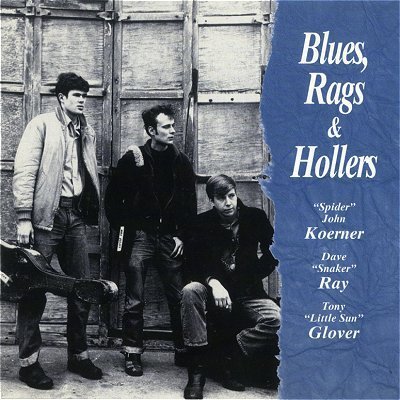
I’m listening to Koerner, Ray and Glover. Do you know them?
They recorded mostly, or at least originally, in the ‘60s, and there’s been nothing like them since. Never was before, so far as I know.
They put out three records over three or four years then, starting with “Blues, Rays and Hollers,” following up with my favorite, “More Blues, Rays and Hollers.” I still have the third, “The Return of Koerner, Ray and Glover,” on vinyl but no way to play it.
Ray – Dave “Snaker” Ray – played mostly 12-astring guitar those days.
“Spider” John Koerner played his six-string guitar and his feet (they were listed as an instrument on at least one album – the only time I know of this side of French-Canadian tootsies that this was the case).
Tony “Little Sun” Glover, played the harmonica and never (but once, I think) sang. He continued to write music reviews in Minnesota. He may be the most cynical human being I’ve ever (second-hand) encountered.
They weren’t a “group” or a “trio.” They came out of NY and the Midwest, got together but didn’t much care whether they were together or not. They were three musicians who… damned if I know what. They appeared together. That was it. And together the whole was greater than the sum of the parts.
They made some of the most incredible music of the ’60s, a time from which, you’d think, all the good stuff was saved and waved in people’s faces. Not KRG. They have never been widely recognized outside Minnesota. Either MN is a hotbed of realization or the rest of the county (as I suspect) is fucked beyond salvation.
If you look at later online notes, it would seem that they first rambled into the recording studio with no idea what they would do and then decided, off-handedly, that they would do it. I believe it, not because what they produced was confused, but because it was off-the-wall stupendous.
In later years, Ray (who, alas, died a few years back) regretted that he had imitated “black” music. He seemed to want to repent. He was wrong. At the age of, I believe, 19 for the first album, he chose songs by Lead Belly and others and gave them a cast purely his own. Yes, he sounded black. But listen to any black musician of the time, and what Ray did was different, nuanced in his only (and I dare say it) holy way.
Koerner’s called Spider because he’s thinner than spaghetti on a diet. Driving through Minneapolis in the early ‘80s, my wife and I found him standing in the bar where he had first performed 20 years before. Quiet, unexpressive – you wouldn’t suspect what lay underneath. I mentioned missing KRG at the Philadelphia Folk Fest in the early '60s. “Yeah, we were the bad boys then.” I’d heard that at a time when most folk musicians traded instruments and smiled beatifically, KRG had threatened to kneecap anyone who touched their guitars. Probably exaggerated. Somewhat.
The only time I saw Koerner him perform live, about 20 years back, his thighs looked like attenuated I-beams. When he stopped to tell jokes, he opened a small umbrella with a headband and fixed it to his head so you’d know he was “somebody else” telling jokes.
His version of “Duncan and Brady”… some of you may have heard Dave van Ronk do it, and that rendition is wonderful, exceptional. Koerner’s is like nothing else on earth. And from the original liner notes and later asides, it seems he never did it twice the same way. The recorded version is pure brain effusion.
Together, Ray and Koerner slammed into “Black Dog” and “What’s the Matter with the Mill.” Did they really just walk into the studio and do this? Probably. And no one will ever do it the same, or as well, again.
Ray could make a 12-string do stuff that’s not supposed to happen if you’re 19-20 years old. But that’s beside the point. The real thing (which I think he missed when reviewing himself in later years) is that he crawled inside the songs. He sang them from inside out.
His take on Lead Belly’s “Fannin Street” was largely a copy and a superb one, but with “Jimmy Bell” or “Honey Bee” he vaulted over the musical hurdles to perform something that stood in the crossroads and beckoned. Then there are oddment hollers like “Black Betty” or “Red Cross Store” – you can’t explain music that alive.
One of Ray’s few early solo albums, “Fine Soft Land,” is as marvelous a rendition of the blues as you’re likely to hear – nuanced and lilting without taking a thing away from the solidity of the blues. The last time I looked, it wasn’t available in any version. Damn!
Glover, up front, didn’t obviously do that much. But I think that, like Ralph Rinzler in the early days of the Greenbriar Boys, he focused the music from underneath. He may well have been the unifying, forth-pushing element behind Ray and Glover. Speaking as a non-musician (my wretched, ill-brain-driven fingers can’t do repetitive motions), I can’t rightly say.
Koerner is still touring, last time I looked, though hard to get hold of. Over the years, he’s worked with various other artists in interesting ways. Nothing that grabbed me like the original work, but that could just be me.
I know only sporadically what KRG did in later years. I have what I think was their last album together, “One Foot in the Groove.” Koerner’s pretty much unchanged, as off- the-wall as ever (his rendition of “Shortnin’ Bread” has me rolling over with my toes in the air). Ray seemed to have succumbed to his old-age regrets, mellowed out, which is too bad. What he does there is not bad, but it’s hardly great.
Beyond the music, if you want to see who and how unlikely they were, pick up the DVD, “Blues, Rays & Hollers, the Koerner, Ray a& Glover Story.” But be prepared for Glover’s unrelenting negativism. It reaches to a kind of grating honesty most of us never face.
by Derek Davis