
Love Theme for Anguished Castles
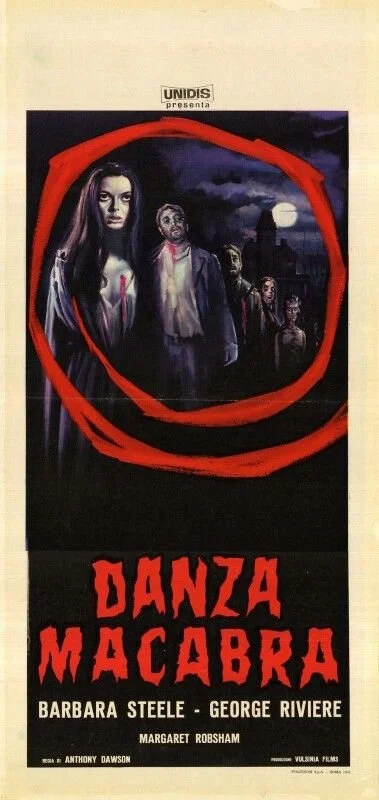
Enter Georges Rivière, the mightiest of men wielding the haughtiest of demeanors. Haughtiness initiated in the womb, where something . . . anything . . . everything . . . offended his tiny sensibilities (all the more tender for being so tiny). Here, in 1964’s Castle of Blood AKA Danza Macabra, playing a penurious dandy silly enough to spend the night in a haunted castle on a bet, Rivière seems to think aloofness will be all the protection he needs. It won’t be! Indeed, only one thing can save the film’s leading man from the visual shibboleths of a dying genre, and that’s the cameraman.
Camera artisan Riccardo Pallottini, playing savior and tormentor, coaxes Rivière onward while punishing his progress. With ace cameramen, point-of-view becomes a more problematic concept, as when George O'Brien wanders glazed through F.W. Murnau’s swamp in Sunrise. There, the camera sometimes recedes from the hero’s advance, sometimes lets him pass and follows him, sometimes loses him altogether to rediscover him later. This weird rhythm disturbs the frontier that would normally separate our inner reality from whatever lies outside us. Tendrils of Mod hypnogogia ensnare Rivière’s helpless body, an object impaled on Castle of Blood’s iron gate (oh wait, that’s how the film ends).
While Castle of Blood’s cliches would seem to be the thumpingly obvious point—a door’s creaking swing illuminates a wall bristling with harnesses and cartwheels… zoom in as a black kitten abandons its lair in a piece of spangly lacework… an organ wheezes as the hero’s sputtering candle casts the impossible shadow of itself on the crumbling masonry—those same hackneyed moments synthesize utterly unexpectedly into cinema pur, which may well leave the viewer momentarily debilitated with time-space issues, a nagging loss of bearings where beginning, middle and end are concerned.
For now, Georges Rivière is getting lost inside his own master shot as little daubs of 1960s aesthetics miraculously harmonize with the 19th century vibe: hairspray lingers throughout this legitimate evocation of monodrama, Romanticism’s stock theme, the solitary and roaming hero—think Schubert’s Winterreise or Caspar David Friedrich’s painting Wanderer Above the Sea of Fog. Imaginative audiences may even hear a reversal of male and female norms, psychological torture generally reserved for Gothic Horror’s doomed women—as if the wind were jeering. Yes, Rivière is haughty. Like he smelled something bad. The dry ice fog, the wind machine, the spray-on cobwebs, the backlighting, and the reverberant footsteps all emerge from the same Gothic toy box (the one with the squeaky hinge), but Pallottini’s execution is exemplary, and the shamelessness total.
In The Virgin of Nuremberg (1963) AKA Horror Castle, again starring Georges Riviere, Antonio Margheriti's camera, again under the control of Riccardo Pallottini, prowls a thunderstormed mansion, first alone, then following Rossana Podestà in auburn wig and negligee, as she lipflaps "Max?" repeatedly, in response to obviously female moans from offscreen/a dubbing studio in Rome. "Max, is that you?" No, obviously not.
The dark and stormy night aesthetic is very on point. Podestà is freaked out by all of it, except, apparently, the torture chamber, complete with caged skeleton, which she wanders into on the ground floor of her medieval home. That's normal, we all have one of those. Margheriti structures the sequence as a series of languid tracking shots, interrupted by abrupt, quick stationary angles which jolts us closer to his leading lady as she gazes from the window (abrupt lightning!) or lights a candle (abrupt lambency!), to the stabs of Riz Ortolani's suspense score, which will, upon the discovery of a leaking iron maiden, segue absurdly but with dreamlike inevitability into a swooning sex-sax pop track for the opening titles—The Love Theme from Horror Castle.
Shot weeks after Castle of Blood but slipping through bureaucratic censorship more efficiently, The Virgin of Nuremberg reaches audiences first—in color so velvety that nigh-obsidian shadows emerge. An illusion perhaps, we nonetheless register Black & White form underlying that fully saturated color palette, that erotically charged excitement Italian cinematographers bring to their experiments with light. And if Riccardo Pallottini is the exemplar of visual experimentation, then Riz Ortolani, who scores both of the above movies, stands in for all journeyman composers. Castle of Blood's musique concrète eschews melody in favor of crashing (a suit of armor falling downstairs in slllloooowww mmmotion, a sledgehammer beating against a bank vault) and shrill, reverberant strings, shivering at the bottom of a well. Eerie high notes that decay more slowly than any plastic skeleton. Low organ hums that seem to be walking us downstairs to somewhere terrible.
Could that terrible place be the near future—Italy’s leap from the Gothic toy box into a brave new world of stainless steal cutlery and candy-colored light—into that thug of a genre, modishly dressed and psychically damaged beyond hope? The Giallo, as exemplified by its ultimate auteur Dario Argento, represents Italy’s collective self-reproach overshooting itself, thereby punishing viewers of every nation. Argento pulls us all down in scale to a worm’s eye view—macro closeups of tiny details, the minuscule rendered colossal—unblinking eyes, flies, and even maggots squirming in the teeth of a comb. Then he offers us wide shots, from the Baroque piazza to the hyper-modern Milanese apartment building, agoraphobic vistas exhaling menace whether shadowed, luridly gel-lit, or blasted with sunlight.
Space itself grabs hold of a whispering politics as Ennio Morricone’s ingenious scores resound like orgasmic nursery rhymes for Il Duce’s grandkids. But why should Italy’s shameless Fascist orgasm remain cloaked beneath such utterly foreign aesthetics? If, in other words, Giallo finds an immediate forebear in Italian Gothic Horror, then what accounts for the latter’s bizarre birth—its fundamental reliance on cobwebbed passages and wax-encrusted candelabra, dungeons festooned with wrist manacles, an iron maiden in every niche, carpets of dry ice fog, dead twig forests, painted hilltop castles, secret doorways through fireplaces or behind beds (both portals of hot passion), crypts, gloomy servants, cracking thunder and flashes of lightning, rubber bats on wires, grand staircases, long dining tables, huge doors with prodigiously pendulous knockers to rival anything in Hollywood?
After all, why should so many visual throwbacks, indeed an entire corpus of undead iconography, arrive willy-nilly to boggle the Mod eye? Amid Italy’s love affair with Fellini and its own sexy ebullience, this otherwise sun-kissed, suggestive peninsula hungers for moon-lit images ripped from German Expressionism. Mightn’t Italian Gothic Horror represent a belated guilt reaction to Mussolini’s homegrown despotism and his unholy alliance with der Führer? Not to mention His Holiness Pope Pius XI, willing and able to collaborate in the Holocaust. If so, The Lumière Sisters take our hats off to Italian narcissism, which apparently processed national shame into a viable export, weird tales twisted like strozzapreti. Or “priest strangler” pasta. It was a sin committed by the impenitent witch in Black Sunday that started us thinking along these lines.
And we wonder if Italy was still Catholic enough in 1960 to register the gravest sin of all.
Final Impenitence finds its voice as the heavens crash around her: “Go ahead," she thunders, “tie me down to the stake, but you will never escape my hunger, nor that of Satan!”
If any one example typifies Italian Gothic Horror and its complicated view of evil, which wonders aloud about precisely where that evil resides—whether in kangaroo courts, the witches they condemn, or a generally cowed national populace—that film is Black Sunday. Before the opening credits roll, priestly authority figures intone their denunciations of the witch: their patriarchal power seems distinctly unattractive compared to the emotional display from British actress Barbara Steele, who, unlike the rest, is acting like a proper Italian. Thus, Steele’s years-long sacrifice to poisonous atmosphere begins: a string of motion pictures essentially lock her inside the Gothic toy box where she’s fated to become an object among objects. Her Ferrari-sleek figure finds itself dragooned into solidarity with funeral urns.
Since the 19th-century audience for literary Gothic Horror was comprised of far fewer men than women, maybe Giallo was invented as an instrument of brutal violence, even revenge against “feminine” preoccupations. Thus, we encounter Steele’s Elizabeth Blackwood—Castle of Blood’s leading man, Georges Rivière, will meet her soon enough. For, once inside the titular castle, he must fight for his place in the spotlight against the sinister hordes of furnishings to which the gliding camera grants a spurious, menacing animation, like the antic armchairs of Maupassant’s story Who Knows?
Seemingly minor adornments elbow the presumptive stars for more screen time, creating a previously unimaginable pecking order: Barbara Steele presides over this atmosphere from within, reliving her own death unto eternity as a sexually dominant ghost whose shadow hits screens the very same year as Giallo, which would transform Italian cinema into a decades-long death mill for women. She was, once upon a time, aiding and abetting Riccardo Pallottini’s camera eye to chase every rational thought from Italy’s collective conscience—the Möbius strip troubling and vexing every linear narrative she touched.
by The Lumière Sisters