
Love Theme for Anguished Castles
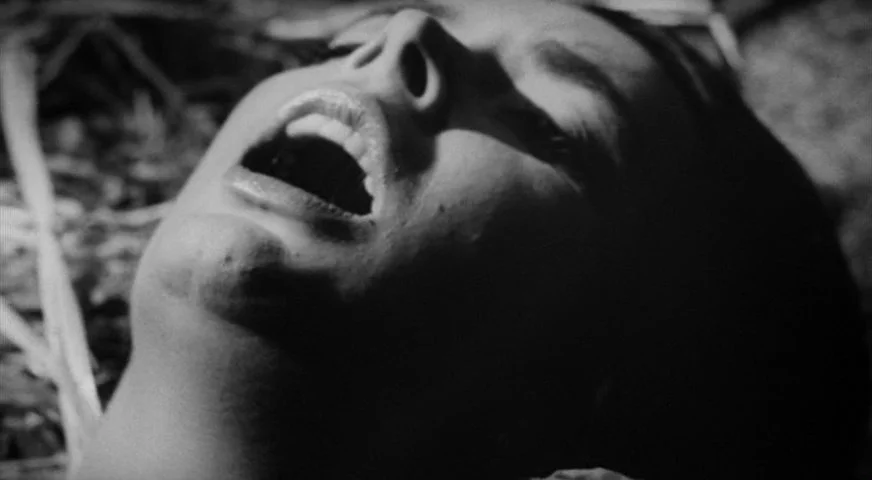
Barbara Steele in Castle of Blood
But art and love are a matter of mouths open in cinnabar, of blackness and redness turned to velvet by assiduous grinding, of understanding the colors that benefit from being rubbed softly one into the other: the least that the practice will make you is skillful: beyond which there’s originality… This is all in Cennini’s handbook for painters, as well as the strict instruction that we must always take pleasure from our work.
— Ali Smith, How to Be Both
Georges Rivière is haughty. Like he smelled something bad. The script?
Here, in 1964’s Castle of Blood, playing a penurious dandy silly enough to spend the night in a haunted castle on a bet, Rivière seems to think aloofness will be all the protection he needs. It won’t be! Indeed, only one thing can save the film’s leading man from the visual shibboleths of a dying genre, and that’s the cameraman.
Camera artisan Riccardo Pallottini, playing savior and tormentor, coaxes Rivière onward while punishing his progress. Nobody would be more surprised than the late Signore Pallottini himself hearing his cinematography praised as “experimental.” And yet, this is Gothic Horror’s greatest master shot — a case of push and pull, whose tension and elasticity continue to create rebounding space 118 years after its creator’s birth: so praise it we shall.
With ace cameramen, point-of-view becomes a more problematic concept, as when George O'Brien wanders glazed through F.W. Murnau’s swamp in Sunrise. There, the camera sometimes recedes from the hero’s advance, sometimes lets him pass and follows him, sometimes loses him altogether to rediscover him later. While Castle of Blood’s cliches would seem to be the thumpingly obvious point — a door’s creaking swing illuminates a wall bristling with harnesses and cartwheels… zoom in as a black kitten abandons its lair in a piece of spangly lacework… an organ wheezes as the hero’s sputtering candle casts the impossible shadow of itself on the crumbling masonry — those same hackneyed moments synthesize utterly unexpectedly into cinema pur.
As Georges Rivière gets lost inside his own master shot, little daubs of 1960s aesthetics miraculously harmonize with the 19th century vibe. Hairspray lingers throughout this legitimate evocation of monodrama, Romanticism’s stock theme, the solitary and roaming hero — think Schubert’s Winterreise or Caspar David Friedrich’s painting Wanderer Above the Sea of Fog.
It’s as if invisible tendrils were connecting Rivière’s body to Pallottini’s will.
Castle of Blood's score eschews melody in favor of crashing (a suit of armor falling downstairs in slllloooowww mmmotion, a sledgehammer beating against a bank vault) and shrill, reverberant strings, shivering at the bottom of a well. Eerie high notes that decay more slowly than any plastic skeleton. Low organ hums that seem to be walking us downstairs to somewhere terrible. Riz Ortolani can do musique concrète. Composer, director, cinematographer and viewer form one compound personality, an amalgamation that escorts itself through otherwise unfathomable spaces. While American horror movies struggle for a prosaic sense of following characters into danger, Italian entries in the genre float or somnambulate, adrift from narrative and character, jerking into sudden focus in shock moments and then gliding off again, glassy-eyed and detached.
The camera moves through and around apparent obstacles to our hero’s progress, seeming obstructions that justify the shot’s reason for existing. They make us conscious of the fact that we are spying on a man who thinks he’s alone, even if he fears he may not be. The dry ice fog, the wind machine, the spray-on cobwebs, the backlighting, and the reverberant footsteps all emerge from the same Gothic toy box (the one with the squeaky hinge), but Pallottini’s execution is exemplary, and the shamelessness total.
In The Virgin of Nuremberg (1963) AKA Horror Castle, again starring Georges Riviere, Antonio Margheriti's camera, again under the control of Riccardo Pallottini, prowls a thunderstormed mansion, first alone, then following Rossana Podestà in auburn wig and negligee, as she lipflaps "Max?" repeatedly, in response to obviously female moans from offscreen/a dubbing studio in Rome. "Max, is that you?” No, obviously not.
The dark and stormy night aesthetic is very on point. Podestà is freaked out by all of it, except, apparently, the torture chamber, complete with caged skeleton, which she wanders into on the ground floor of her medieval home. That's normal, we all have one of those. Margheriti structures the sequence as a series of languid tracking shots, interrupted by abrupt, quick stationary angles which jolts us closer to his leading lady as she gazes from the window (abrupt lightning!) or lights a candle (abrupt lambency!), to the stabs of (yes, once again) Riz Ortolani's suspense score, which will, upon the discovery of a leaking iron maiden, segue absurdly but with dreamlike inevitability into a swooning sex-sax pop track for the opening titles — The Love Theme from Horror Castle. When we cut to a giant closeup of a syringe plunger being depressed, Ortolani reacts with furious vamping as if accompanying some beatnik rave. It's not about doing music correctly, it's about shocking and unsettling — and what could be more unsettling than a love theme for an iron maiden?
Amidst the splendiferous cheese of Italian Horror, we enter the deepest metaphysics. Or the standard Catholic obsessions. In either case, we spend an awfully long time amongst the dead.
Castle of Blood in particular invites us to join the recently deceased in some exceedingly intimate ways: sonically, sexually and what have you — wherever early-Sixties Hollywood fears to tread. When the dead stare back at us, they absorb our life force into the glowing screen, whose own metaphorical whisper, “There must be other Alices,” invites new, unexpected iterations of Lewis Carroll’s looking glass. Enter a raven-haired ingenue, maturing as an actress, while retaining a profound sense of uncontrollable childhood rage, staggeringly tall yet capable of playing emotions too vast for the human body — then, commanding them into air. Barbara Steele, who holds the patent on gothic atmosphere, occasionally leases it to cinema. Here, in Castle of Blood, she’s pursued by a camera that may as well be the all-engulfing eye of some hypnotized cat. Picture the primordial shadow, rather than the reflection of Alice to summon the most erotic blacks and whites ever filmed.
Shot weeks after Castle of Blood but slipping through bureaucratic censorship more efficiently, The Virgin of Nuremberg reaches audiences first — in color so velvety that nigh-obsidian undertones emerge. An illusion perhaps, we nonetheless register Black & White form beneath that fully saturated color palette, that erotically charged excitement Italian cinematographers bring to their experiments with light. An all-embracing light, whose many-handed welcoming remains cloaked by collective amnesia. Not to mention that unique light’s bizarre origin story — if a single through line can be detected in its tangled paternal lineage(s): including Adolph Hitler.
Why else should so many visual throwbacks, indeed an entire corpus of undead iconography, arrive willy-nilly to boggle the Mod eye? Amid Italy’s love affair with Fellini and its own sexy ebullience, an arch Gothic fountainhead rises up; and this otherwise sun-kissed, suggestive peninsula hungers for crooked headstones, images ripped from The Cabinet of Dr. Caligari under German light. Mightn’t Italian Gothic Horror have originated in guilt? Was the genre’s unexpected appearance on the screen a belated reaction to Fascism and Mussolini’s infamous Nazi alliance, perhaps? If so, let’s take our hats off to Italian narcissism, which apparently processed national shame into a viable export, weird tales twisted like strozzapreti. Or “priest strangler” pasta.
Because Castle of Blood is an unlikely masterpiece, we recently asked horror savant and Video Watchdog founder Tim Lucas to help me sort out its elusive provenance. Antonio Margheriti remains the credited director but I have my doubts. Lucas apparently shares them: “This is far and away Margheriti’s best work, and it has always confounded me because it doesn’t feel like his other work; it has more taste.” The (normally) self-evident division of labor between director and director of photography buckles and gives way to seamless expression of the kind cinephiles generally attribute to their favorite auteurs. Is Margheriti capable of such piercing visual thrall? Sergio Corbucci (father of spaghetti western sadism with Django) is a better bet. Or so Lucas implies: “Corbucci shot the first week before Margheriti replaced him, but who really knows to what extent Margheriti replaced him? He agreed to be listed as director to help the film get completed, and surely he was on the set (we see him giving a cameo in the tavern scene), but that doesn’t mean he necessarily directed so much as ‘stood guard’.”
Castle of Blood begins with the old chestnut of the hale and hearty chap induced to spend the night in a haunted castle for a bet. It also throws in Edgar Allan Poe, and uses its subsequent apparitions as a kind of time travel device, allowing the penurious hero to glimpse the demises of those who have gone before him. One of these is Steele, yet again up to Lady Chatterley antics with the muscle-bound gardener in the stables. And then everyone turns out to be a vampire, though the origins of the bloodsucking plague are never established.
Corbucci serves up murky travelogue of the Gothic mind, wafting down draughty corridors for minutes on end, while a musical saw whines eerily on the soundtrack. Steele is already enmeshed in an undead love quadrangle (husband/lover/lesbian stalker) when the hero crashes in to complicate her existence, shagging her as the camera pans to the fire and only noticing her lack of heartbeat afterwards. Steele is a good bad girl, whose motivation and true nature remain up in the air until the last few minutes, which manage to chuck fragments of Lost Horizon and The Legend of Sleepy Hollow into the seething stew. The appallingly cynical conclusion (Poe worries that nobody’s going to believe this one) confirms the hero’s earlier observation: it’s the living you really have to watch out for.
“Italians make visually gorgeous but incoherent movies,” quipped Pauline Kael.
We’ll allow Kael her pronouncement in this particular case — glib though it be. She never condescended to address Italian genre horror, but we like to imagine the late hero of American film criticism thrilling to this B-grade masterpiece, in which the camera eye extends, wraith-like, from a personal source. This illusory sense of one-point perspective gliding alongside the actors, and inside their strangely integrated collective mind-frame, creates a funny feeling; as if the viewer were in the audience watching their own spectral image glower back into the darkened theatre. Tim Lucas provides more context, this time regarding Castle of Blood’s self-fractionating storylines and their shared Italian wellspring.
I also think we find a certain kind of forebears in the Italian anthology films, which would tell numerous stories – usually romantic or tragic – that took place over a period of time at the same location, like the movie Villa Borghese, for example. But Castle of Blood opens a door to a whole subgenre in which a modern person enters an antiquated villa and goes back in time, revealed to be a kind of hero/heroine in an Eternal Return scenario – in essence, a tragedy they have lived through must be lived through again, as a circle of Hell or karmic lesson. It can also be triggered by the introduction of the twin of a lost love, as in I Vampiri, The Third Eye, and Black Sunday.
Barbara Steele’s face follows the same identikit pattern as the cinema that launched her – possessing beauty that invites mixed metaphors. The American camera eye is a stalker, the Italian a gawping tourist. And its viewfinder aims at the wanton hypnagogia of shadows, the infinity of indwelling vistas turned outward, coarsely referred to as “visuals.” Castle of Blood stretches Alice on the rack, swathes her in the diaphanous fraudulence of Italian genre horror, a post-modern dream jumble – kabuki wig, eyelashes that go on for ever. Steele’s mutable visage, its discordant composition (Raymond Durgnat calls it “an art-school face, with something wild and regional, possibly even Mary Webb-ish”) finds a dark liquid pool to be Protean in. American films use the camera to bird-dog the cast, or to push in, making thought perceptible. Since Cabiria, Italian films have used the camera to explore space, show off the sets, bring the environment to dimensional life. In horror cinema, this becomes an atmospheric duty, the prowling lens that suggests a roving POV dislocated from anyone onscreen. Thus, Castle of Blood presents “Elizabeth Blackwood” as a revenant without hope, forced to relive her own violent death once a year — denied redemption, knowledge or peace. Absorbing Steele’s autumnal presence, Pallottini’s cinematography is all mien, silent-era Gothic. Others may ask for more. For us, that’s sufficient.
By David Cairns and Daniel Riccuito