
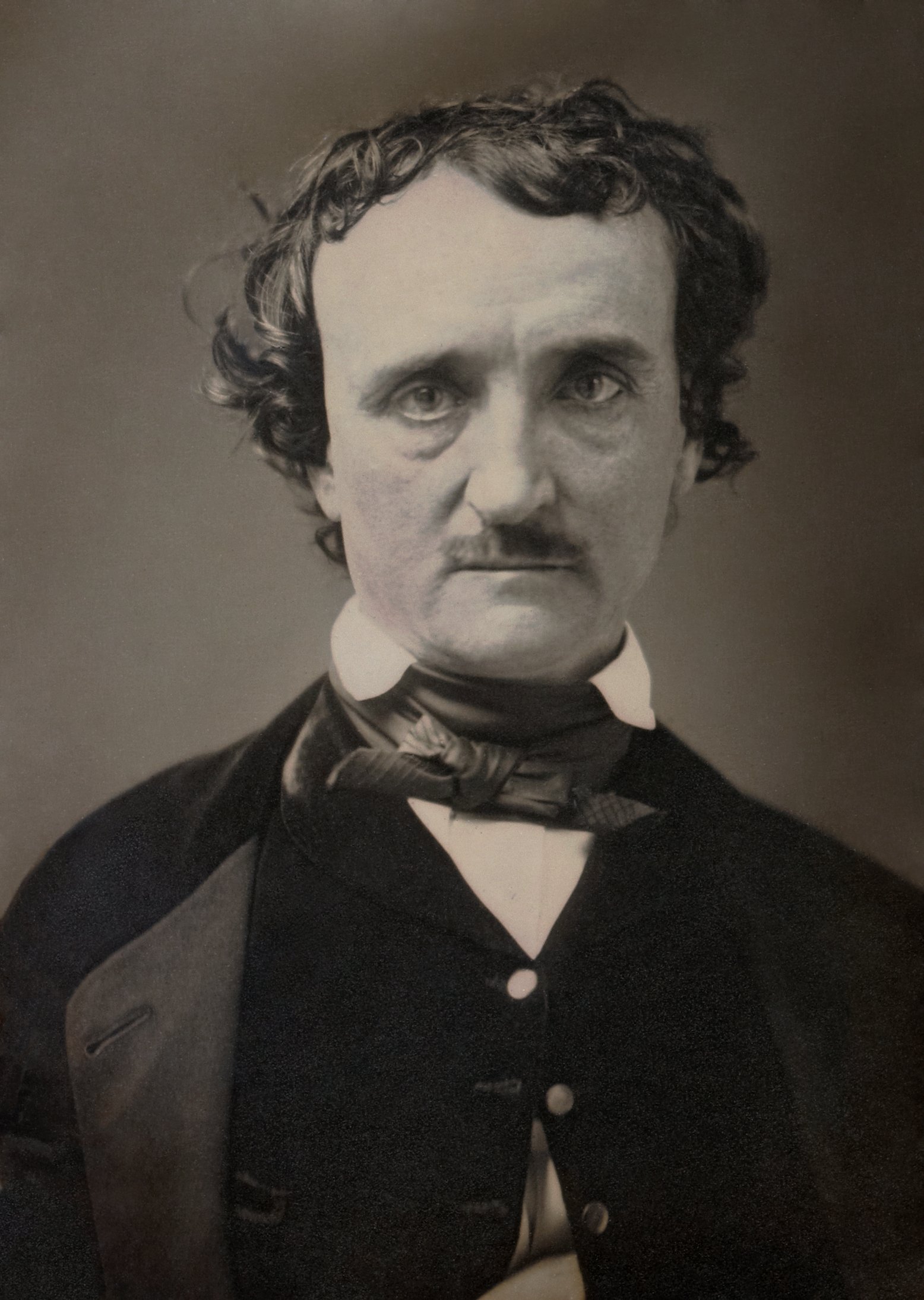
This essay intends to explore an axiom every cinephile will profess but few sincerely believe: Film is light.
There are times, though, when that light may take on a Stygian cast, burning with a flamme noire severity, a weird and otherworldly keenness. Or it may burn lurid and loud — especially if it’s a very old film, acting like a séance that summons the unruly dead. The darkness in cinema best typified by that form we call film noir is in its essence an extension of the peculiarly American darkness of Edgar Allan Poe.
What has Poe been to the movies — beyond a kind of literary convenience store where filmmakers can casually shoplift inspiration without penalty? Taken alone, the endless screen adaptations (Poe in Cinema) shortchange serious students of film history with a few impoverishing names and dates to guide them. Here, the writers propose a new cosmology of authorship within the porous nature of celluloid: we will examine Poe as the presiding intelligence over cinema itself (Poe as Cinema); shorthand to unify under one governing conceptual provenance a living medium previously victimized by autopsy scholarship. Taking for granted that motion pictures are pictures first and foremost, a spectacle above all else, we ask a few awkward questions: How, for instance, do movies absorb the written word? Do they, rather, absorb the author? To what extent should we worry about this mechanical creature, which seems to be parasitic — a replacement for the viewer’s brain?
Early, nitrate-based film stock, with its twinkling mineral core, gives Poe’s crepuscular light its time to shine and thereby illuminate the world. No longer held in the solitary confinement of a page of reproduced text or an image, frozen, rendered in paint or ink. Poe’s singularly tormented vision is finally written alchemically, in cinematographic rays beamed through silver salts; into moving images of such aggressive vitality as to chase every rational thing from one’s mind. A Black & White image flipped into negative makes black fire, or black sunlight such as illumines Nosferatu’s Transylvanian forests, through which a box-like carriage rattles at Mack Sennett speed. But with the slightest underexposure, a little dupey degradation of the print, or even a little imagination (such collaboration is not discouraged), this liquid blackness will spread everywhere and anywhere, the most luminous pestilence known to creation. Be it in the laughing nightmare of Fleischer cartoons of old (Out of the Inkwell, indeed) or John Alton’s vision of the night, we are left to wonder: is daylight burning out the corner of a building, or is it the blackness of the building which is eating into the sky?
As with many such questions, film permits us no easy answer. We are simply to watch as the characters smudge. As their shadows pulsate and flicker, emanate out beyond themselves. But if Poe represents the loss of control over one’s existence and the ensuing panic, then cinema, consciously or not, takes existential dread as a given.
God, a vague and unseen deity, died at the moment cinema was born, replaced by a new celestial order. Saints and prophets made poor film characters, giving off the feeling of having stepped out of a stained glass window, flat, Day-Glo icons moving uncomfortably through three-dimensional space. Movies rather rejoiced in dirt and rags, texture and imperfection, so that the most lackluster clown easily outperformed all the icon messiahs. At 45 minutes, Fernand Zecca’s The Life and Passion of Christ (1903) is one of the earliest feature films, but compared to the same filmmaker’s less ambitious, more playful shorts, it’s a beautiful snooze. A different execution climaxes his Story of a Crime (1901), in which we get to see, by brutal jump cut, a guillotine decapitation before our very eyes. This, as Maxim Gorky prophesied, is what the public wants. Or maybe the events of 1901, cinematic and otherwise, allow “the public” to define itself in ways heretofore unthinkable. The year brings Victoria Regina’s propitious death. And with her passing, Edgar Allan Poe’s pronunciamento on celebrity, “the ludicrous heightened into the grotesque,“ comes to new and anarchic fruition as an incendiary schnook, one of history’s finest.
When he shot President William McKinley at the Pan-American Exposition in Buffalo on September 6th, 1901, the currents of fear and vengeance unleashed by Leon Czolgosz would carry him on a journey from reflexive beatings at the hands of police and a post-Victorian mob — ladies in bustles shedding all restraint, transformed from well-honed symbols of middle-class decorum into yowling banshees, screaming “GIVE HIM TO US!” — straight to the electric chair, from whence his corpse would be taken for additional punishment, a process where ghoulish prison authorities at Auburn separated the head from the body, and then poured sulfuric acid on what remained, before secreting the sorry residue of America’s lost anarchist son into an unmarked grave.
Despite attempts to erase Czoglosz from history, a visual document survives, oozing with pathos and bitter recrimination. It is impossible, looking into those eyes, not to feel unnerved and, yes, sympathetic with him — his desperate act, after all, was as critical a part of America’s greed-engorged industrial fantasia as the near daily spectacle of peaceful strikers, his friends among them, being slaughtered in the name of profit.
If you like, the last photograph of Leon Czolgosz is a parable whose moral lesson has been swallowed by America’s collective madness. As when Poe’s fictive victim finds himself entombed alive behind a madman’s avenging masonry in The Cask of Amontillado. Whatever ethical aptitude we possess simply freezes, horror boring itself into the same hidden domain where rogue impulses boil, potentially releasing our repressed insurrections.
Motion pictures have presented similar threats to authority — from their misspent childhood years in late-Victorian fairgrounds to their grimy adolescence in Edwardian nickelodeon parlors. The inmates, emboldened under the spell of Klieg lights, were not only running the asylum, but re-shaping the world in its image, and the blunt instruments of church and state proved impotent against the anarchy of this freshly liberated ghetto. More profoundly than any other of cinema’s shady genres, it is film noir that embodies Edgar Allan Poe, Leon Czolgosz, and their respective relationships to our nation’s skittering, self-immolating rage.
Pursued through abandoned industrial parks and labyrinthine sewer systems, noir characters are born tickets punched, fate sealed. The black-listed, and therefore uncredited, Lionel Stander narrates Blast of Silence, pronouncing “hate” more times than anyone has counted. Listen for the unmistakable echoes of Stander’s corroded instrument as this, the most prosperous nation of late modernity comes tumbling around us. And keep a lumpen eye open for Leon Czolgosz’s shadow, cast upon the ensuing century.
Long before the official beginnings of noir in the Forties, Hollywood thrillers routinely used the visual tropes of dark shadows, low-key lighting, expressionist angles, and featured detectives, gangsters etc. What noir added was a sense of corruption, of capitalist society gone awry (or, perhaps, working exactly as it was supposed to, to the detriment of honest citizens). Post-WWII, this served as a release of pent-up pressure: criticism of the status quo had been seen as unpatriotic during the war. Suddenly, it was acceptable, even desirable, to turn that righteous anger inward, against domestic problems. Veterans lugged their battlefield violence home with them, an American principle brought to new fruition. Or to quote dirty cop Detective Lieutenant Barney Nolan (Edmond O’Brien) in Shield for Murder…
“You come to hate people. All of them. Everyone you meet.” Catharsis was rarely so artful.
Cyril Endfield's Try and Get Me! — the last movie he would make in the United States before other ladies in bustles (or, more properly, the institutional shade of those who once bedeviled Czolgosz) chased him onto the Blacklist, then across the Atlantic — gives us two American saps for the price of one: a chronically underemployed veteran (Frank Lovejoy), lost amid post-war, petit bourgeois prosperity, and his opposite number: a swaggering crook (Lloyd Bridges) with all the charm of a fourth-rate aluminum siding hustler. The two meet. A spree of small-time stick-ups ensues. The fast money brings faster ambition, and ideas above their station (the kidnapping and ransom of the son of a local moneybags that can only go sideways) that soon look like destiny.
Try and Get Me! was adapted by Jo Pagano from his 1947 novel, The Condemned. It was inspired by the 1933 kidnapping and murder of California department store heir Brooke Hart and the subsequent lynching of the two men responsible. But while Pagano's novel focuses largely upon media's responsibility for stoking, and then unleashing the public's inner lunacy, Endfield's film never entirely leaves behind his two American losers, strung up with the blessing of at least one duly elected governor.
What would the surgical excision of an influence look like? The censorious were on to something, even if they could never fully articulate the precise blasphemies committed by the noir scribe. Had these sententious old owls recognized their true enemies — form and form-making — they would finally have been rendered powerless. Hitchcock’s Vertigo, once named the greatest film ever made by Sight & Sound, isn’t canonical noir but is nonclerical Poe. The camera gives birth to the otherwise nestled darkness of interiority; taking inward and outward aim simultaneously, minus the difficult plot lines and rancorous dialogue enumerated under the Hays Code. Vertigo is, in essence, a corpulent point of view stalking without the disguise of excessive Formalism. Here it stands, naked in the light of day: the literature of obsession without prosody.
Granted, the noir genre seems an unlikely Poe derivative, but what of Laura — fatalism, romance and Necro-fantasy (with Lydecker as Usher)? DOA is the kind of concept Poe might have dreamed up; one of the great noir scribes, Cornell Woolrich is channeling Poe through an all-thumbs pulp sensibility. And how hard would it be to cast Val Lewton as the horror noir hybrid, with premature burials, ancestral disease, lunatics taking over bedlam?
In Poe’s Mesmeric Revelations a voluntary subject is quite near physical death and under the ministrations of his mesmerist, answering precise questions about the nature of God. Before dying, he says God is “ultimate or unparticled” matter: “What men attempt to embody in the word ‘thought,’ is this matter in motion.” The same unnamable textures apparently survive on television, a case of Poe resonating inside our minds, a collective consciousness replaced by cathode rays. If Rod Serling’s The Twilight Zone appropriates that evergreen of horror — paranoid fear — for a 1960s television audience, then we needn’t look far for the show’s inspiration. Mod Italy hopped on the Poe bandwagon amid its love affair with Fellini and its own sexy ebullience.
Cobwebbed passages and wax-encrusted candelabra, dungeons festooned with wrist manacles, an iron maiden in every niche, carpets of dry ice fog, dead twig forests, painted hilltop castles, secret doorways through fireplaces or behind beds (both portals of hot passion), crypts, gloomy servants, cracking thunder and flashes of lightning, inexplicably tinted light sources, candles impossibly casting their own shadows, rubber bats on wires, grand staircases, long dining tables, huge doors with prodigiously pendulous knockers to rival anything in Hollywood, all by Poe’s time already well-worn imagery of the Gothic.
Poe was famous for theorizing a workable formula to produce the effects he desired, and then he carried it out according to Gothic conventions and expectations. Like a storyboard, his theory would allow him to test the effect of his tropes and prosody before he even began to write a word. European movies often took their cues from this schematic approach whenever they dressed up Poe’s ghost in up-to-the-minute threads.
Spirits of the Dead is one of those compendium films, with voguish directors (Malle, Vadim, Fellini) entrusted with bringing to the screen a Poe story each. Only the Fellini episode, Toby Dammit, is notable; indeed, very notable, a hallucinatory yarn owing as much to Mario Bava's Kill, Baby, Kill! as to Poe's Never Bet the Devil Your Head, its ostensible source. The title character, played by Terence Stamp with white-blond hair and dark roots, and constant beads of witch hazel perspiration, is visiting Rome to attend an awards ceremony, and to play Christ in a western. But he’s fatally distracted by his new sports car, and a vision of the devil in the form of a little girl. Toby’s ride through a hellscape of nocturnal Rome seems lifted from Jules Dassin’s 10.30 p.m. Summer (1966), but it works even better for Fellini than it did in the Duras adaptation. An oppressively subjective film, Toby Dammit narrows the view down to the Ferrari’s headlights, a ghastly floodlit interzone where human forms are gradually replaced with mannequins and cut-outs, as the city becomes as unreal as an elaborate movie set, an uncanny valley laid out for the staging of an epic stunt/snuff film.
The Sixties also witness Italy’s sunny and suggestive peninsula leaping headlong into stainless steel cutlery and candy-colored light; into that thug of a genre, modishly dressed and psychically damaged beyond hope. The giallo fetishizes murder. And yet, for the directors who rode most dexterously the giallo wave, homicide was something one did to women. Indulging in equal-opportunity lechery was merely an excuse to find other, more violent outlets for their misogyny. Please enter into evidence the demented enthusiasm for woman-killing evinced by Dario Argento, Mario Bava, Lucio Fulci, et al. – whatever trifling token massacres of men one might exhume from their respective oeuvres are inconsequential. Argento’s defense, “I love women, so I would rather see a beautiful woman killed than an ugly man,” should not satisfy us, and hardly seems designed to (also bear in mind Poe’s assertion that the death of a beautiful young woman was the most poetic of all subjects). Filmmakers like Argento have no interest in sex per se. Suffering seems inessential, but terror and death are key, photographed with the same clinical absorption and aesthetic gloss as giallo-maestros habitually apply to their interior design. Here, it must be emphasized that design implicates the viewer as the Italian camera-eye gawps like some unabashed tourist. Knife, wallpaper, onyx pinky ring – each detail transforms into an object made eerily subject: a sentient and glowering fragment of our own conscience, staring back at us in the darkened theater and pronouncing ineluctable guilt.
Like Edgar Allan Poe before him, David Lynch is a resolutely American artist. For all of his Corcoran School of the Arts training in the prevailing flood tides of old world modernism, he has never held himself aloof from a mass audience. Indeed, his charming, if occasionally off-putting allegiance to the aesthetics of post-war conservatism have, throughout his career in film and television, been the current strong enough to deliver him to America's mainstream. His Boy Scout Days saw him standing in attendance at John F. Kennedy’s storied inauguration, hearing the fresh-minted herald of our Neo-Conservative present. The tintinnabulations of that voice, its ringing projection of a Cold War above all other emanations of state, foretold the terrain of Donald Trump’s more déclassé inaugural spectacle of 2017, a year that sounds like some number lifted from a burning boxcar.
The people of Twin Peaks: The Return are Kennedy’s America, perhaps a bit wind-blown and fraying at the edges, dropped into the 21st century, with Trump’s dreary mismanagement suddenly attached like the piece of the jigsaw puzzle that had been lost behind an Eames potato-chip chair, and now was found. Lynch may seem trapped inside the twisting form of his own Möbius strip, but even his blind spots and contradictory attitudes are obsessively accounted for. Surrealism’s Eagle Scout is finally addressing the present in all of its grim forms and vexing paradoxes. Otherwise fragmented stories synch up thematically in a matrix of limbos: abandoned housing developments; predatory casinos bilking senior citizens out of their long-sought retirement years; quiet communities where carnage pays a call without warning, like some invisible shiv planted between the ribs — all minus noticeable segues or directional guidance from interstitial fabric to hold Lynch’s latest (and last) Twin Peaks iteration together. Out-of-the-blue musical interludes and transcendent images combine to limn for us an earlier national heyday, complete with familiar syrup — sweet ooze. Who could blame us for giving in to the manufactured nostalgic longing compelling us, even against our will, to trust cheap promises, this blatant loser’s paradise with terrific music.
The top on the convertible is down, the radio on, The Paris Sisters singing I Love How You Love Me as a reincarnated Laura Palmer lifts her face to a cloudless sky. Within the tapestry of this early Phil Spector production — his trademark wall of schlock eternally associated with AM Romance and Death (conditions Spector knew all too well) — the voice of Priscilla Paris could be a dream goddess lullaby from the whispering gallery, or sweet nothings from the crypt. We don’t know. We’ll never know. This moment in Lynch’s Return might have been lifted from America’s abiding post-war dream of materialist deliverance. On its incandescent surface, that is; for, even under daytime conditions, the Pacific Northwest remains vulnerable, as if Poe’s crepuscular light lives inside the locals. Amanda Seyfried’s Becky becomes utterly transformed, a star captured in deathless, Sternbergian close-up, a pair of enormous eyes melting Spector’s dark edifice of sugar — iridescent search lights, hoping the sun will swallow her whole.
We can only bear witness and internalize this shimmering ingenue, this angel in a Ford Thunderbird trading places with Old Sol, as if whatever she just snorted has entered our system through hers. But in that ephemeral instant she achieves oneness with all things, the transcendence of stardom — true, temporal stardom — shorn of fame and the imperatives of show-business. Histories without language, or even thought, flicker through Lynch’s brightly-lit séance, in which Poe’s obsession with the demise of young female beauty — Laura’s and Becky’s — stands affirmed and denied.
Other limbos within Lynch’s honeycomb universe include a trailer park named after an indigenous fish and an early-1960s diner in perfect condition. We succumb to the spiritual valence of pie, coffee and that winning incarnation of FBI virtue, Agent Cooper. We smell the diaphanous diner’s heavenly menu options just as powerfully as we toot Becky’s unnamed powder. And yet, the obvious question arises: why pay this giddy visit to a year pregnant with oligarchs and grief? Lynch’s dead are wraiths composed of mass memory, a vox populi of the spirit realm, responding to otherwise forsaken democratic impulses. In short, the dead are not dead until we say they are. Their will and agency are available right now, all for the price of a subscription to Showtime.
We’re not simply going back to an old story or a popular television series after its twenty-five-year hiatus.
Return also spells two explicit evergreens on the religious right: Resurrection and Homecoming.
For Lynch, home is that Lemon Popsicle/Strawberry Milkshake species of innocence proffered by America’s music industry between 1957 and 1964. The horror genre always has to have some component of innocence to be truly devastating, be it the existential kind that inspires the malevolence everyone paid to have vicarious transit with, or the mere victimization of the unsuspecting. Either way, there was no other period in American popular culture when innocence of any variety was so lavishly examined, then toyed with, and finally killed. The free-floating chord that opens The Everly Brothers song, All I Have To Do is Dream, remains a lamentation in sound: the sudden recrudescence of Poe’s beating, tell-tale heart. At the end of Episode Three, brothers Jack Torrey and Page Burkum dream with that identical American, woozy-making twang.
Now, the brothers Everly are revenant beings. We’re right there with them inside Lynch’s spotless perdition. A fragment of time that’s gotten itself knocked out of place, where America cannot stop sighing its homesick longing at us hapless TV tourists.
Between 1961 and 1963 — the former year resounding with Eisenhower’s “Military Industrial Complex” and the latter with Camelot’s violent thud — Curtis Harrington’s Night Tide languished in a can, on a shelf. Harrington never seemed cognizant of the fact that our ambient national temperature had reached frigidity. When he wasn’t making obscure filmic baubles or practicing satanic rights, he might be found sleeping in a bedroom whose walls were decorated with mummified bats. Openly lifted from “Annabelle Lee,” Harrington’s title remains nothing more than a banal fact as compared to his film’s strange, and strangely hushed, invitation. If we sense something familiar, a coziness in Night Tide, where the horror dimension remains almost entirely on the edge of consciousness, it could be perverse nostalgia talking: the eerie combination of ColdWar ennui and our looming fear of atomic comeuppance, Poe on the wind.
California’s Venice Beach becomes the gloriously ramshackle arena for Harrington’s occult programmer. Picture a thousand elves rising with glee to the same, single-minded curatorial task and you’ll have a sense of what is involved here. Somehow, the quiet ebullience of these elfin labors summon Night Tide’s all-embracing place-ness, the feeling that the cast, the script, everything on the screen, remains faithful to that rotting, low-horizon dream that Venice Beach had become: a gaudy ruin, irreplaceable yet destined for erasure, the memory of an adolescent USA greased for the skids of late-stage capitalism.
Originally screened by Henri Langlois at the Cinémathèque française, Night Tide, with its meager $50,000 budget, would still need financial help from Roger Corman, who had always worn the odd-sox apparel of high art and low commerce with grace. It was Corman’s gift as a visionary schlockmeister, after all, that helped bring Poe to the American drive-in circuit. The late 1950s and early 1960s — a period which saw approximately 4,000 outdoor theaters dotting the nation — embodied post-War Prosperity, four-wheeled consumerism dressed in aerodynamic tail fins and shameless chrome. Amidst the attendant suburban sprawl, choked highways and fatal collisions, Corman, Johnny-on-the spot, would create nearly a dozen screen adaptations: Poe by the yard. Wearing his producer’s hat, he pays Night Tide’s creditors, freeing both Poe and Harrington together, in one gentle expressionist wave, to finally lap against a broad commercial market.
Was his generous act a mitzvah to cinema or simply a way of serving the medium’s biological determinism, essentially unaltered since Edison?
Either way, Night Tide was used as padding for Corman’s company and its sleazy double-bills.
Oozing into existence from beneath the American grind house appeared a reptile film species, looking forward and backward in the same instance. Backward, that is, to the extreme commerciality of 1940s Monogram horror films, and still further to fin de siècle dime museums with their giddy advertisements for Joe-Joe, the Dog-Faced Boy; and forward towards Joe Sarno, a master klutz of underbelly filmmaking. It cannot be overstated: sexploitation and horror were hotbeds of legitimate experimentalism.
Curtis Harrington had spent two decades fruitlessly bashing his head against the avant-garde wall, West Coast division, a schlockmeister arriviste suddenly gone Hollywood — that is, any imaginable “Hollywood” rude enough to splotch him right in the kisser with flat root beer or leave him smelling of exhaust fumes and gravel, hot from the hissing sand beneath. While square-jawed American males barely older than himself were off fighting Naziism, Harrington had captured his own Trans configuration on celluloid.
His proximal inspiration: Edgar Allan Poe.
“My memory,” Harrington writes, “was seared with it, leaving a scar that I would never lose. It was as if I had discovered my soul mate in the world of literature.”
That scar — his blunt, 9 minute The Fall of the House of Usher (1942) — is not a striking example of any particular strain of cinema known in its time. Harrington stands before us like some religious celebrant in the act of receiving God. A nimbus of innocence causes our awkward sixteen-year-old blasphemer to glow. Donning a wig and displaying no particular gifts as an actor, he nonetheless appears before us transfigured. His decision to play both doomed siblings — Roderick and Madeline — exclaims, blurts and spills the beans.
Night Tide resurrects Poe’s Madeline in the Mod guise of an old sideshow attraction. Despite her offscreen life as a nightclub chanteuse, Linda Lawson (Mora, the Mermaid) never sings in any conventional sense. Throughout the film, her breathy speaking voice expresses intense, alien musicality lurking behind an opaque and equally lyric curtain of melancholia. Her words become almost incantatory, summoning one gnostic boardwalk from the film’s various grubby locales. “Come live above a merry-go-round,” she seems to whisper, “take breakfast with a hot sailor and a hotter mermaid, spend endless hours in Venice Beach, of all places, with an old rummy sea captain, listening to the strange tales behind the morbid souvenirs of his life.”
By the 1930s, with oil rigs springing up like industrial dandelions, Venice Beach — unveiled a quarter century earlier as "Venice of America," and still called, with a straight face, a Peninsula — was an all-American eyesore. Built upon reclaimed swampland, this one-time dreamscape of would-be aesthete, Abbot Kinney, was now thoroughly abandoned, even by its tourists. And so, Poe’s vision of death and resurrection finds itself a decaying boardwalk ready for its close-up in the hands of Curtis Harrington. Gazing into the mermaid’s mythical mirror, which reveals the otherwise hidden self, a horrified Johnny (Dennis Hopper) sees Mora staring back at him. How do the Night Tide lovers become entwined in this bedazzled dime store looking glass? Suddenly the old story — sailor meets mermaid — requires an internal logic beyond narrative. Like smoke, the truth gets in Hopper’s eyes. Intense, somewhat myopic — they seem to be always focused on distances beyond the frame. Deeply hollowed under a very straight brow, so they peer out warily like cave-dwellers, wondering if this was such a good idea, and considering a strategic retreat.
Night Tide’s promises may be eternal, but the same cannot be said of life.
Cinema requires eulogists to commemorate talents excised from canonical film history. And here, the limitless domain of movie orphanhood finds itself represented by an actress officially classified under “Dissipated Outlier”… Scratching remembrances in longhand for the director's 2007 funeral, cult deity Barbara Steele reminds us of Curtis Harrington’s essential gentleness, despite his squalid dinner parties summoning imperial decadence, scenes out of Hogarth. “Once you were inside his charmed circle you would never be banished,” writes Steele, apparently likening the deceased to a fanciful movie set fashioned by his own living hands — “it was such a delightful place to be, you wouldn’t want to escape… and you loved him with all your heart.” Well, doesn’t that selfsame pas de deux delineate Night Tide's inner world: unwonted inhabitants and mainstream audience (lovingly dragooned), like two bodies joined in a single swirling embrace?
By Daniel Riccuito and Tom Sutpen