
Throughout our history, we’ve always been instructed to be terrified of one diabolical group of outsiders or another. Pick any era, and it can be identified in part by who or what we were fretting over—anarchists, communists, the Japanese, the Italians, Satanic child molesters, terrorists. But over that same period, as all those other fears came and went, one remained constant and true, and only one: we have always been absolutely terrified of our teenagers. Why do they act like that? Why do they talk like that? Why are they so rebellious and sullen? What the hell have they got to be sullen about? And that godawful music! Time was these were all undeniable symptoms that our kids were using drugs, experimenting with sex, or hanging out with a tough crowd. Nowadays the dominant unspoken question seems to be “When is my kid gonna shoot up his school?” The context has changed, the methodology has changed, but ultimately that question is merely a slight variation on the same question American adults have been asking all along.
While our fears of specific foreigners and different ways of thinking were reflected in cinematic terms during their dominant eras, our unwavering dread of teenagers led to the birth of one of the hardiest sub-genres in film history, stretching from at least the ‘20s to the present.
Unlike, say, women in prison, blaxploitation, or asteroid pictures, juvenile delinquent films have become such a broad, reflective category that there are few things that can be said that hold true for all of them, save for antisocial behavior on the part of our Young People. The thieving, murderous hobo kids of Wild Boys of the Road, the reckless behavior of hopped-up kids in Assassin of Youth, the smartass juvies of The Dead End Kids films, the drama queen antics of Rebel Without a Cause, the rock and roll hijinx of countless AIP quickies, from biker films, to street gang films, to drug pictures, to the more nihilistic portrayals of recent decades. For all the youthful mayhem, though, there’s always something to blame. In the early ‘30s we blamed marijuana, the economy. and hot jazz music. Later we blamed a lack of parental control, the media, other adults, society at large, heavy metal, the easy accessibility of drugs, the easy accessibility of guns, the economy again, violent video games, violent movies, some cheap medical excuse like autism or ADHD, or whatever the hell was in vogue at the moment.
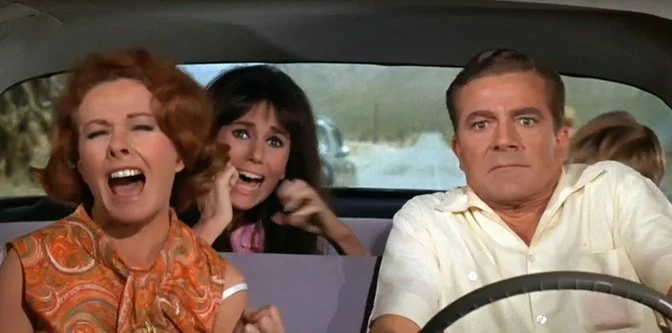
Personally I find it endlessly hilarious the number of parents I know who came of age as radicals and hippies in the ‘60s who are now absolutely confounded by children who are simply doing the same things they were doing back then (“I think she may be smoking pot!”). In a way, this is the dilemma faced by Dana Andrews and Jeanne Crain in John Brom’s oddly anachronistic sort-of drive-in feature, Hot Rods to Hell.
Made in 1967 as a TV movie, the fact that Hot Rods was produced by teensploitation maestro Sam Katzman all but required the film be released to drive-ins first, so it was. It seems an odd choice now, as the film was so pointedly aimed at frantic adults, zeroing in on their deep fear of those villainous teens. That may help explain why a film released a mere two years before Easy Rider has the look and feel of a picture made 20 years earlier. But had the film been made in the mid-’50s (which it was, several times), the focus would have been on the high-spirited joy riding teens just out for some kicks who find themselves victimized by humorless authority figures. Here that focus has shifted, and we see the action through the eyes of those once-fun-loving teens who have since grown up to become paranoid, humorless adults out to put a stop to everyone’s fun.
Driving the point home, the film stars Dana Andrews and Jean Crain in what would be their fourth and last picture together. They’d become a famous pair in ‘45’s State Fair in which they played, yes, a couple of free-spirited youngsters all googly-eyed in love and living in a wholesome world. Twenty-five years later, Andrews career was on the skids and his heavy drinking was more evident than ever. He and Crain play Tom and Peg Phillips,, who with their two kids are living the perfect Eisenhower-era life. unfortunately nobody bothered to tell them the Eisenhower era ended some time back, and that the world had changed a great deal since then. But they’ll learn soon enough. On Christmas Eve a reckless drunk drives Tom off the road, landing him in the hospital for several months with a back injury. While laying there in his brace, the once fearless and happy Tom becomes sullen, paranoid, and frightened. Thinking it will be good for him, his brother and Peg arrange for Tom to buy a motel in the middle of the California desert.
Driving across the desert en route to their new home a few minutes later, Tom and his perfect family are nearly wrecked by a bunch of drag racing teenage hooligans. Unlike most young thugs, the ne’er-do-wells here were good looking, had neatly-trimmed hair, wore button down collars and preppy sweaters, and drove fancy, expensive, souped-up hot rods.
“They could’ve killed us,” Tom’s attractive teenage daughter says after the hot rods speed away.
“They could’ve killed themselves,” Tom replies. “Not that it makes any difference to them.” And that of course is the historically traditional interpretation of any alien group you fear but do not comprehend—that human life means nothing to them, not even their own. It was said about the Japanese, the North Vietnamese, and has often been said about the American teenager.
After spotting one of the teens at a gas station a few miles down the road, Tom confronts him in a weak, shaky manner, and that’s enough to set the rest of the story in motion. These crazy young hoods can smell fear, see? And when they smell fear they smell blood.
Unlike most of the amoral, antisocial teens from earlier JD films, we learn that these rotten punks are actually rich kids from good and loving families, which helps explain the clothes, the haircuts, and the fancy cars. But living out there in the middle of the desert like that there’s not much to do and they’re bored. They’re just looking for some kicks. Some of those kicks are found by hanging out at the cafe—the only teen hangout in the area—that just happens to be attached to the Phillips’ new motel. And after that confrontation at the gas station they decide to find some new kicks by giving old man Philips the business, which mostly involves trying to run him off the road whenever he gets in his car. Tom really doesn’t help matters with his impulse to call the cops at the slightest infraction or his plan to put a stop to all the unwholesome goings-on at the cafe every night, all that crazy rock’n’roll music and wild dancing and beer drinking and such.
Needless to say, things escalate until Tom is forced to fight back with the same lawless, nihilistic methods those goddamn kids were using against him. It was inevitable. The interesting thing is once he becomes everything he fears and hates, once he finds the strength to act like a cheap teenage punk, he feels much better about himself. He finally reclaims his manhood by driving other people off the road.
So while much of the film really does take the form of a classic ‘50s drive-in picture told from the perspective of Old Man Killjoy, the square who’s trying to ruin it for everybody, it ends with Tom finally coming to understand and accept—even embrace—the mindset of the younger generation in a changing world. A few people might be killed along the way, but so what?
I’m sure it was the intention of the filmmakers to have Tom’s final act represent a restoration of order and a return to Eisenhower-era morality. What they did instead, however accidentally, was have him click into and celebrate the nihilism and pointless anger felt by the youth in a world where Eisenhower was dead, Kennedy was dead, a war no one fully understood was being fought, and the country was in turmoil.
In the larger JD spectrum, for all the hair pulling and jumping about in the search for answers as to why our kids act this way, I’m waiting for a filmmaker to finally confront the simplest answer of all—namely that teenagers are by nature a bunch of rotten little lowlife bastards who are out to kill us all.
by Jim Knipfel