
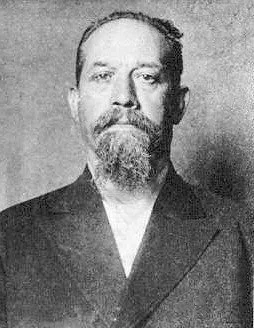
Luigi Galleani
On the afternoon of Monday, October 22nd, a staffer working at the Katonah, NY estate of liberal billionaire George Soros discovered a suspicious package someone had left near the mailbox. Opening the package and gleaning it contained a six-inch pipe bomb, he scurried it out to the nearby woods and called the police.
The following evening a similar package addressed to Hillary Clinton’s Westchester County home was intercepted before it could do any damage, and the following morning two more pipe bombs arrived at former President Barack Obama’s Washington, D.C. office, as well as the Manhattan offices of CNN. By week’s end, similar mail bombs, twelve in total, were aimed at prominent Democrats including Maxine Waters, Eric Holder and former Vice President Joe Biden, as well as actor Robert DeNiro. All the bombs, it was reported at the time, consisted of six-inch lengths of pipe packed with black powder, wrapped in black tape, with a timing mechanism attatched and wires protruding from both ends. No one was injured, and none of the crude explosive devices detonated by themselves.
The connection between all the intended targets was clear, so much so you almost have to feel bad for those, like Chuck Schumer and Elizabeth Warren, who apparently didn’t make the cut. All were prominent liberals and outspoken Trump critics. All have also been the targets in return of the president’s public vitriol. Several—particularly Soros, Obama and Clinton—have also been cited as central nefarious players in a web of online conspiracy theories ranging from Pizzagate to QAnin to the supposed bankrolling of the Honduran Caravan.
The question facing investigators was determining whether the would-be bomber or bombers had been inspired by the president’s rhetoric, which often seemed to encourage such behavior, or one of the conspiracy theories. Adherents of Pizzagate and QAnon, after all, had been involved in several acts of violence in recent years, while the increasingly visible White Nationalist movement had never been known for their restraint when it came to confronting critics of the president.
By Wednesday afternoon, before even half of the mail bombs had materialized, conspiracy theorists and conservative pundits had already declared the whole thing a hoax, a false flag operation designed to demonize the Right, win sympathy for the Left, and draw attention away from the caravan in the days prior to the midterm elections. But who couldn’t see that coming the minute the Soros news hit? Going conspiratorial has become mere reflex for half the country when confronted with unpleasant news.
Then on Friday, as two more packages were discovered, the FBI arrested 56-year-old Cesar Sayoc Jr., a Republican from Florida with a tawdry small-timer’s criminal record who, by early accounts anyway, drives a white van covered in pro-trump, anti-CNN and generally conspiratorial bumper stickers. Well, if he’s the guy I guess that’s that for the conspiracy theorists, unless they want to claim he’s as much a patsy as Oswald, which no doubt some will.
Let’s pause there a second an back up a century, as Sayoc , or whoever was responsible for targeting powerful American liberals, had a solid historical script to follow, albeit one on the flip side of the coin and with a few notable differences—namely that in 1919 mad bombers knew how to build bombs that worked.
On April 29th, a package arrived at the home of Georgia senator Thomas W. Hardwick. Hardwick wasn’t home at the time, so his housekeeper brought the box inside and, together with Hardwick’s wife, set about opening it.
The package was wrapped in brown paper. Inside was a box wrapped in green paper, announcing the package to be a Gimbel’s novelty sampler. Obviously curious, the housekeeper opened the end of the box marked “open.” In so doing, she released a spring which allowed a small vial of acid to spill onto three blasting caps, which then detonated the stick of dynamite that had been packed inside a small, hollowed out wooden block. The resulting explosion blew off the housekeeper’s hands, and left Hardwick’s wife with serious burns and lacerations.
Around that same time, an identical package arrived at the home of Rayme Weston Finch, a Bureau of Investigation agent with the Justice Department. One of Finch’s staffers took it upon himself to open the curious package, but opening it from the wrong end. The acid vial merely tumbled out onto the table, and the bomb didn’t detonate.
After these two incidents, law enforcement departments, the post office and the media all began posting warnings about any similar packages. As it happened, a sharp-eyed postal clerk in New York had already set aside over a dozen identical packages for lack of postage. Scanning the names of the targets, investigators started to glean something of the bombers motivation. The targets included senators and congressmen, judges, mayors, law enforcement officials, newspaper editors, and wealthy businessmen. Perhaps the three most prominent intended targets were J.P. Morgan, John D. Rockefeller, and Attorney general A. Mitchell Palmer.
Every one of the targets had either supported the kind of anti-immigrant/anti-radical policies that were so popular in the States after the Bolshevik Revolution, or took steps to enforce those policies. Fisk, for instance, had lead a raid on the offices of an anarchist magazine a year earlier, arresting three prominent Galleanists, followers of Luigi Galleani, whose “Propaganda of the Deed” philosophy encouraged bombings, assassinations and other acts of violence against capitalists and politicians. Hardwick had sponsored legislation aimed at crushing the labor movement and driving Left-leaning immigrants (mostly Italians) out of the country.
All in all, some thirty-six bombs were mailed around the end of April, it’s assumed in the hopes the packages would all be opened on May Day.
On June 2nd, as federal investigators were still trying to narrow down their list of suspects for April’s mail bombs, eight much more powerful bombs, once again targeting judges, politicians and Attorney General Palmer, were detonated simultaneously in cities across the country. Along with being packed with metallic shrapnel, each of the devices also contained a leaflet which read:
War, Class war, and you were the first to wage it under the cover of the powerful institutions you call order, in the darkness of your laws. There will have to be bloodshed; we will not dodge; there will have to be murder: we will kill, because it is necessary; there will have to be destruction; we will destroy to rid the world of your tyrannical institutions.
This time there were two casualties. One was a night watchman, the other the former editor of the above-mentioned Galleanist magazine, who was in the process of depositing a 25-pound bomb on Palmer’s front steps when it prematurely exploded. The bomb demolished the front of the house, but Palmer, who was at home with his family at the time, was in a back room and remained unharmed.
With the bomber’s corpse and those flyers, the feds had the clue they needed and Galleani was promptly deported to Italy.
But that was hardly the end of it, particularly from Palmer’s perspective. Toward the end of the year, the Attorney General, a long-time hardliner when it came to immigration, Sedition, labor unions an radicalism, launched what came to be known as The Palmer Raids. Leaving the U.S. Constitution in some other room someplace, cops across the country rounded up roughly 10,000 suspected anarchists, communists and socialists, most of them Italian. In the end over 500 were deported. Meanwhile, American intellectuals whose own political views edged into the pink found themselves subject to federal and local suspicion and persecution, as those springtime bombs launched the first Red Scare.
Although no one was ever arrested or charged, it’s suspected some of Galleani’s followers may have had the last word on the issue—those last words being something along the lines of “FUCK YOU, PALMER.”
At noon on September 16th, 1920, a horse-drawn wagon packed with explosives detonated in the middle of Wall Street, killing 38 and sending hundreds to nearby hospitals.
Which brings us back to the present and Mr. Sayoc, a fairly namby-pamby mail bomber with an obvious ideological agenda. You do have to wonder what might have happened had one of the pipe bombs actually exploded, injuring or killing one or more people. Given the present administration has no interest in cracking down on violence on the Right, might it have gone down as one of the first triggers that sparked the new Civil War, or would we all just shrug and get on with the day?
by Jim Knipfel