
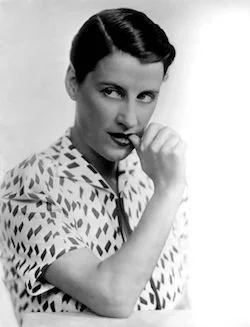
When it is said that someone lives in their own world, it is often not meant kindly or admiringly, but Beatrice Lillie lived and worked very much in her own world like a child does at play, seemingly impervious to outside reaction or convention. If you “got” her no one was funnier, and in her heyday she was actually billed as “The Funniest Woman in the World,” all by herself. Why is someone funny, especially if you are not an easy laugher? Because of an element of surprise, or the swift introduction of something unexpected, and Lillie’s comic style was nothing but unexpected, aberrant, capricious.
She was born in Canada in 1894, and she started performing early with her mother and her sister Muriel. Lillie’s mother would sometimes sing an “art” song called “There Are Fairies at the Bottom of Our Garden,” and later on Lillie was persuaded to try the “Fairies” song for laughs, as can be seen in an appearance on The Ed Sullivan Show in 1952. When she sings, “And the queen, well can you guess who that may be?” the word “queen” comes out as “kuh-ween,” and Lillie is the ultimate in pansy flair here, using a feather fan as a self-delighted child would.
Lillie had her hair cut short in the 1920s and kept it that way, and she often did trouser roles on stage in the 1910s for her showman mentor André Charlot because most of the male actors were off fighting in World War I. On the cover of the album Thirty Minutes with Beatrice Lillie, she is turned to profile with this severe brush cut and looks very chic lesbian, but she had several male lovers. In 1920 she married a tall man named Sir Robert Peel, and so Lillie could call herself Lady Peel for the rest of her life, mainly for a gag. Peel was a gambler who put her deeply in debt by the time of his death in 1934, and so she had to keep working and commanding large fees on stage to pay these off. Her son with Peel, who was also very tall and good-looking and named Robert, died during World War II, and her anguish over this is made clear in her autobiography Every Other Inch a Lady, which was published in 1972.
Lillie appeared regularly in revues in the theater, and she made a film debut in Exit Smiling (1926), in which she plays Violet, a drudge-of-all-work behind the scenes in a repertory theater company who wants to play a vamp on stage and gets to dress up in male clothes to threaten the leading man of the troupe, played by swish expert Franklin Pangborn. The gender signifiers are all over the place here, and Lillie gets her laughs with some physical comic business and even gamely sells an unrequited love theme when Violet falls for a young actor (Jack Pickford).
Lillie did a sketch with Frank Fay in The Show of Shows (1929) where Fay keeps interrupting her as she tries to speak about a girl who was a “sailor’s delight,” and here she utilizes one of her sharpest weapons: the unexpected pause. Her lost feature Are You There? (1930) seems to survive only as a few songs without picture, but that was a perfect title to express her restless weirdness. It isn’t easy sometimes to get on Lillie’s wavelength in what remains of her work, but then that was always the case; you either “get” her or you don’t, and “Get her!” was her favorite camp phrase.
In the Bing Crosby picture Doctor Rhythm (1938) she plays Mrs. Lorelei Dodge-Blodgett, a society woman who does Lillie’s noted “One Dozen Double Damask Dinner Napkins” routine with Franklin Pangborn. At 44 here she is dry and naughty-ish and hard and oblivious, and some of her effects are clearly long-practiced and set, yet the result is fresh because she seems so easily bored and prone to yawns. She gets some of her biggest laughs by acting suspicious at random, which is why everything she said or that people said around her began to sound like a double entendre. Lillie often seems demanding, but demanding what?
Her face says, “Now, no nonsense!” and yet she is pure nonsense, and such purity can be more than a little intimidating. She wears “funny” clothes and carries a bent walking stick in Doctor Rhythm, but these are superfluous because it is Lillie herself who is bent. When Kenneth Tynan profiled her in the 1950s, she told him that maybe people laughed at her because of her nose, as if searching for a simple explanation. Tynan himself felt that Lillie wanted to do without language entirely, which is the point of her dinner napkin routine where she makes comic hay out of “danner nipkins” and “nanner dimkins.” It is easy to imagine Lillie playing with dolls for hours, or getting caught in the revolving door of a hotel and staying in there for a half hour because she liked it, just as Zelda and F. Scott Fitzgerald once did.
On Approval (1944) is her masterpiece, and it is shared with her co-star and director Clive Brook. On Approval is not just a film that Lillie is in, as her others are, but a real Beatrice Lillie film that seems to take its irreverent tone from her. It mines the recent past (the 1890s) for laughs, and it is high comedy, whereas Lillie herself was neither high nor low but somewhere off to the side. Her Maria Wislack makes jokes and waits for her laughs as Beatrice does in Much Ado About Nothing, and she keeps saying the non-word “Ho!” as an all-purpose exclamation until the film itself takes her up on it and becomes obsessed with it. Maria has a managing and bossy manner, but she is very silly underneath, and this is a strange combination.
The height of Lillie’s art on screen comes in the way On Approval has the 41-year-old Maria at the piano singing a song that begins, “I’m just 17, and I’ve never been” only to cut her off to show other cast members before going back to her singing “I’m just 17” twice, and then making us wait quite a while until she goes back to the piano and finally sings the whole first line: “I’m just 17, and I’ve never been, to any stately ball!” The visual nightmare towards the end of that film suits Lillie’s sensibility perfectly, especially when she is done up in Grecian garb and holding poses.
It seems a shame that Lillie didn’t make a few more films as a friend to screwball comedy heroines of the 1930s, or maybe an appearance or two in some Warner Brothers adventure movies of the 1940s (imagine Bea confronting Bogart) or some specialty cameos in Technicolor MGM musicals. She stuck to the theater and capped her career with a show called An Evening with Beatrice Lillie in 1952, for which she won a Tony award and which she toured in extensively. Lillie did many of her best songs here, including the very camp “Maud,” where she talks to a female friend about how she and their set are all “rotten to the core,” and the Ivor Novello ballad “There are Times,” which she sings fairly straight.
By the 1960s, Lillie’s wits were getting fuddled by Alzheimer’s disease, but she appeared as Madame Arcati in High Spirits, the musical of Noel Coward’s Blithe Spirit, and she was the wicked Mrs. Meers in the heavy-going musical hit Thoroughly Modern Millie (1967), where she is finally vanquished by another camp performer of a very different stripe, Carol Channing. Lillie lived for over 20 years more after that, but in decline, and she was cared for by her long-time friend and companion John Philip Huck, who died the day after she did in 1989.
Her memory has been perpetuated by Bruce Laffey, who wrote a book about Lillie and his friendship with her, and John Ellis, who has lovingly presented all manner of droll Lillie-ana on YouTube and elsewhere. The meaning of Lillie’s life and art might remain obscure or at least hard to pinpoint, but that’s the fun of her, and the danger too, for she had an edge that admitted only initiates for play.
by Dan Callahan