
“Irving Lerner was an artist -” I can remember that sentence fragment in an introduction Martin Scorsese wrote for a season of films which influenced his work. He said that Murder by Contract, Lerner’s pulpy assassination thriller, had inspired the “minimalism” he aimed for in Taxi Driver, although both films manage to make simplicity seem baroque at times. Location shooting, long-held set-ups, intense close-ups and an unblinking view of criminal activity connect the films, but it’s a sort of tribute to Scorsese’s imagination at the time that he transmuted all his sources so thoroughly.
Lerner worked in documentaries (the famous Muscle Beach, 1948, in collaboration with Joseph Strick) and television, and his career climaxed with the theatrical adaptation The Royal Hunt of the Sun (1969), which details the Spanish conquistadors’ first encounter with the Incas. Where a David Lean sensibility might have been expected, Lerner provides sumple, graphic lay-outs which flatten and compress the action into a series of comic book panels. Cramped, rather than expansive, the film looks both great and cheap.
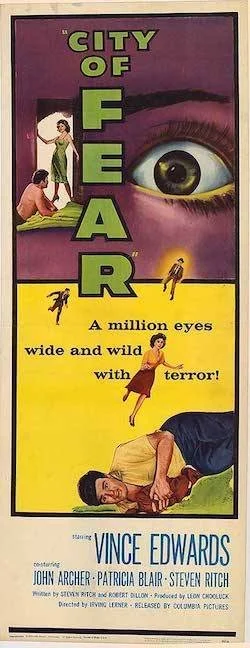
The aesthetic of poverty was Lerner’s friend. City of Fear (1959) is a nuclear anxiety thriller in which a San Quentin fugitive (Vince Edwards) somehow acquires a canister of deadly Cobalt 60, believing in contains heroin. As the authorities prepare to evacuate LA, and Jerry Goldsmith’s score rattles and blares on the soundtrack, Edwards tries to monetize his ill-gotten gains.
From the start, Lerner makes a virtue of necessity, the chief necessity being to make a film out of spit. A wide lens frames Edwards close as he drives, sneering at the radio as it recounts his criminal exploits. Lerner holds the shot ruthlessly, relentlessly: he could easily cut to a POV, but I think he wants us to know, early on, that this is a film of limited means, in which every resource will be stretched to breaking point. Chief among these is the electrifying Edwards, a very different figure from his Ben Casey role on TV, as a prison-hardened psycho slowly eaten away by radiation poisoning. The plot is structured not by any true deadline regarding the threat to the city, but by the amount of time it takes it’s hero-villain to die.
Edwards was in Kubrick’s The Killing, and that film’s cinematographer, Lucien Ballard, is along for the ride too, bringing the kind of single-source lighting Kubrick splashed around so much in his noirs. Apart from Edwards, the cast features Lyle Talbot, corpulent and glum, looking like he’s been sat in the same chair for the twenty-five years since his days as a primo pre-code lout. Gun moll Patricia Blair is luscious, even as radiation sweat sets in.
Lerner gets a lot of Dragnet-type atmosphere out of the blankness of LA in b&w, and the lack of money for, well, anything, ends up being to the film’s benefit. Amping up the menace of that shiny canister, the sound of an off screen ice-cream van and laughing children make us imagine the awful consequences of radioactive dispersal. Every room at the police station is a featureless box, decorated only by stark shadows, and the camera glides through the wall partitions like a ghost. The sets are insubstantial as hell, the store-room of a shoe shop where much of the action takes place providing an apt analogue: the shoe box.
Pair it with Carnival of Souls; marvel at its seedy, stark deadpan; just don’t forget that Irving Lerner was an artist.
by David Cairns