
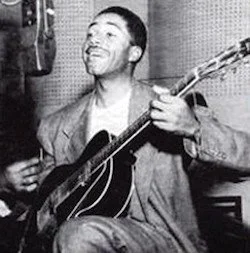
I first heard Slim Gaillard in a cramped little new and used punk rock record store just off South Street in Philadelphia in the mid-‘80s. You wouldn’t normally be expecting the spiked and leathered clerk in a place like that to be playing ’postwar jazz, but Gaillard was a different kind of finger-popping jazzbo, as singular a groovy beatnik punk rock wildman as they come.
Bulee “Slim” Gaillard’s early life, as he describes it, was as storied, fantastical, even mythical as Salvador Dali’s or an early 20th century boy’s adventure novel. Given official records are sparse, it’s just better and somehow more fitting to simply take him at his word. It only makes sense, really, and helps explain as well as anything how he became what he did.
The motormouthed madcap hepcat bebop comedy genius behind 1938’s “Flat Foot Floogie (with a Floy Floy),” a performer whose unexpected slips into rapid-fire Spanish, Arabic and Yiddish can at first sound like skilled mimicry, a kind of scatting Sid Caesar, was born in Cuba in 1916 to an Afro-Cuban mother and a German Jewish father. His father was a steamship steward who sometimes brought the young Gaillard along on ocean voyages to show him a bit of the world. But after a stop in Crete in 1928, the ship somehow sailed on half an hour earlier than scheduled, leaving the 12-year-old Gaillard behind. Completely alone and speaking only Spanish at the time, out of simple necessity he picked up enough Greek to get by for the next couple years. He also occasionally hopped aboard passing ships to visit the Middle East, where he likewise learned some Arabic and became enamored with the people, the music and the culture. Then at 16, deciding it was about time he returned home to see his parents again, he booked passage on a ship he thought was headed for Havana.
Only problem was, the boat skipped Havana, sailing north to New York. Gaillard didn’t disembark there, instead staying aboard as the ship made it’s way through the St. Lawrence before docking in Detroit. Considering he spoke no English, Detroit seemed much more amenable, he would note years later, mostly on account of it’s large immigrant population. With so many Greeks, Arabs and Hispanics vying for work in the auto plants, he was at least able to find people with whom he could communicate, and was taken in by an Armenian family. He picked up English as quickly as he picked up the others, though, and started working odd jobs. Among the odder, there in the midst of Prohibition, was a stint with the notorious Purple Gang, for whom he made deliveries in a hearse carrying a coffin filled with bootleg whiskey. After witnessing too much violence, the preternaturally gentle Gaillard realized it wasn’t the life for him, and took the advice of a tough local beat cop (who also happened to be black) who warned him to get away from the gangs, get out of the neighborhood, and do something with himself. For a black teenager in Detroit in the 1930s, his escape routes were limited. He could go into boxing, or go into music. He tried his hand at boxing for a bit, then decided maybe music was the preferable route.
Gaillard started taking night classes, and after some backstage encouragement from Duke Ellington himself, eventually learned to play guitar, sax, vibraphone, piano and drums. In the mid-30s he moved to New York, having decided he wanted to be a professional entertainer.
Since work as a professional musician was hard to come by, he became what he called a professional amateur, making the rounds of the amateur nights at the local clubs, changing his act as he did to avoid recognition. Sometimes he’d be a dancer, others a pianist, still others a sax player. Simple fact was he could get paid $15 a night on the amateur stages, which was better than a lot of professionals were getting paid. The trick, though, was he couldn’t be too good, If he was too good, they’d never let him play amateur night. So he always had to drop in a few intentional flat notes to cover himself.
Although he was an excellent musician who could play everything from boogie woogie to bebop to Big Band to Afro-Cuban to American standards to children’s songs and classical, Gaillard will never be remembered for his playing. Despite having so many languages at his disposal (the list had since come to include Armenian, German and Yiddish), Gaillard found there were still ideas and concepts beyond what any of them could express. To rectify this he began inventing his own vocabulary, centered around the adjectival verb “vout” (and it’s variations vouty, McVoutm McVouty, etc.) and the suffixes o-reenee, o-roonee, and o-rootee. They were fluid in both usage and meaning, and could be dropped in pretty much anywhere in conversation. By the time he teamed with bassist Slam Stewart and the pair began recording as the musical comedy team Slim and Slam in the late ‘30s, Gaillard had started writing his own songs in the new language he had christened, yes, Vout-O-Reenee. Beyong that, the pair was a master of the dueling jive comic scat, playing off each other and riffing on everything from La boheme and “Jingle Bells” to chicken clucks and food references. Gotta say, Gaillard wrote an unusual number of songs about food—avocados, chili, fried chicken, ice cream, matzoh balls, bagels, peanuts, and whatever else came to mind when he was hungry. He also wrote songs about motorcycles, cement mixers, and mass communication.
Slim and Slam first came to the public’s attention when Benny Goodman performed their song “Flat Foot Floogie (with a Floy Floy) on the radio in late 1937. The song was an overnight sensation, and when Slim and Slam recorded their own bersion shortly thereafter, it reached number two on the Billboard charts. A copy of the song was even included in a time capsule buried at the 1939 New York World’s Fair. The capsule is scheduled to be reopened in the year 6939, and you have to wonder what whoever or whatever finds it will make of what kind of people we were.
Other outlandishly catchy novelty hits like “Cement Mixer (Put-Ti Put-Ti)” and “McVouty” soon followed. The pair’s between-song banter, marked by non-sequiturs, bad jokes, and Gaillard’s new language made them radio favorites. In 1941 they appeared as themselves in the appropriately wild and accidentally postmodern Hellzapoppin’, and performed in a handful of other films in the early ’40s.. Gaillard’s facility for languages, accents and crazy sound effects also earned him occasional voice work on animated Warner Brothers shorts from the era.
In 1943 Gaillard was drafted into the Army Air Corps, trained as a pilot, and flew a B-25 on bombing missions over Europe, which is something worth pausing to think about for a moment. After his plane was struck by anti-aircraft fire in 1944 and Gaillard was hospitalized for months with an arm full of shrapnel, he was discharged. He resumed his musical career, solo this time, recording jams with the likes of Dizzy Gillespie and Charlie Parker and releasing his majestic four-part “Groove Juice Symphony.”
Gaillard was tall and rail thin with a pencil mustache, a groovy, mellow, and utterly unpredictable hepcat’s hepcat, and was deeply respected within the jazz community. While playing a stint at a little club in San Francisco in the late ‘40s, he met Jack Kerouac and Neal Cassady, whom he says hun out at the club eight nights a week. They became good friends, Gaillard being impressed by their deep understanding and love of the music. Kerouac would later immortalize Gaillard by famously recounting the meeting in On the Road. (It’s also interesting to note that during a 1968 episode of William Buckley’s Firing Line, a very drunken Kerouac interrupted the discussion about the hippie movement with an impromptu rendition of “Flat Foot Floogie.”)
By the late 1950s, however, the music scene had started to change, rock’n’roll was coming to dominate the airwaves, the jazz clubs which had lined Manhattan’s 52nd Street were shutting down, and Gaillard was starting to feel like he no longer belonged. It’s unclear if the 1957 release of Little Richard’s “Tutti Frutti” had anything to do with this perception. The song was of course a massive hit and is today considered a fundamental, defining classic of early rock’n’roll. True to form, Little Richard refused to acknowledge the song (down to the “Tutti Frutti-o-roottee” chorus) was simply a bowdlerized version of Slim and Slam’s 1938 hit of the same name. Little Richard fans insist up and down they were two completely different and unrelated songs since the Slim and Slam version was about ice cream not girls, but when the singer himself notes his original title was “Tutti Frutti McVouty,” well, there you go.
Gaillard insisted he had nothing against the new music, but it simply wasn’t his scene, so by the end of the decade he stopped recording, stopped performing, dropped out and started looking for something else to do.
For an entertainer of his range, ability and goofy charisma, the choice seemed easy, and he picked up and moved to California. Although often cast as musicians who bore an uncanny resemblance to Slim Gaillard, over the next two decades he would appear opposite Bobby Darin and Stella Stevens in John Cassavetes 1961 feature Too Late Blues and in the 1958 Harlem Globetrotters movie Go, Man, Go! He had guest spots on Marcus Welby, M.D., Charlie’s Angels and Medical Center. He played Sam, the baseball expert in Roots: The Next Generation, and Raymond Burr’s butler in Love’s Savage Fury. Although he claims he was one of the gorillas in 1968’s Planet of the Apes, I honestly can find no verification of this, no matter how much I want to believe it.
After a dinner with Dizzy Gillespie around 1980, Gaillard decided to return to his one true calling. He signed on for a number of jazz festivals throughout Europe, and started work on a couple new albums. Also at Dizzy’s recommendation, Gaillard picked up again in 1983 and moved to London, where the atmosphere was much more welcoming for American jazz greats than it was in the States.
As if to prove a point, shortly after his arrival, Gaillard was approached by the BBC, which produced a remarkable four-part, four-hour documentary about his life and career. Slim Gaillard Civilization allowed Gaillard to tell his own story, combining archive footage with clips from recent performances, conversations between Gaillard and old friends, candid shots of a family get-together in California (his daughter Jan was married to Marvin Gaye), a few impromptu songs, and even some dramatic recreations of scenes from his childhood. Gaillard’s slow, gentle and simple poetic narration leaves his tale sounding like a children’s bedtime story, which is the overall form the documentary takes.
He was a little slower, a little more, yes, mellow, and the manic energy of half-a decade earlier had ebbed a bit. A new recording of “How High the Moon?” seemed staid and over-rehearsed, even a little bored compared with the unpredictable and mad anarchic ad-libbing of his original 1947 recording, but remains uniquely his own. More than anything, there was a new and unexpected air of melancholy about the 68-year-old, much of it focused on a scene from his childhood. As he was leaving Cuba with his father for what would be the last time, Gaillard had been instructed not to look back, because he would see his mother standing there on the dock and want to go home. He did as he was told, never once thinking he would never see her again. After being abandoned in Crete, he never saw either of his parents again.
Gaillard died in 1991 at age 75, and is mostly remembered today as a novelty act, a kind of clown prince of jazz, but he’d led a singularly American life for someone who didn’t speak English until he was 16, and remains one of the most unique, eccentric, and insanely talented musical entertainers the country’s produced.
O-Roonee.
Jim Knipfel