
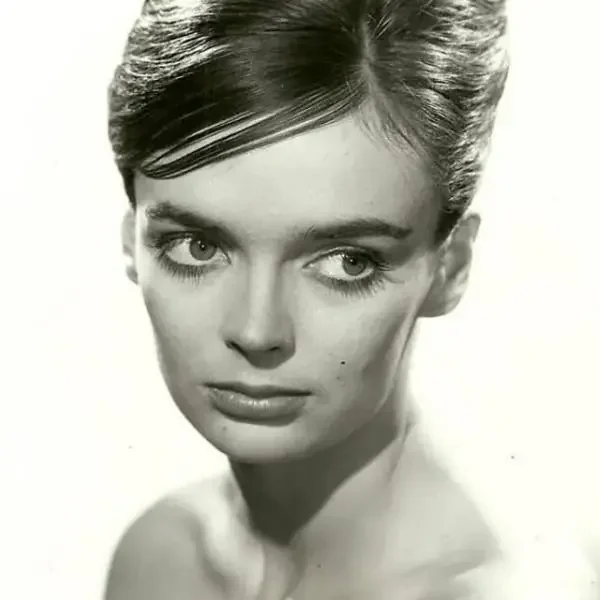
Barbara Steele
Confession: I am a fanboy collector of Raymond Durgnat’s self-published, comic-book size Motion magazine. In particular Motion #4, Companion to Violence and Sadism in the Cinema. On its cheaply printed cover, an apparition appears. Or should that be reappears? The British Board of Film Censors had decided to ban an ingenue of unsettling beauty, or rather, to ban the Italian Gothic launching her star career, Black Sunday (1960).
I won’t even attempt neutrality, a critical appreciation of the sacred image turning Raymond Durgnat’s paper bauble into my own personal Rosetta Stone. Barbara Steele meets our gaze with eyes as glassy as the camera lens, face dotted with perforations black as her pupils, so it’s like being stared at by a dozen eyes at once, windows not of any soul, but of an obsidian emptiness. Durgnat was hardly immune to those unnamable subtleties called presence.
But unlike lesser critics, he left his subject alive and well after he was done dissecting the concrete workings of its magic. That he fetishizes Steele with such spontaneity in 1963, the last year before giallo would turn Italian cinema into a decades-long death mill, now seems prescient. Again, only a fanboy would gush over a triviality like that — a mere quirk of historical timing. And yet, I take comfort from Durgnat’s own openness; susceptibility to what I’ll call a consequential wistfulness, best expressed when he writes: “There is no real horror without beauty, as Keats would have said if he could have beheld Black Sunday.”
Claims Steele herself, “I never had a decent role.”
In my own mind, she remains the ultimate wraith, howling at Italian Horror’s paper moon. Castle of Blood (1964), a worthy challenger to Black Sunday, gives her a puzzling lover to contend with, something unexpressed playing on his lips. This nigh silent movie transforms its vampiric ghosts into the very gloom that surrounds them (and us). Tendrils of Mod hypnagogia allow Steele’s Elizabeth Blackwood to draw erotic energy from Alan Foster (Georges Rivière). Where all things supernatural are concerned, he is aloof — or whistling in the dark, as the case may be. Steele’s man-eating revenant works slowly, agelessly and sometimes without ego, which separates her from the titular castle’s other undead blood-sucking fiends. Her psychic pain, that of an enlightened somnambulist gliding between two worlds, would tend to buttress Motion’s boldest pronunciamentos.
However, there is an unfair advantage to be had over Durgnat and this conceptual alliance with Keats.
In the course of a conversation about something thoroughly innocuous — miscellaneous home repair, let’s say, or weather in Los Angeles, or something equally drowsy — she’ll slide, right before you know it, into alien syntax. Suddenly we’re discussing a marriageable chair made from Van Gogh sunlight, then the hordes of damp, obese, bikini-clad horror fans that haunt the autograph shows. She’s rushing off later to an event dubbed Crypticon Seattle, or some such extraordinary thing. Why, only yesterday she archly characterized the looming trauma of the event as “moving into a Dianne Arbus weekend.”
It’s downright incongruous. Not the event, really, or even her presence at it (though when you think about it, there is that). No. It’s the whole universe summoned by the totality of this woman’s life through just a few minutes’ gab: the high culture allusions (Arbus, Van Gogh) slamming up against the sweat-soaked, panting cheapness of her destination; as if all of it laid bare particular facts concerning the last century. But then, this essential incongruity has always embraced Barbara Steele. In Europe — unlike the United States, where certain lines of division are observed more devoutly than we care to admit — the boundaries between high and low culture, art and trash, are not so much permeable as they are wholly non-existent.
If Federico Fellini, for example, could pop for the price of a dazzling cameo in Otto e Mezzo (1963), chances were that a Mario Bava or a Riccardo Freda could afford you as lead in a still-forbidding gothic chiller or, later, a candy-colored giallo. In other corners of the globe, ours for instance, a career arc like that would be viewed rather askance, a garden variety one-way journey to the skids or, worse, American-International Pictures. Barbara Steele was different. Always. She could leap like a ballerina out of Nightmare Castle and into Young Törless; or from The Ghost into L'Armata Brancaleone (1966).
Seizing medieval costume design from King Arthur’s Court and fusing it with Oskar Schlemmer’s modern geometry, the last film on this list serves as a blueprint for all but sociopathic immoderation. What does it say about us that L'Armata Brancaleone assumes, correctly, audiences would enjoy — and I do mean that the moment is joyous — watching Steele flagellate a man while being flagellated by him? Speaking strictly for myself, the scene is equal parts hilarious, erotic, foolish and pazzo (translation: “coo-coo bananas”).
In real life, she and Anthony Quinn recited poetry to each other across Topanga Canyon. Onscreen she oozes sex and sinister energy: a zealously witchy abandon that radiates from those eyes, those fingers, that voice… Over the hiss and crackle of our weak connection, she might predict my future or cast some uncanny spell on me. Minus any noticeable segue, she once declared: “Flying at night, Danielle, is like being a sperm again.”
Who talks that way? I never know what to expect. Even Barbara’s “Have a groovy day” suggests an affect that is Sixties to the point of hysteria. If I set aside her ironic sensibility for a second, and think seriously about old contradictions — her screen-image swathed in Black Sunday’s period trappings — she instantly melts through them, while miraculously leaving the mod-a-go-go psychedelic zeitgeist of all those decades ago, intact.
Italian cameramen and Steele’s face were an unexpected 1960s marriage. A brazen collision that would herald the new thespic truth that, from this moment forward, the art of acting was in how you responded to light, and how light responded to you. She materializes as a kabuki demon one moment and a radioactive waxwork the next, an almost religious transfiguration, an appeal to what Keats called negative capability – one’s ability to appreciate something without wholly understanding it; in fact, one’s ability to appreciate an object for its mystery.
That’s what her suitors get wrong in Castle of Blood. Suitors, plural, including the obligatory stable boy with great hair. They obviously never read Keats, and seek out mystery for some idiotic notion of conquest. Having it off with the help turns more complicated when a naive visitor, armed with reason, arrives at the forbidding iron gate.
Enter Georges Rivière, the mightiest of men wielding the haughtiest of demeanors. Haughtiness initiated in the womb, where something . . . anything . . . everything . . . offended his tiny sensibilities (all the more tender for being so tiny). I flash to language intoned by Barbara, incantatory words she aimed at me. They might have stopped Rivière’s Alan Foster in his arrogant and ill-fated tracks.
“You are a closet, a big closet, with intricate Elizabethan locks made of brass.
“The inside is lined with baize so that nothing can be heard, a place where Mozart rehearsals are held.”
She’s a vampire who writes imagist poetry, and whose leading man is still alive at 102.
For now, he’s busy getting lost in his own master shot —
Camera artisan Riccardo Pallottini, playing savior and tormentor, coaxes Rivière onward while punishing his progress. With ace cameramen, point-of-view becomes a more problematic concept, as when George O'Brien wanders glazed through F.W. Murnau’s swamp in Sunrise. There, the camera sometimes recedes from the hero’s advance, sometimes lets him pass and follows him, sometimes loses him altogether to rediscover him later.
Steele slips par hasard into Gothic Horror, with its sumptuous visual salad of slapdash mullioned windows and chintzy Brilliantine heroes. Does Castle of Blood’s Georges Aristide Claude Félix Rivière have a clue? Hairspray lingers throughout this legitimate evocation of monodrama, Romanticism’s stock theme, the solitary and roaming hero — think Schubert’s Winterreise or Caspar David Friedrich’s painting Wanderer Above the Sea of Fog. Imaginative audiences may even hear a reversal of male and female norms, psychological torture generally reserved for Gothic Horror’s doomed women—as if the wind were jeering. The dry ice fog, the wind machine, the spray-on cobwebs, the backlighting, and the reverberant footsteps all emerge from the same Gothic toy box (the one with the squeaky hinge), but Pallottini’s execution is exemplary, and the shamelessness total.
Barbara Steele’s origin story, since every goddess must have one, includes her first supplicants.
But more about huddled masses, seventeen million of my peasant Italian ancestors, later on…
By the Sixties new waves were crashing everywhere at such a rough-and-tumble pace that few could surf them from screen to magical screen. The frisson of La Nouvelle Vague should be appreciated within a tempest of plurality that shook Hollywood, whose producers, trained in the relative stasis of studio-system majesty, were being tossed willy-nilly on the backs of Italian, British and German breakers. And, emerging from this unpredicted deluge of international currents, spawning endlessly exploitive countercurrents, came Barbara Steele, a castaway or, as she herself puts it, “an unwilling immigrant” to the heart of Hollywood-land where she unhappily resides today.
If Steele’s personal opera, from laughter to rage and back, appeals to my “Italo-Americano” (her word) taste for the dramatic, then it also conjures the beautiful… eerie feeling that I have just reached 1960s Rome on my ancient landline. My Goddess, you see, remains a prisoner of her proudest memory, Fellini’s 8½, compared to which her horror films — The Long Hair of Death, An Angel for Satan, Terror-Creatures from the Grave — essentially amount to the gothic flop house of movie yore. I witnessed Steele’s eyes, axioms of cinema, emit pain and fury when she finally confessed to me (once and only once): “I was made for horror.”
Followed by laughter equating with a thousand stilettos pointed inward.
Nearly seventy years have passed since she played an avenging witch in Black Sunday, but no matter how stubbornly the diva refuses to claim her title as Italy’s reigning Scream Queen, the aura of dry ice and stage blood lingers in the cinematic unconscious, trailing her in gory wreaths. Before the opening credits roll, priestly authority figures intone their denunciations of the witch: their patriarchal power seems distinctly unattractive compared to the emotional display from Steele, who, unlike the rest, is acting like a proper Italian. (It’s not personal pain that matters in these moments, but the channeling of a much larger agony.) Final Impenitence finds its voice as the heavens crash around her:
“Go ahead,” she thunders, “tie me down to the stake, but you will never escape my hunger, nor that of Satan!”
Motion pictures are the original sin, a violation against the real. And Steele knows it, too. Very rarely do actors display such awareness of the implications of their craft (and its limitless) power to condition us. She rises and falls on an ethical seesaw, willfully, defiantly imperfect. The id of Irony made flesh, she is an instinctive shape-shifter who can summon a steely, almost self-parodic Vaudeville act of her own presumptive star power (Elizabeth I, by way of Norma Desmond); lashing out wildly against other women like a blind man with a pistol — the word ‘hate’ fluorescing, dancing on chapped lips into telephone dada. Steele-speech is composed of startling word-images, piled giddily on top of one another, evoking the landscape around her L.A. home — “coyotes come down the hill like perfect ghosts, walking like Nijinsky.” The Adriatic: “all wonderful two thousand year old blonde stones — breathing light — like an old cathedral — every cell in my body receives this landscape like a blind man.” Paris: “every encounter is like a little love affair… including the dogs…” Croatia: “nocturnal medieval eels, swimming in the skull-infested Roman fortress, under the full moon in the inky sea.”
In the late Eighties, she would find herself surrounded by the ghosts and barbed wire that cling to her psyche to this day. Immediately after producing Paramount’s War and Remembrance, an extremely popular mini-series, she burned every stitch of the clothing she’d worn inside the gates of Auschwitz. I was therefore unsurprised when, last week, my friend shouted: “How could such cruelty be allowed… Now?!”
Having no answers, I left her to contemplate Holocausts past and present in solitude.
Steele’s generation of bombed-out Brits witnessed presumptively adamantine laws created to seal WWII in memory, while keeping the nightmare from rising again. That Western democracies have openly declared their ghouls' burlesque in Gaza is, to her way of thinking, well, unthinkable. All the screen can offer us are references, allusions of the kind that Alain Resnais sought to distill in his 1956 indictment against genocide, Night and Fog. Steele talks compulsively about annihilation.
“I feel it on a molecular level,” she says, drawing out ‘feel’ like a linguistic tendril.
*
I was filming in Austria on Halloween night in the ancient mining town of Eisenstadt, the film Tief Oben. We had great steaming wooden vats of hot red wine for everybody to keep them going. It was arctic weather, snowing fiercely when the director suddenly asked all the extras to be naked other than their boots and the little mining lamps on their heads. Naturally they refused. At which point the director tore off his own clothes in a rage as a challenge… and was the lone white freezing body in the dark night.
In the middle of this frenzied rebellion, I decided to walk home alone. The local villagers had made little paper boats that they sent down the river set alight, a ritual of remembrance for their dead relatives…
Suddenly a dozen motorbikes came roaring by with everyone on them dressed as skeletons. They got off their bikes and started to dance around me in a circle holding hands — then they mounted their motorized steeds and took off into the night making unearthly shrieks and whistles…
I continued walking on in this medieval village surrounded by ghosts…
by Daniel Riccuito