
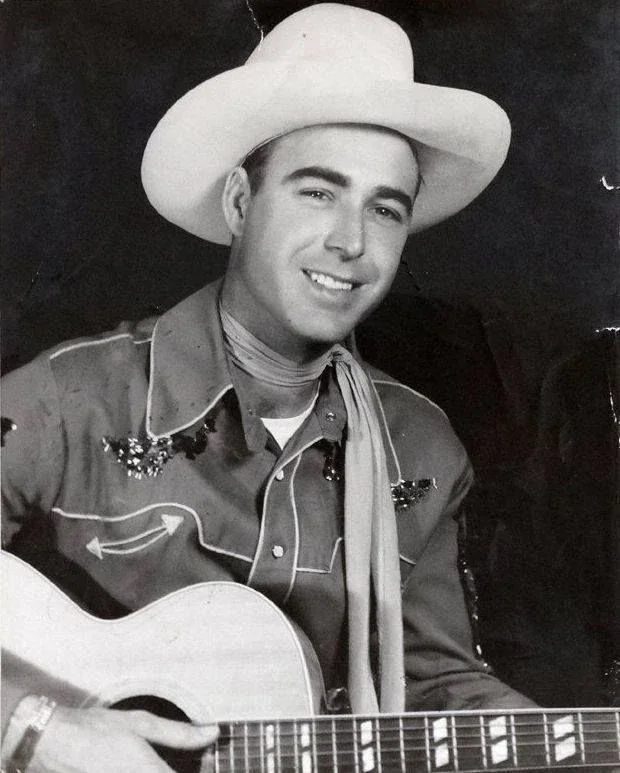
In 1953, less than a year after Hank Williams died in the back seat of a Cadillac en route to a show, his widow Billie Jean Jones married another country singer, an up-and-comer named johnny Horton. The two men couldn’t have been any more different.
Horton was a clean-cut, clean living country boy with few demons and a flair for snappy dressing. An avid hunter and fisherman since his childhood in Texas, Horton only began concentrating on music when a career as a commercial fisherman in Alaska didn’t exactly pan out. In the mid-‘40s, after winning a radio station talent contest in Texas, he picked himself up a more Western-style wardrobe, moved to Pasadena, and in 1949 found regular work as both a guest performer and backup musician on a local country music TV show, Hometown Jamboree.
According to one source Horton, dubbed “The Singing Fisherman,” was so popular the station gave him his own half-hour show on Saturday nights in which between songs he would, yes, display his casting technique and offer fishing tips. It seems pretty remarkable considering he had yet to record a single song, and however much I would like to believe such a show actually existed, I can find no evidence of this.
Anyway, in the early ’50s, Horton moved from Pasadena to Shreveport, Louisiana. The hunting and fishing were better in Louisiana than they had been in Pasadena. That was first and foremost. But second, Shreveport was home to the highly influential Louisiana Hayride radio show. Everyone who was anyone in country music appeared on the Hayride, and a few years down the line the show would give Elvis his first national exposure.
Horton began recording his own songs and touring little venues around the area, though not much came of it. His first wife left him, preferring Los Angeles to Louisiana, and he soon took up with Jones, whose dead husband had been a regular on the Hayride. Jones still had plenty of connections in the business, firmly believed in her new husband’s career, and by 1955 Horton himself would become a show regular. Not long afterward he made his debut at The Grand Ole Opry, and in 1956 he had his first minor hit with the Hank Williams-inspired Honky Tonk Man.
The problem was, on his own there was nothing spectacular or terribly memorable about Horton. He could sing well, sliding from an easy tenor into a sharp growl and yodel, and he was a decent musician with a solid backup band, but the same thing could have been said about a thousand other up and comers in Nashville at the time.
Then, as if by accident, Horton stumbled into something in 1958, after “When It’s Springtime in Alaska (It’s 40 Below” became his first number one hit. The first-person song, about a prospector who falls for a saloon singer, runs afoul of her fiancee, and gets killed as a result was clearly deeply inspired by Marty Robbins’ Western ballads, which were extremely popular at the time. The hook, however, seemed to be in moving the action from the mythical Old West to Alaska during the gold rush. Although the historical setting had taken on nearly as mythical an air, it had yet to be so savagely plundered and exploited as the settling of the West.
Over the next two years Horton would have a string of hits which, often marked by martial drumming and a stridently strummed banjo, offered up sketches of moments and figures from American history not often celebrated in musical terms.
So of course there was “The Battle of New Orleans,” in which the British were portrayed as a bunch of cowardly ponces sent scurrying by Col. Jackson’s ragtag army of farmers armed with squirrel rifles. While obviously hearkening back to his first hit, “North to Alaska” (commissioned for the John Wayne film of the same name) focused on the actual men who made the first big gold strike in 1892. Despite everything he’d said about them in his New Orleans song, “Sink the Bismarck” turned around and celebrated the heroic efforts of the British Navy (and the Allies in general) to track down and destroy the most powerful battleship of WWII. And “Johnny Freedom” was an all-encompassing anthem hailing the jack-of-all-trades American Spirit throughout history, citing the soldiers at Valley Forge, Daniel Boone, Lincoln, and Yankee Doodle.
It was of course a neat and highly successful populist trick. In his “Saga Songs” as he called them, Horton turned on its head what folk singers like Woody Guthrie had been doing for some time. While the folkies tended to concentrate on the underdogs, the downtrodden, the forgotten heroes from forgotten moments in history, Horton sang with the decided and unquestionable voice of the victor, perpetuating the standard American mythology culled straight from any 8th grade history textbook and dumbed down even further. Circumstances, counterpoints, any underlying ulterior motives are simply not an issue. All that matters is that we won. Even his hit “Johnny Reb,” at heart an encouragement to appreciate and admire those fallen Confederate soldiers who never gave up the fight does so by citing Lincoln’s own (after the fact) respect for Southern tenacity and idealism. It seems an odd and cynical move, if you think about it, coming from a Texas/Louisiana native. It was all a whitewash, a bolstering of the fundamental and prevailing power structures, and people ate it up, accepting the songs as a kind of catchy, toe-tapping historical record. I even had a history teacher in 6th grade use Horton’s “Battle of New Orleans” to explain to us what happened.
It should however be noted that two of Horton’s Saga Songs don’t follow the standard and cynical American Mythology pattern, and in fact feel more like traditional folk songs. Interestingly, both concern the Battle of Little Big Horn.
In “Jim Bridger,” Horton recounts the legend of the illiterate mountain man who was on friendly terms with most of the Indian tribes of the West, had the deepest respect for them, and often acted as a negotiator between the Indians and the US government. As the story goes, Bridger urged Custer to treat the Indians fairly and decently, but Custer was an asshole about it. Despite being legendary and, yes, nearly mythical in his day, and despite Horton’s plea that we never forget him, Bridger has long since faded from the cultural memory, likely because Disney never gave him the Daniel Boone/Davy Crockett treatment. More importantly, in the long run he failed miserably.
In “Comanche,” Horton is not singing about the tribe, but rather Custer’s horse, whom he argues was the only true hero among the American forces that day. Not like that asshole Custer. Neither song did very well.
1960 was a mighty fine year for Horton. He was riding high with several hits on the charts, was making dozens of TV appearances, he’d done that song for the John Wayne movie, and was reportedly anxious to make the leap into movie acting himself. Then at the height of Horton’s popularity as the nation’s favorite historian, Hank Williams got his revenge.
On the night of Friday, November 4th, Horton played a show at the Skyline Club in Austin, Texas. It may be apocryphal, but it’s said that Horton, who didn’t drink, told someone backstage that he didn’t want to go near the club’s bar out of fear that if he did he’d be killed by a drunk driver that night.
I’m not sure if Horton ever went near the bar or not, but after the show he piled into his car with his manager and his bass player for the long drive back to Louisiana. He was anxious to get home that night because duck season opened the next day and he had two hunting buddies waiting for him.
It was all but inevitable that a drunk driver would come swerving out of the fog and slam head-on into Horton’s car, killing him instantly.
Strange thing is, Hank Williams had played his own last show at the Skyline Club before dying in a car eight years earlier. Now with Horton’s death, 28-year-old Billie Jean Jones had been widowed for the second time.
In the years following Horton’s death his influence, brief as it was, continued to be felt as other Saga Songs touting an equally questionable understanding of history (like “The Ballad of the Green Berets”) went on to become huge hits.
by Jim Knipfel