
Constance Collier: A Book Full of Clippings
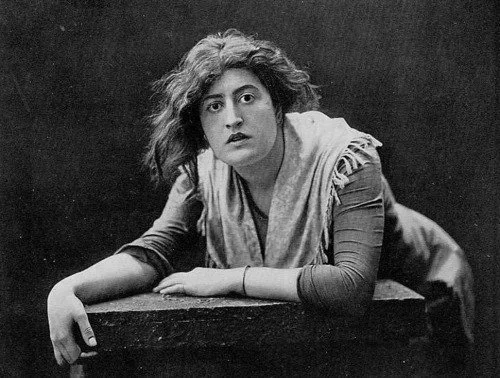
“Oh, oh, oh, hang the tradition of the theater!” cries Katharine Hepburn as Terry Randall in Stage Door (1937). She’s refusing to go on stage because of a colleague’s suicide, and so her drama coach Miss Luther, played by Constance Collier, has to tell her that the show must go on. Collier herself was an exemplar of the theater, so much so that writer-director Joseph Mankiewicz appropriated her theater debut as a fairy in a production of A Midsummer Night’s Dream as the first theater appearance of his theater diva Margo Channing (Bette Davis) in All About Eve (1950). Collier first found her niche in Hollywood as a vocal coach to silent stars hoping to make a transition into sound, and she was a tough and thorough taskmaster. Colleen Moore reported that when she trained with Collier that they would only work on one word at a time, and theater star Eva Le Gallienne called her “a ruthlessly honest teacher.”
As a young woman, the towering Collier was a Gaiety Girl at The Gaiety Theatre in London, but she made her name and reputation as the star actress in the company of Herbert Beerbohm Tree. In her late 20s, in 1906, she gave what many felt was her finest performance in Shakespeare’s Antony and Cleopatra, and the surviving photos show a woman of formidable regality, a real queen in silver robes holding a golden scepter with a golden calf headpiece finishing the royal effect. She toured with Tree for many years, excelling especially as Viola and Olivia in Twelfth Night and Portia in The Merchant of Venice, and they appeared as extras in D.W. Griffith’s Intolerance (1916) and did a few silent films, including a version of Macbeth that was not well received. Her one marriage, to an actor suggestively named Julian L’Estrange, ended when he died during the influenza epidemic of 1918.
Collier easily made the transition to older roles in the theater, having a smash hit as a woman trying to hold on to her kept boy in W. Somerset Maugham’s Our Betters, and hewing to her Shakespearean background by playing Gertrude to John Barrymore’s era-defining Hamlet. In the early 1930s, she created the role of Carlotta on stage in Dinner at Eight, a role that went to Marie Dressler in the film version, and then gradually she started to do character parts for film.
Collier’s Miss Luther in Stage Door is first seen knitting in a chair by the main staircase of The Footlights Club, looking on as two girls get into a fight over a pair of stockings. “Are you running a theatrical boarding house or a gymnasium?” Miss Luther asks manager Mrs. Orcutt (Elizabeth Dunne). There are ropes of beads dripping down off of her sturdy frame, which looks like a couch that first needed re-upholstering twenty years ago. Miss Luther sits in that spot so that she can waylay any new girl who comes in; she is desperately in need of money and is ever ready to offer her services as a drama coach.
When Hepburn’s obviously rich Terry enters the house, Miss Luther rises to the occasion in her grandest manner, sidling up to Terry and asking Mrs. Orcutt if “the Guild” called. “I couldn’t consider playing it, it’s far too trivial, I couldn’t consider…” she trills, then stops dead to look at Terry. “How do you do?” she asks, in a wolfish descending inflection. Collier’s voice is both fluting and gravelly, and she uses her hands in the old theatrical manner, palms up and fingers ready to spring out to emphasize her points.
Miss Luther and Terry survey one of the features of The Footlights Club, the chair Sarah Bernhardt sat in when she played Queen Elizabeth in New York, and when Terry says, “They say she was wonderful,” Miss Luther responds with, “Oh yes, she was very good, very good in some things,” and this really is an intricate line reading by Collier. She conveys that Miss Luther is respectful of Bernhardt and she doesn’t at all emphasize the “some things” at the end of the line, but she still manages to get across the fact that Miss Luther is criticizing certain Bernhardt performances, out of either professional jealousy or closely considered opinion, by letting the words just trail off. As Terry walks away from her up the stairs, Miss Luther cries, “If I don’t get the right play soon, I may do a little coaching…myself,” and this is another dizzyingly colorful line reading, because Collier builds the line all the way to the top of the stairs with Terry vocally to the word “soon,” and then goes back down vocally until “myself” is a vulnerable vocal up-down afterthought, accompanied by a very desperate look.
Miss Luther is a seedy lady, or a lady who has gone to seed, and she was never at the level of Collier herself in her prime. After dinner, after Terry has bored the other girls with talk about Twelfth Night, Miss Luther encourages her and then says, “I’ve a few of my notices here if you’d care to see them,” in a gentle, hopeful voice. She finds reviews of her performance in Twelfth Night and says, “Oh how lucky, they’re right on top,” in that same shy, girlish tone. If Collier had wanted to get a bigger laugh, she could have said this line in a way that underlined Miss Luther’s duplicity and ego, but instead she chooses to play the reality of the moment, the vulnerability. The best Miss Luther can do for Terry is a review from Atlantic City, but she seems particularly proud of this notice.
The other girls at The Footlights Club are given to sneering at Miss Luther, and she’s no saint. When Terry is having trouble in rehearsals for a play, Collier uses that same girlish tone of expectancy when she shamelessly asks the producer, “Could you possibly see an older woman in the part?” This is a huge laugh line, and after Collier says it the camera pulls back from Miss Luther and she goes slightly out of focus. The film abandons her here, but Collier is visibly saying something to herself in the wake of this fresh rejection. I’m not sure what she’s saying. I’m not a lip reader. But it seems to be something to buck herself up. For a life in the theater, you can never give up hope, even if hope is sometimes indistinguishable from delusion.
“It is only after we have suffered that we can make the audience feel with us,” Miss Luther says to Terry, after the girl has gone on and given a star-making performance. This is archetypal acting teacher talk, and Collier herself will always be most remembered as Miss Luther and as a coach and mentor to Hepburn as she embarked on Shakespearean roles on stage in the 1950s. Collier enjoyed a juicy part in Mitchell Leisen’s Kitty (1945) as a drunken fallen aristocrat who teaches Paulette Goddard how to be a lady, and she also brought some comic relief to Hitchcock’s heavy Rope (1948), with its demanding ten-minute takes. Toward the end of her life, Collier even did a bit of coaching of Marilyn Monroe, saying afterward that only a camera could capture Monroe’s special qualities.
Collier in her few films sometimes indicates emotions for the second balcony, and we cannot know what it would have been like to see and hear her Cleopatra or her Viola, but her work lived on in the quality of Hepburn’s best later performances. She represents a theatrical tradition that has long since vanished, with her starry, head-up smiles, her rolled “r’s,” her facility with theatrical “business” with fans or cigarettes or even napkins. And as Miss Luther in Stage Door, Collier gives a major performance that draws on aspects of her own position as star-turned-coach but also moves in that imaginative territory that is the hallmark of all truly well-rounded acting.
by Dan Callahan