
Jean Butler
For those of The Chiseler’s readers who’ve forgotten or don’t know, Clifford Odets and John Garfield – both many years dead now – had been subpoenaed to appear in Washington, DC before the House Committee on Un-American Activities in the early 1950s to answer a now familiar barrage of questions about their political affiliations and such of their acquaintances as might have held similar beliefs. They responded in significantly disparate ways – decisions that reconfigured their lives from that point on.
John Garfield’s friends, including my parents Jean and Hugo Butler, called him Julie. It could have been the company he kept that caught the eye of the Committee. His wife and my mother may have partnered in a bit of recruiting for leftwing causes, but Julie always said he’d never been a pinko.
His firstborn daughter was a playmate of mine; we called her Lolly though that wasn’t her name. That would’ve been 1945. She’d show up at our house on Franklin Avenue, a grown-up six or seven with freckles and curls and, in the language of the times, a sucker in her mouth: a lollipop. But then her visits stopped. She’d had an allergic reaction to something, I was told. She was dead.
A few years later – we were living in the Hollywood Hills by then – my father invited me to join him in our ’46 Chevy for a drive to an industrial neighborhood where “He Ran All the Way” was being shot. He introduced me to Jimmy Howe; there was a discussion with my sister’s friend Jan Berry’s dad, but of the actors I saw nothing until a few months later, when my parents took me to what they called a preview. Lolly’s father was okay in it, I thought, but looking at Shelley Winters made me feel good all over.
By this time The Hollywood Ten, as they were known, had been convicted for Contempt of Congress and were serving time in various prisons. In HUAC’s ongoing hearings the Committee heard a trendy Hollywood dentist include my father in a list of clients the dentist presumed to be Reds. It was inevitable, my father knew, that the Committee would include him in one of its follow-up netfuls of Un-Americans and that the FBI would soon be knocking on our door with a subpoena.
My sisters and I knew nothing of this; we were sorry when the house in the hills was sold and we moved to a rented place on North Serrano. Soon Hugo was no longer around, not that Susan, Mary and I were aware of it: only Jean knew that he was lying low in the safety of various friendly colleagues’ homes. One evening two FBI agents did in fact knock on the door, and asked to see Hugo when Jean opened it. An actress since the age of nineteen – her career had segued from “It’s a Gift” to “One Man’s Family” – she staunched her tears with a handkerchief and told them that she and Hugo had “had a disagreement” and he’d left. She didn’t know where he was, she said, and didn’t know when she’d see him again.
She reached him by phone minutes later at Musso’s. “Get on your horse,” she told him. “No shit,” he said, the moment come at last. His credits at this point included “Lassie Come Home”, “Young Tom Edison”, “A Christmas Carol”, “Edison the Man”, and Renoir’s “The Southerner”.
They’d planned for this, and Hugo returned to the Serrano house that weekend with a gleaming black ’41 Cadillac. Jean had done the necessary packing and with essential luggage and our cat in the car, we left Los Angeles. Trumbo (none of his friends called him Dalton), having been released from prison, sold his ranch in the Lockwood Valley and our families met up in Ensenada, a three-vehicle caravan, arriving in the crystalline air of Mexico City late in 1951.
A small community of leftwing expats had already established itself there and soon we were part of it. It may have been a long-distance call from Ring, in May of ’52, in which Jean and Hugo learned that Julie had died. They knew he’d been subpoenaed, faced the Committee and incriminated no one; it was the stresses of that confrontation, they believed, that killed him – possibly exacerbated by the fact that the studios slammed the door on him at once. I never met David, his son. Only his second daughter, an actress, survives. Her name is Julie.
And Clifford Odets? I may have read “Waiting for Lefty” at sixteen in Mexico while laid up with hepatitis, and though I never met him either I was later close to a couple of people who knew him well: both actors in Richard Boone’s Repertory Theatre series. Clifford was its in-house dramatist and story editor; they spoke of him with fondness and awe. This was twelve or thirteen years after his HUAC testimony, in which context Jim Knipfel writes in his Chiseler article “The Golden Boys”, “In fairness, it must be said that he only named people who’d been named by previous witnesses.” That’s fairness, and gallantry too, but it may be the only homage our exiguous band would ever have granted him.
In the insecurity of my parents’ life throughout their years of exile and the blacklist, harboring as I did the knowledge that up north in the States there lived (I’m guessing) twenty million stone McCarthyites who wouldn’t’ve scrupled to round us up – progressives (pinkos), closet socialists, repentant Stalinists and bitter Trotskyists, all five remaining communists – and shoot us dead, in that reality a friendly witness was a friendly witness, and stoolies would always be the lowest of the low.
Unable to reconcile the opposing forces that informed my early life I found a false security in hypervigilance and isolation; I was intellectually stuck, emotionally shut down. It was probably obvious to everyone I knew, including Jean and Hugo Butler. Then – it may have been the summer of 1956 (first-run American movies took a while to show up in Mexico) I went with a couple of friends to one of the downtown cines and saw “East of Eden”. Calling it a game changer hardly does it justice. In James Dean’s incarnation of Cal Trask I felt his struggle with the friction of opposing forces, felt his pain on the path through grief and desolation, felt his joy and glory in the hour of his victory. That was the half of it anyway. The other half, the engine that produced what I felt, was the consensual, almost violent fusion of actor and director in the sacrament of authenticity. This was the root of their power and their gift.
It wasn’t lost on me that the director was Elia Kazan, whose brooding eminence was rooted in the theater – in the Method – and who, in his 1952 appearance before the Committee, had named names.
What I couldn’t have imagined was that my first job in the movie world would find me on the set of his “America, America.” But that’s a story for another time.
No heroes.
So said Trumbo, the inextinguishable prophet of the Hollywood Ten, on his receipt in 1970 of the Writers Guild’s Laurel Award for lifetime achievement as a screenwriter (“Spartacus”, “Exodus”, “Papillon”, “The Brave One”, “Roman Holiday” and others) – twenty-two years after doing time in Leavenworth. His crime? Asserting his First Amendment rights in declining to answer Yes or No to the questions put to him by the House Committee for Un-American Activities. Excerpted from a longer talk, his words were these: “When you who were in your forties or younger look back on that dark time with curiosity, as I think occasionally you should, it will do no good to search for villains or heroes or saints or devils because there were none; there were only victims.”
Not everyone who’d been blacklisted agreed. The high moral ground, they felt, wasn’t Trumbo’s to claim. He seemed to be forgiving informers and inquisitors alike. Any number of men and women whose names were forever linked to leftwing causes, courtesy of witnesses compliant with the Committee, had never drawn an unpatriotic breath and found themselves abruptly unemployed and unemployable. Not just movie people. Educators, government officials, labor organizers, scientists (viz. C. Nolan’s “Oppenheimer”).
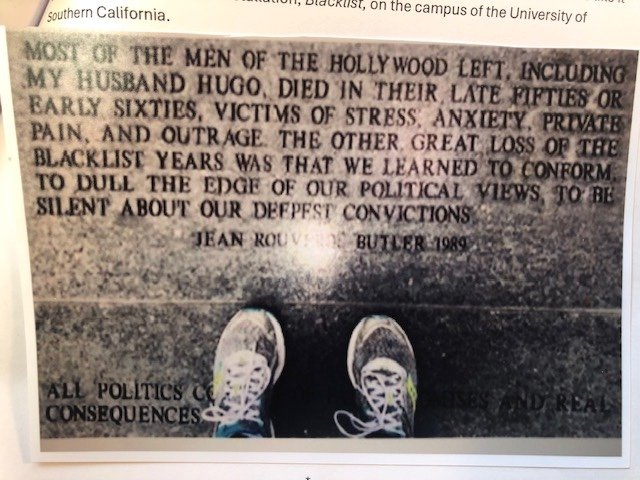
Here below is my mother’s summation. It’s written in stone. You’ll find it and others like it in Jenny Holzer’s public art installation, Blacklist, on the campus of the University of Southern California.
By Michael Butler
Dedicated to the memory of Lolly Garfield