
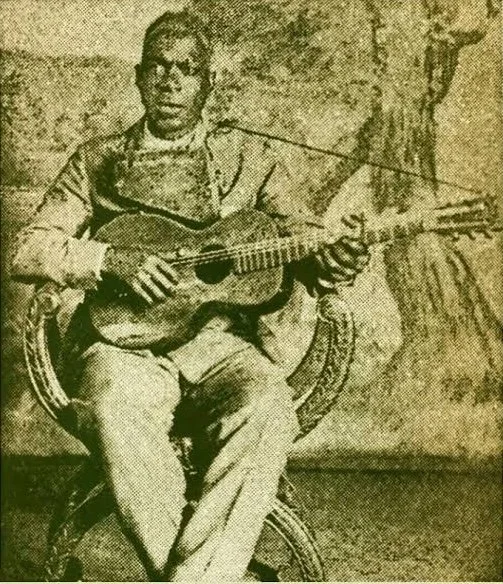
Henry Thomas
In 1949, Mack McCormick, a blues historian and Smithsonian advisor, claimed to have seen musician and singer Henry Thomas on the street in Houston. Thomas would have been about 75 years old at the time. The disheveled character, McCormick said, stood six-foot-three, just like Thomas, and was wearing several layers of clothes. He mentioned nothing about the tall stranger singing or even carrying a guitar, but he was pretty sure it was Thomas anyway.
McCormick may have been right, even if his supporting evidence was a bit flimsy. Most blues historians, with even less evidence than McCormick, dismiss the claim, insisting instead Thomas died in 1930 at around age 55. They don’t clarify how or why it was they agreed on that particular year, but it was enough for them to band together and pooh-pooh McCormick’s silly assertion that Thomas was still ambling around Texas nearly twenty years later.
To be honest, nobody really knows for sure where Thomas went or what he did after 1929, so why not just claim he died right around then and be done with it? But by the same token nobody really knows all that much about what he did prior to 1927, either. Whenever he died, Henrty Thomas left behind plenty of open space for idle speculation and unfounded conclusions, given nearly nothing at all was known about him. We don’t even know all that much about that two-year span between 1927 and 1929 except he recorded two dozen songs for Vocalion Records in Chicago, and those songs remain pretty much the only solid evidence we have Thomas ever existed at all.
What we do know is this:
Henry Thomas was born in 1874 in Big Sandy, Texas, the son of freed slaves. By the time he was in his teens he’d become a hobo, treaveling the country in boxcars, though mostly concentrating on the routes covered by the Texas & Pacific Railroad. Although he had no fixed address, he came to be known to the people who lived in the towns served by the T & P line.
Years later, the residents of those towns remembered Thomas as a friendly, gregarious sort, though they don’t recall much else. One thing that did come out was that Thomas seemed to enjoy a good spectacle. In1893, he bragged about a recent visit he’d made to the Columbian Exposition in Chicago. A decade later in 1903, he again bragged about hopping a train to Missouri to see the St, Louis World’s Fair first hand.
That, literally, is all we know today about Thomas first thirty years, as recounted in Nick Tosches’ 1977 book Country: The Twisted Roots of Rock’n’Roll, assorted histories of American blues, and The Handbook of Texas. Another quarter-century of silence would follow that visit to St. Louis.
Then in 1927, a 53-year-old Thomas hopped another train and headed for Chicago. When he passed back through the towns along the Texas & Pacific line some time later, he told people he just recorded some records up there.
It wasn’t that far-fetched a boast. Some historians have speculated—but again only speculated—that during his wanderings Thomas earned a little money as an itinerant street musician, singing old songs while accompanying himself on guitar and a set of hand-carved bamboo pan pipes known as quills.
Sure enough, a few weeks after Thomas was boasting about his new career, his records began appearing in Texas music stores.
According to the files kept by Vocalion Records, in late June of 1927, Thomas recorded his first songs for them, his take on “John Henry,” which was released with “Cotton Field Blues.” In total he would record twenty-four songs for Vocalion, of which all but one were released, sometimes under the misleading name “Ragtime Texas.”
The popular blues of the time—like Bessie Smith, say—had taken a number of cues from jazz. The recordings were well orchestrated and sophisticated, with singers backed by large ensembles. In contrast Tomas, with nothing but his high, rasping voice, his guitar and his quills, was rough and raw. It was unpolished and untamed street music carried over from the 19th century. Some have argued that what we’re hearing in Thomas’ songs may well represent the earliest form of the blues ever captured on a recording. Listening to him, the unsophisticated simplicity of these songs, it’s hard to escape the notion that what you’re hearing is the primal core of something, a kind of proto blues that would eventually evolve into Leadbelly and Howlin’ Wolf. It’s been noted that the basic lyrical structure of songs like “Red River Blues” is quite different from what would later come to be thought of as basic blues structure. Before being replaced by the harmonica as a standard instrument in blues, folk and country, the quills as a popular accompanying instrument could be traced back to the 1700s in America, and earlier than that in South America and the Caribbean. And his simple rhythmic guitar playing, which some speculate was adapted from banjo picking, would later go on to become a style unto itself dubbed Texas Blues.
Some critics have referred to Tomas as a gospel singer, but I have no idea where they’re coming up with that one. Yes, at times Thomas primitive blues—occasionally accentuated by whoops and foot stomps, can remind me of Blind willie Johnson, though without the religious material. Instead of salvation and a vengeful God, Thomas sticks to more earthly themes: trains, fishing, work, gambling, love, hate and domestic troubles. And more trains, sometimes using the quills to provide sound effects. The spiritual may sneak in there now and again, but generally keeps a low profile.
Another interesting thing about Thomas is that nearly a decade before Bob Wills and nearly three decades before Elvis, he was a performer in whom black and white music came together. A number of the songs he recorded—“John Henry,” “Casey Jones,” etc.—had previously been performed by white artists, though it’s feasible to consider (and this is my own cheap speculation here) that he included those songs in his repertoire simply to appeal to his white audiences among the townsfolk and railroad employees he entertained.
After vocalion released the last of Thomas’ recordings (“Charmin’ Betsy” b/w “Lovin’ Babe,” recorded on October 7th, 1929), he vanished and was never heard from again. Maybe he died as the experts claim, or maybe he opted for another railroad line and ended up in Florida. I don’t know, and neither does anyone else.
In 1952, Harry Smith included two Thomas tracks on his seminal Anthology of American Folk Music collection, and a decade later in 1962 someone gathered together all of Thomas’ extant recordings and released them to a new audience as Henry Thomas Sings The Texas Blues. The timing was very good.
Just as Thomas had performed songs previously recorded by white artists, in the exploding folk scene of the early Sixties, white artists would turn around and record their own versions of Thomas originals. The first of whom, not surprisingly, was Bob Dylan, who despite changing the title slightly recorded his version of Thomas “Honey, Won’t You Allow Me one More Chance?” Dylan was later followed by The lovin’ Spoonmful, The Nitty Gritty Dirt Band, Canned Heat and The Grateful Dead, among others, all of whom found something worth plundering in Thomas’ limited musical catalog.
It leaves me wondering. As popular (if under the radar) as Thomas has become among those interested in authentic American blues, where are all his royalties going?
by Jim Knipfel