
While living in Brooklyn’s Park Slope neighborhood in the 1920s, Henry Miller quit his job at Western Union and surrounded himself with all the trappings he felt were necessary to become a great writer. In the second-floor parlor of his Sixth Avenue brownstone, he had a roll-top desk, a sheaf of blank paper, several sharpened pencils, and a bunch of chairs surrounding the desk where all his other writer friends would sit as they discussed literature. He also had a supportive (if crazy) taxi dancer of a wife in the form of June Smith, and no day Job to distract him from his more important work. Unfortunately, for all the trappings, he never found the spark he so desperately wanted to capture, and his early stabs at fiction were stale, clunky, and kind of embarrassing.
He fled from Brooklyn to Paris in 1930, and there among the whores, the cafes, the lights, the artists, the starvation and crappy jobs, he finally did find his voice. He published Tropic of Cancer with Obelisk Press in 1934, and soon followed it with other Obelisk titles like Tropic of Capricorn, Black Spring, and Quiet Days in Clichy. Tropic of Cancer had made Miller an overnight literary sensation throughout Europe, though of course it and all the other Obelisk titles, having been declared obscene, were promptly banned in the United States.
Twenty-seven years after its initial publication, in 1961 Tropic of Cancer was finally published in America by Grove Press. Still banned at the time, the publication led to a fierce Supreme Court battle which eventually ended with the lifting of the ban not only on Cancer, but his other Obelisk titles as well. When at long last Miller’s more controversial works were legally published in the States in 1965, they held the top five spots on the NY Times bestseller list. Miller, then in his early seventies, immediately earned a reputation as the country’s most famous and notorious dirty old man of letters.
(As an ironic aside, Grove Press’s Barney Rosset once told me Miller was opposed to lifting the ban on his work, as he kinda liked his stature as a literary outlaw. Lift the ban, he said, and he’d not only become mainstream, his books would be taught in college courses, a thought which mortified him.)
That’s the famous part of the story. People tend to forget that beginning in the late Thirties, Miller published any number of wholly legitimate and wholly legal books in the U.S., most notably under the auspices of New Directions. But essay collections, character sketches and travelogues like The Cosmological Eye (1939) and The Wisdom of the Heart (1941), free as they were of sex and naughty language, went almost completely ignored by readers and critics alike. Who the hell wanted to read Miller writing about art, spirituality or a bunch of painters and literary types no one had ever heard of? That the number of non-obscene works far outweighed the dirty, filthy ones was irrelevant, and remains so to this day. When people talk about Miller today, they’re rarely talking about Stand Still Like the Hummingbird or The Books in My Life.
Now, in the latter half of the Thirties, Miller began traveling around Europe, landing for a spell in Greece, which inspired his glorious The Colossus of Maroussi (released in the States in 1941 by New Directions). But in 1940 Miller reluctantly left Greece and sailed West, having decided to write a book about America.
He wanted to take a look around and see first hand what the nation of his birth had become. He had no intention of staying, figuring he would only be in the States a few months before escaping elsewhere again. The plan was to take a cross-country road trip, keeping a diary of his observations and impressions and thoughts as he went.
To this end, after landing in New York he conscripted his friend, painter Abe Rattner (a fellow expatriate who’d only recently returned to New York), to join him. Initially, Miller envisioned the final product as a lavish art book, with his prose illustrated by Rattner’s watercolors, but that, like so much else about the trip, didn’t quite pan out.
Considering neither man knew how to drive, the first order of business was to take a few driving lessons and buy a cheap used car. The two then set out with a jerk, following an unplanned, peripatetic route from New York, to Chicago, through the South and across the Southwest before ending up in Southern California.
Rattner abandoned the adventure after only a few weeks, opting instead to stay with friends in New Orleans. Miller, forging on alone, would remain on the road for close to a year.
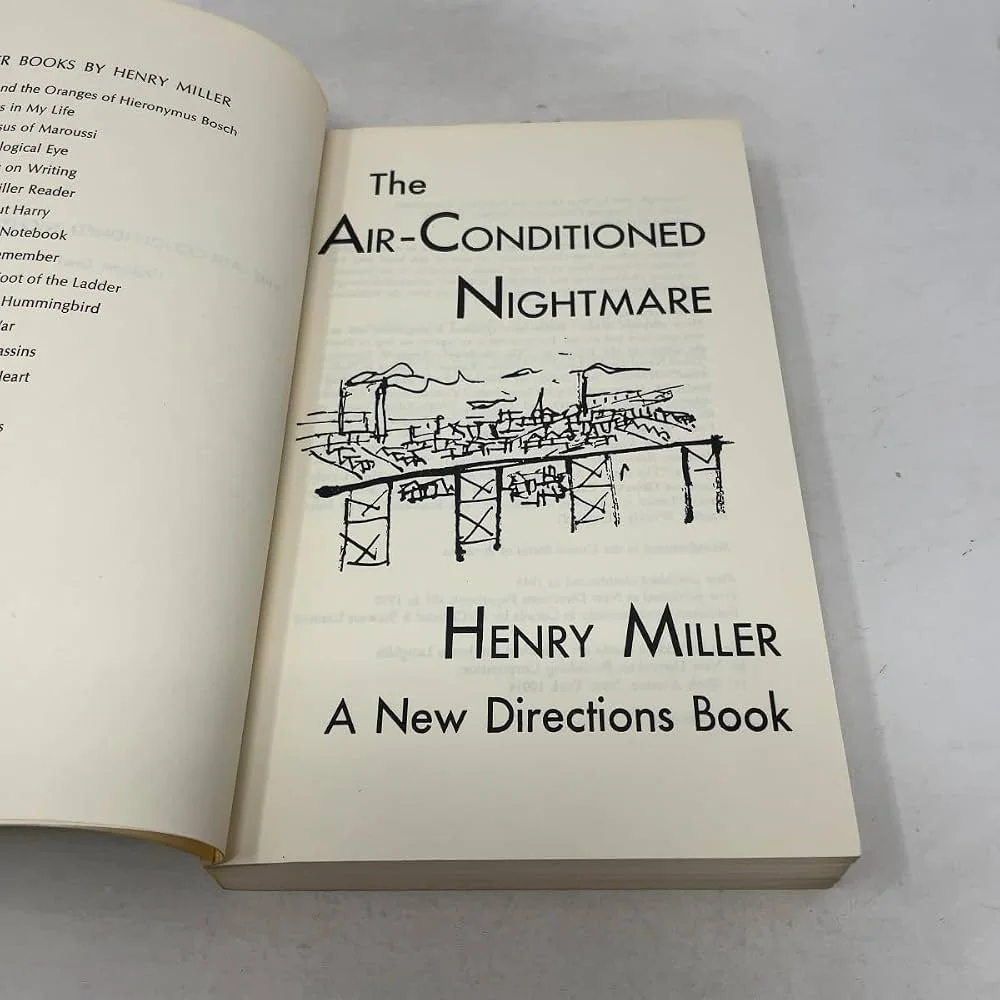
The resulting book, The Air-Conditioned Nightmare, was completed in 1941 (an addendum to Miller’s preface notes the attack on Pearl Harbor), but wouldn’t be published until the war had ended, perhaps for obvious reasons.
Nightmare remains one of the stranger entries among his New Directions titles, an extended essay/road diary/meditation which, while employing any number of familiar themes and tropes from his other works, remains as peripatetic as his journey itself, with no solid center and no consistent tone or attitude. As someone who never left New York during the three decades he lived in America, Miller here takes on the role of an expatriate seeing his home country for the first time, approaching it with suspicious, alien eyes and a number of pre-conceived notions. As the journey progresses, he drifts from rage and contempt for everything he encounters in the Northeast and Midwest, to admiration, respect, even boundless enthusiasm and joy as he moves further south and west. But his mood swings are abrupt and unpredictable.
[NOTE: However much I would like to include a few lengthy excerpts to illustrate assorted points or highlight his brilliant and seismic prose, I’m blind, had to have my computer read me an eBook edition of the book this time around, and still haven’t figured out how to cut and paste passages from an eBook. So fuck you—just go read the goddamn thing yourself. Thank you.]
Despite loving, rough-edged portraits of the Brooklyn of his childhood in Black Spring and other works, returning to New York as a man in his forties, and one who’s been away for nearly a decade, the city has suddenly become the worst place in the world. The New York he sees in 1940 is akin to the New York Maxim Gorky saw two decades earlier, and, like Gorky, it launches him into a rant about the degenerate, corrupt, and downright imbecilic nature of America as a whole. Remember that to Miller, New York was all he knew of America, and as a result, New York was America. He rails against the flag, patriotism, pointless ideological differences both political and religious, the gulf between the rich and the poor, the primitive state of race relations, the insanity of warfare and the attitude citizens and politicians alike take toward immigrants. The rant rolls on for the first thirty pages of Air-Conditioned Nightmare, which leaves the book’s opening chapters both exhilarating in their continued relevance, and dispiriting when you recognize that nearly eighty years later not a goddamn thing has changed.
An encounter with an ex-con working as a railroad porter leads to an extended celebration of the nature of crime, and while Miller contemplates the slums of Chicago, his thoughts reflexively wander back to the comparatively charming slums of Paris. It’s a psychic lurch that occurs throughout the book, and he can’t seem to help himself. While encountering something for the first time in the homeland he fled, he can’t help but compare it with a similar situation, or atmosphere, or character from his adopted and true home in France.
In that, and several other things, there are a number of (very deliberate parallels here between Miller and Louis-Ferdinand Celine, one of Miller’s literary idols. Celine recounts a similarly phantasmmagoric visit to America in his debut novel, 1932’s Journey to the End of the Night. But while Celine is a nihilist who saw all the same ugliness Miller does here, he merely accepts it as a given, with no hope of salvation or redemption. Humans, to Celine, are disgusting and stupid animals who’ve turned the world into a cesspool which only grows deeper and more filthy by the day. Miller, in contrast, is an anarchist and reluctant humanist. While just as horrified by the factories and the slums, he still holds out hope that one day the poor and downtrodden of the world would come together, set aside their differences, and ignite a revolution to snatch the power away from the wealthy buzzards who’d been feeding on them for centuries.
When Miller and Rattner cross the Mason-Dixon Line, two things happen,. A certain hypocrisy at the heart of Miller’s humanism begins to reveal itself, and the nature of the book changes.
While Miller loves and appreciates indoor plumbing, he finds the idea of a clean toilet an affront, a symbol of the empty bourgeois materialism that so dominates American consciousness. Still, he believes everyone should have a toilet. For all his raging in the book’s early pages about the evils of racism, he adores the remnants of the Confederacy in the Deep South. He loves the old plantations and the people, who tend to be far more charming, easygoing and creative than their staid, rational and scientific counterparts to the North. And for all his celebrations of the poor, the common folk and blue collar workers, he seems uncomfortable in their presence, observing them the same way he would the camels and giraffes in the zoo. He finds them interesting (as in the case of that ex-con porter), but in the end does not have the language to communicate with them. At the same time, he despises the wealthy, but if they turn out to be at all eccentric or creative, all is forgiven.
And that reveals a fundamental and often contradictory dichotomy within Miller: after declaring himself an artist upon his arrival in Paris in 1930, he divided humanity into two categories—those who were artists and those who weren’t. If you’re poor and struggling but not an artist, he may have sympathy for your plight, but only in very general philosophical terms. He likely won’t care much about you personally. If, however, you’re rich and you paint well, he’ll sing your praises endlessly. It’s telling that even while starving and struggling himself in Paris, he spent far more time among the rich than the poor. Yes, a lot of it involved mooching, but that’s beside the point. The rich tended to be more educated, cultured and well-read, so he could at least communicate with them.
The further he travels through the American South and West, the more artists and eccentrics he encounters, the more his enthusiasm for the country grows, and the structure of the book shifts from a travelogue and running critique of America to a collection of character sketches of America’s unsung painters, composers, visionaries and kooks.
We get chapters about a friend of Rattner’s—a charming and erudite oddball who lives on an elaborate and gorgeous family estate in Louisiana, a skilled surgeon who’s also a respected painter, an unheralded avantgarde composer, a visionary who had dreams of building an enormous pyramid which would contain documentation showing generations thousands, even tens of thousands of years in the future just how the American empire collapsed, and yes, an auto mechanic whose innate understanding of cars deeply impressed Miller, even if he understood little of what the man was saying.
In the final chapters of the book Miller again returns to road diary format as he spends several days around the Grand Canyon before pushing on to California. But following his exultation at the grandeur of the canyon, his bile again rises to levels close to where it was when he first set out from New York.
He never makes it clear exactly how this came about, but on his first night in Los Angeles, he finds himself invited to a drunken dinner party in a Hollywood mansion attended by a bunch of obnoxious millionaires. They are neither eccentric, wise, or charming as some of the other wealthy types he’d met along the way had been, and so he again finds himself wholly unable to communicate, looking at them again like creatures in a zoo. As an expatriate, artist, and literary outlaw, he is completely alienated in the midst of what so many might consider the embodiment of the American Dream, right? What screams “America” more than a millionaire party at a Hollywood mansion?
In a final darkly ironic contradiction, Miller’s contempt turns to bitterness as he closes The Air-Conditioned Nightmare abruptly by explaining he’d been turned down for a Guggenheim Fellowship to fund the project, followed by a list of the (clearly banal and silly) people who had received Guggenheims in 1941.
While some Miller scholars have argued his deep disdain for the United States likely arose from the fact the government had banned his most famous works, I think a much more likely explanation can be seen in the final pages here. Namely that in the wealthiest nation on earth, no one was willing to send him a whopping check.
In what was perhaps the biggest irony of all, a year before his frontal assault on America was published, Miller—who had insisted from the start the cross country trip would only be a temporary detour before he returned to the much more amenable artistic climate in Europe—settled in Big Sur, California. He would remain in California for the rest of his life.
by Jim Knipfel