
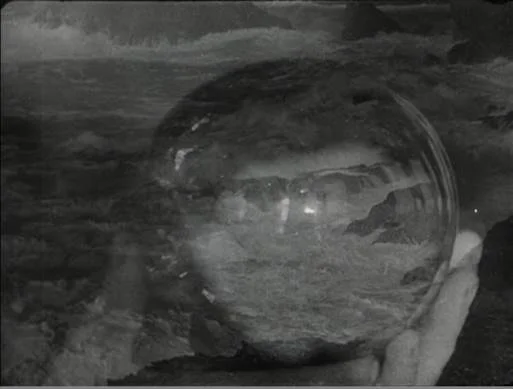
Le Tempestaire (1947) is almost enough to shake my devout atheism. Is this a film, an experiment in sonic plasticity, a séance, or some elaborate form of dialectical math — one plus one equals three? Full disclosure: painters, who speak monosyllabic caveman lingo to describe the dynamic force-field-like tension of the picture plane, raised me. Add a “blue” to a “red” and you may get “space.” “Push and pull,” the muscular rhythms resulting from colors that vie for spatial dominance. And Jean Epstein’s penultimate film mirrors the same painterly axiom of sublimated emotion; only here, the dialectic involves sonic and visual elements. Twinned movements. The sea heaves in slow motion. Throwing off well-spoken shrieks. An instrument more alive than the Theremin matches octave for brooding octave my growing apprehension as nature’s working parts are isolated and reshuffled. Everything — sound, image, time itself — decelerates. (Think E.J. Marey brought into a fully cinematic register of experience, without pause or rupture and complete with synchronous, fully dissected hubbub.) Until the grammar, syntax, and disputations of a cresting wave become movie stars. Who knows why this soundtrack qualifies as something far greater than anguished dramaturgy? The results are easier to grasp formally than ‘spiritually’.
Le Tempestaire doesn’t merely resemble an undulating graveyard — or evoke metaphorical lost souls wailing in the storm. Epstein’s plastic means are so perfectly allied that formalism itself buckles. As the music troubles the imagery and the imagery brakes to a nigh standstill, we suddenly find ourselves engulfed by spirits.