
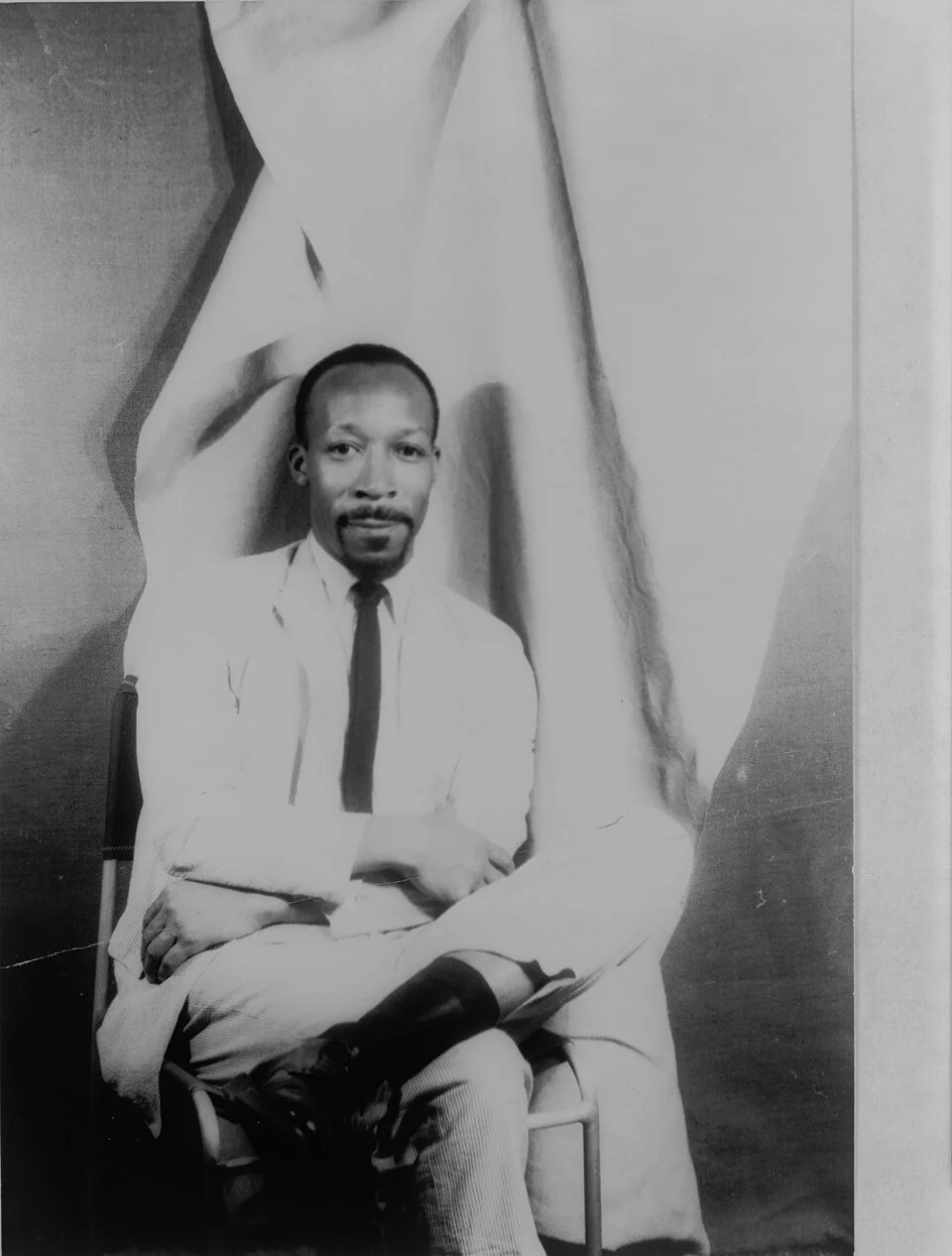
John A. Williams was born in Jackson, Mississippi in 1925, though when he was still quite young his family relocated to Syracuse, NY. He would remain in the Northeast for the rest of his life, moving to New York City after college, then to Teaneck, NJ, in 1975 where he felt the atmosphere would be a bit more tolerant of his interracial marriage. As an African-American journalist and novelist documenting the black experience in white America, he would hit the bestseller charts and win the National Book Award twice—first in 1983 for Click Song and again in 1998 for Safari West. Yet despite his status within the African-American literary community at the time, Williams (who died in 2015) is sadly forgotten today, save for the legacy of six pages which continue to reverberate, even though few would ever connect them to Williams.
Williams published his Third novel in 1967. The Man who Cried I Am was at once a thinly veiled account of his friend and fellow novelist Richard Wright’s final days, a far reaching overview of the black experience in America and elsewhere since the Thirties, and a bitter railing against what he perceived to be the failures of the Civil Rights movement.
Williams, not surprisingly considering he’d grown up in mid-20th century America, had experienced his share of racism both direct and subtle. He was nearly beaten to death by white sailors while serving in the Navy during WWII, and several years later had a prestigious literary award mysteriously evaporate at the last minute after what the New Yorker’s Merve Emre termed “a racially charged meeting” with the chair of the foundation handing out the prize.
Fed up both with the veiled smiling racism of white liberals as well as the tendency for blacks in the literary community and the Civil rights movement to adopt those same liberal principles, Williams used the novel to pull what might be called a prank or a hoax, but which nevertheless struck a deep chord at the time and took on a life of its own.
In the final chapters of The Man Who Cried I Am, Harry Ames, his Wright doppelgänger, an expatriate living in Europe and dying of colon cancer, comes into possession of several pages of a classified intelligence document. Carefully mimicking the format and style of official internal federal memos and reports, the King Alfred Plan, as it was called, details a series of proposed measures to round up the nation’s entire black population in the event of a widespread racial uprising. After being forced into concentration camps around the country, tens of millions of Black American men, women and children would then either be exterminated or deported to Africa.
There were of course several historical precedents for the idea, from the Palmer Raids in the Thirties, to the internment of Japanese citizens during WWII, to the McCarran Act of the Fifties, a contingency plan to round up and imprison the nation’s radicals and communists in the event of a national emergency, to the FBI’s close surveillance of America’s Black militant movement of the Sixties.
Taking a look around the country, it didn’t strike Williams as that far-fetched an idea to believe the government would have such a plan on the books as it stood. Urban blacks had already been corralled and concentrated into ghettoes as it was, so camps weren’t that big a leap. Yes it was paranoid, but given his experience and the experiences of millions of other black Americans, it was a paranoia that was wholly justified.
As Williams and his editor worked through early drafts of the novel, his editor encouraged him to make The King Alfred Plan as believable as possible,, and in the end the six pages reproduced in the novel from the supposed classified dossier included memos from the Secretary of Defense and the chair of the National Security Council, as well as a Department of the Interior map detailing where the concentration camps would be established.
As the book’s publisher, Little, Brown, began preparing a marketing campaign in the months before release, Williams, who had a background in marketing himself, approached them with a few ideas of his own. He suggested they isolate those six pages of supposed government documents and simply send those around to reviewers, bookstores, even foreign embassies without any context at all, and absolutely no hint the pages were part of an upcoming work of fiction.
Removing all references to the book’s title, author, publisher, or even any indication they were from a forthcoming novel seems a counterintuitive way to create buzz and pre-sell copies of a soon-to-be-released book, but Williams had a point to make.
It’s unclear how many of Williams’ suggestions were followed through by Little, Brown’s marketing department, but it was Williams himself who dealt the coup-de-grace. Sending the context-free excerpt to bookstores and critics would likely just confuse them. If you wanted to make an impact and spread the word, the trick was bringing it directly to the people. He had a hundred mimeographed copies of The King Alfred Plan made up, and began leaving them on the subway, particularly around New York’s black neighborhoods.
During that summer of 1967, the country was on fire as it was, with violent race riots erupting in major cities from coast to coast. Those people who came across the “misplaced” document had no trouble at all accepting it as true, and word quickly spread throughout not only the black militant underground, but the community as a whole. There had long been that simmering suspicion the cops and the white racist government wanted to wipe them out once and for all, and now here was the proof.
Here’s the interesting thing. As so often happens with conspiracy theories, especially those derived from fictional sources like sci fi movies, as The King Alfred Plan was circulated around the country both by hand and word of mouth, it continued to evolve, with people along the way making additions and improvements to Williams’ original text to increase the sense of veracity. Specific names and places were dropped in, together with a few official-sounding intelligence department acronyms. Someone even took it upon him or herself to rework that supposed Interior Department map, making it much more detailed and specific. Still others, referring to the Plan, began looking into other things, like the designs of inner city ghettoes, which seemed to reflect the urban planner’s goal to make it as easy as possible for the military to round up the inhabitants when the order came down. The Plan was read aloud at radical meetings, discussed on the radio and reprinted in underground newspapers. No one doubted it was the real thing, and Williams never stepped forward to set the record straight.
It’s not surprising, then, that years after The Man Who Cried I Am was published, after it hit the bestseller lists, after it went through six printings, and after it was mostly forgotten, The King Alfred Plan was still taken at face value within certain circles. Gil-Scott Heron recorded a song which accepts the plan as truth, several black activists testifying before Congress in 1970 made reference to it apparently without being aware of Williams’ novel and, after hearing repeated references to it during their ongoing surveillance of politicized black groups, the FBI was forced to undertake their own investigation into whether or not it was real.
I’m absolutely convinced Williams knew exactly what he had unleashed, and toward the end of the novel, Ames reads the plan over the phone to a thinly-veiled Malcolm X, urging him to call for immediate revolution. You have to wonder, after all he’d seen and experienced, if Williams himself wasn’t hoping the dissemination of that “classified dossier” might actually finally spark a race war in the streets of America.
That of course never transpired, but the cruel irony of it all is that after the more recent riots in L.A., Baltimore and elsewhere. After the spotlight was placed on the epidemic of cops gunning down unarmed black kids, after the rise of Black Lives Matter, and after the renewed demonization of anyone who isn’t white among the acolytes of the present administration, if something like the King Alfred Plan didn’t exist when Williams first imagined it, it does now.
by Jim Knipfel