
Nobody
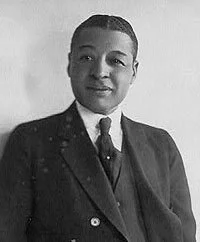
“Nobody” was first sung 110 years ago, and it’s still one of the best American pop songs ever made. It’s been recorded numerous times by artists ranging from Nina Simone to Johnny Cash to the Four Lads to the Muppets. But nobody has ever sung “Nobody” quite as well as its co-writer, the great Broadway and vaudeville comedian Bert Williams.
Born in the Caribbean in 1875 to an Afro-Caribbean mother and an Afro-Dutch father, Williams moved to New York and then California with his family as a boy. He teamed up there with George Walker; they did blackface song and dance routines in minstrel shows, medicine shows and vaudeville, billing themselves as “The Two Real Coons.” Black performers were generally required to wear the blackface at the time. Some, like Williams, accepted it as part of the job; others, including Walker, hated it. As they developed their act, Walker, who was slight and graceful, became the natty, cakewalking dandy to Williams’ shuffling sadsack clown.
After working their way around the vaudeville circuits for several years they hit Broadway in 1898 in the cast of Clorindy, or, the Origin of the Cakewalk, the first Broadway musical revue entirely written and performed by black artists. Composer Will Marion Cook was Oberlin-trained and had studied in Europe under Dvorak. He later recalled that on hearing Clorindy songs like “Who Dat Say Chicken in Dis Crowd,” his mother, an Oberlin graduate herself, cried, “Oh Will! Will! I’ve sent you all over the world to study and become a great musician, and you return such a nigger!” Jesse A. Shipp, who wrote the book, had toured with minstrel shows in his youth. Paul Laurence Dunbar, the first black American poet to gain national acclaim, contributed lyrics. Williams and Walker were featured in the cast, but the star of the show was Ernest Hogan, the black performer and composer who had kicked off the fad for “coon songs” with his 1890 “All Coons Look Alike to Me.”
The American psychosis about race has never been more schizophrenic than at that point (although current events offer some deplorable parallels). On the one hand, race relations were reaching a post-Civil War nadir. Jim Crow and segregation laws enforced an American apartheid. Lynchings of blacks were at their historical peak. The Klan and white “nativist” groups were spreading hatred not only of blacks but of Catholics, Jews, immigrants of all types, leftists, suffragists and unionists. Immensely popularly coon songs, written and performed by both blacks and whites, reduced their black characters to a small set of repulsively racist signifiers.
At the same time, it was the dawn of a golden age for black singers, dancers, comics, playwrights and composers. Whites who refused to eat with blacks in restaurants or let them sleep in the same hotels went crazy for ragtime and jazz, clamored to learn the Charleston and the Black Bottom, and flocked to all-black shows on Broadway.
The team behind Clorindy went on to create several more revues, including In Dahomey, which premiered on Broadway in 1903 and toured for several years, with command performances for Edward VII in London. They followed that in 1906 with Abyssinia. It was less successful both creatively and at the box office, but it launched “Nobody.”
Williams wrote the music, his frequent songwriting and performance collaborator Alex Rogers the lyrics. Like many great pop songs, “Nobody” is deceptively simple on the surface, emotionally rich underneath. Structurally it just alternates four-line verses and a four-line chorus, over and over. The verses are spoken over a nondescript orchestral stroll. They’re a litany of woe:
When life seems full of clouds and rain
And I am full of nothin’ and pain
Who soothes my thumpin’, bumpin’ brain?
Nobody.
When winter comes with snow and sleet
And me with hunger and cold feet
Who says, “Here’s twenty-five cents, go ahead and eat”?
Nobody.
One time when things was lookin’ bright
I started to whittle on a stick one night
Who cried out, “Stop now, that’s dynamite”?
Not a soul.
And so on. A clownishly lachrymose trombone announces the chorus, which is where things get more complex. Sung to a tootling fife, the words turn from comically melancholic to surprisingly bitter:
I ain’t never done nothin’ to nobody
I ain’t never got nothin’ from nobody, no time
So until I get something from somebody, sometime
I’ll never do nothin’ for nobody, no time
Performed with care for its subtleties, “Nobody” is both funny and sad, doleful yet defiant. However, few performers have proven up to the challenge of tricking out these delicacies. Although Williams gave it its stage debut in 1906, “Nobody” was actually first recorded the year prior by a white man, the baritone Arthur Collins. Prolific and popular in his day, Collins was billed as the King of Ragtime. He specialized in coon songs and other ethnic stylizations that tickled audiences then but sound vulgar and utterly unfunny now. He also sang the first or early recordings of standards like “Meet Me in St. Louis,” “Bill Bailey, Won’t You Please Come Home,” “Any Rags,” “Hello Ma Baby,” and Harry Von Tilzer’s “I Love My Wife, But Oh You Kid!” He steamrollers over “Nobody” as though it were just another coon song, crushing every humane nuance under his broadly stereotyped “Negro” delivery.
After George Walker suffered a stroke, Williams went on to an illustrious solo career. In the mid-1910s he starred in Ziegfeld’s Follies, with casts that also featured W. C. Fields, Will Rogers, Fanny Brice, and a young Eddie Cantor in blackface playing Bert’s son. Audiences kept demanding “Nobody” right up until he collapsed on stage in 1922 and died at only 46.
Williams recorded “Nobody” more than once. His best version can be found on the excellent Archeophone compilation Stomp and Swerve. http://www.archeophone.com/product_info.php?products_id=38 It’s a genius performance. It’s probably going too far to call the song his anthem. He performed a lot of wonderful songs and well-loved routines in his career. Still, it’s hard not to believe the song’s miserably resentful loser must have haunted him – and that his relationship to the character is what makes “Nobody” so powerful in his performance, when other singers have often treated it as merely an amusing novelty. He was one of the most successful, highest paid, most widely admired performers of his time. But off-stage, even with his light skin and Caribbean birth, he was just another Negro. “Few Americans, especially those of African, Asian or native origin, dared hope for a life as blessed as Bert Williams’,” Frank Cullen writes in the encyclopedic Vaudeville Old & New. And yet “the gain of fame and fortune… does not trump the daily reminders of second-class citizenship or a deep-seated melancholia.” When not performing he was quiet and held himself at some distance. His small circle of friends included a few white drinking buddies like Ring Lardner, Buster Keaton’s dad Joe, and Fields. He was the star of the Follies, but couldn’t join Actors Equity until Fields forced the issue.
Fields famously said that Bert Williams was the funniest man he ever met, and the saddest. He put both sides into “Nobody,” and after more than a century it can still make you laugh and want to cry.
by John Strausbaugh