
The Heart of New York
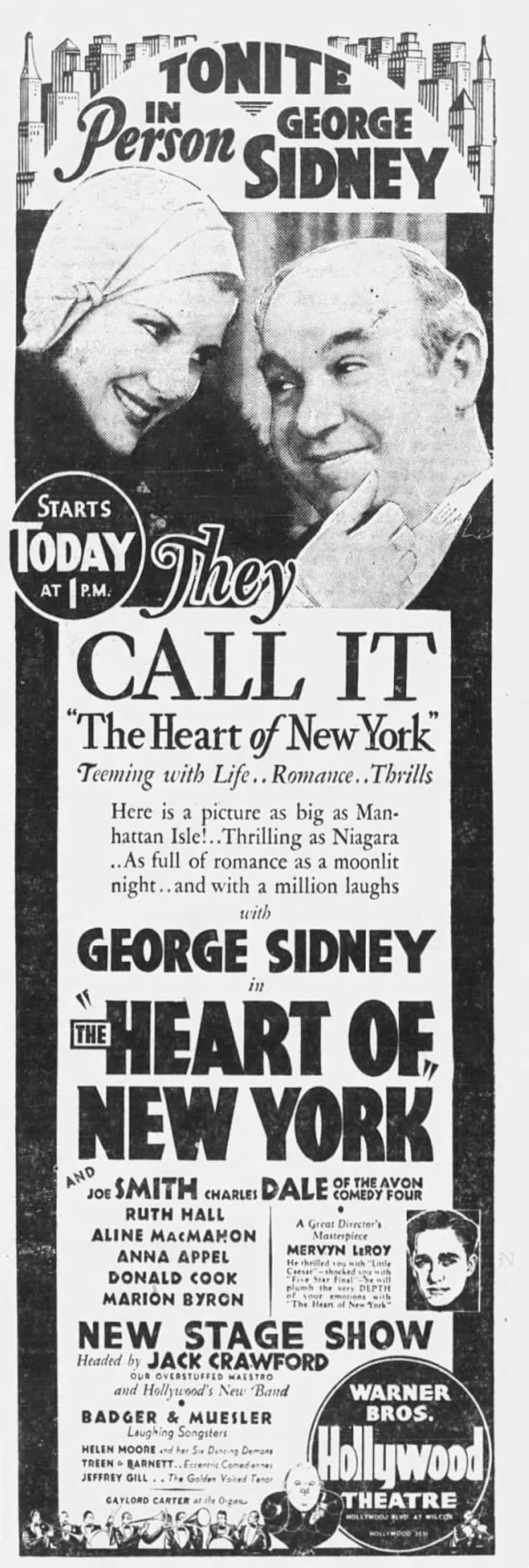
The Heart of New York, a 1932 Warner Bros. comedy about the Jewish Lower East Side, sometimes shows up on TCM. It’s worth a look. It was adapted from a play, Mendel, Inc., that had a successful run on Broadway in 1929 and 1930. Except for the pointedly deracinated title, the movie preserves the story’s essential Jewishness.
Playwright David Freedman grew up on the Lower East Side, where his father wrote for the Yiddish newspapers. As an adult David wrote poetry, gags for Eddie Cantor’s radio show, sketches for several Broadway musicals and revues, and a series of stories about a Lower East Side character, Mendel Marantz, that he compiled into his hit play. Piling success on success, Freedman moved off the Lower East Side to the magnificent Beresford apartment building on the Upper West Side. Sadly, he died of a heart attack there while still in his thirties.
Mendel Marantz’s story comes straight out of New York Yiddish theater, and takes place in an entirely Jewish universe. The characters all speak, act and gesture in ways immediately identifiable as Jewish to 1930s audiences, but they’re not caricatures or stereotypes, just exaggerated and broadly played for sympathetic laughs. Mendel is a poor plumber on the Lower East Side, a dreamer who’s always ducking the landlord. Because his wife Zelda makes him help with the dishes, lazy Mendel invents an automatic dishwasher. It make him suddenly, impossibly wealthy. Now he can afford to be truly lazy, paying other people to do all his chores for him – including hiring guys to play tennis and polo for him.
But in classic Yiddish theater mode, Mendel finds that instead of buying him happiness, his new wealth only causes problems. Zelda and the kids want to move uptown and live among the swells, but Mendel wants to stay on the Lower East Side. It’s his world, and he knows he’d never feel comfortable among the hoity-toity, mostly German Jews uptown. He buys their tenement building and fixes it up. The wife and kids kick him out, his partner in the dishwasher business tries to cheat him. It all comes out all right in the end, with everyone learning that love and family are more important than money – more basic Yiddish theater.
Mervyn LeRoy (Little Caesar, I Am a Fugitive from a Chain Gang, The Wizard of Oz, The Bad Seed) directed the film. Most of the cast is Jewish actors, but not all; for example, Aline MacMahon, in only the second of her many movies, displays sturdy stage-Jewish skills in a key supporting role as the next-door neighbor.
George Sidney plays Mendel. Born Sammy Greenfeld in Hungary and raised from childhood on the Lower East Side, he specialized in playing lovable nudniks on stage and in film, from the 1915 silent short Bizzy Izzy, a character he invented, through the Cohens and Kellys series of comedies – The Cohens and Kellys in Atlantic City, The Cohens and Kellys in Africa, The Cohens and Kellys in Trouble, etc. – from 1926 to 1933.
The comedy duo Smith & Dale steal every scene of the film they’re in as Sam Shtrudel and Bernard Schnaps, a pair of schlemiels whom they had played to great acclaim in the stage version. Legend has it that they first met in the 1890s as a couple of kids on the Lower East Side, Joe Sultzer and Charlie Marks, when they ran into each other on rented bikes. It led to a life-long partnership. After doing some blackface and busking in Broadway saloons, they got their first break at the Palace, a beer garden at East Thirteen Street and Third Avenue. Without telling them, Joe’s older brother, who booked the Palace, had given them the stage names Smith & Dale, which stuck.
They went on to a very long and successful career doing schtick in vaudeville, on Broadway and in Hollywood. They were guests many times on Ed Sullivan’s show in the 1950s, and were still occasionally performing right up to Charlie’s death, at the age of 90, in 1971. Smith died a decade later and had himself buried beside his lifelong pal, with a single tombstone that boasts SMITH & DALE – BOOKED SOLID.
by John Strausbaugh