
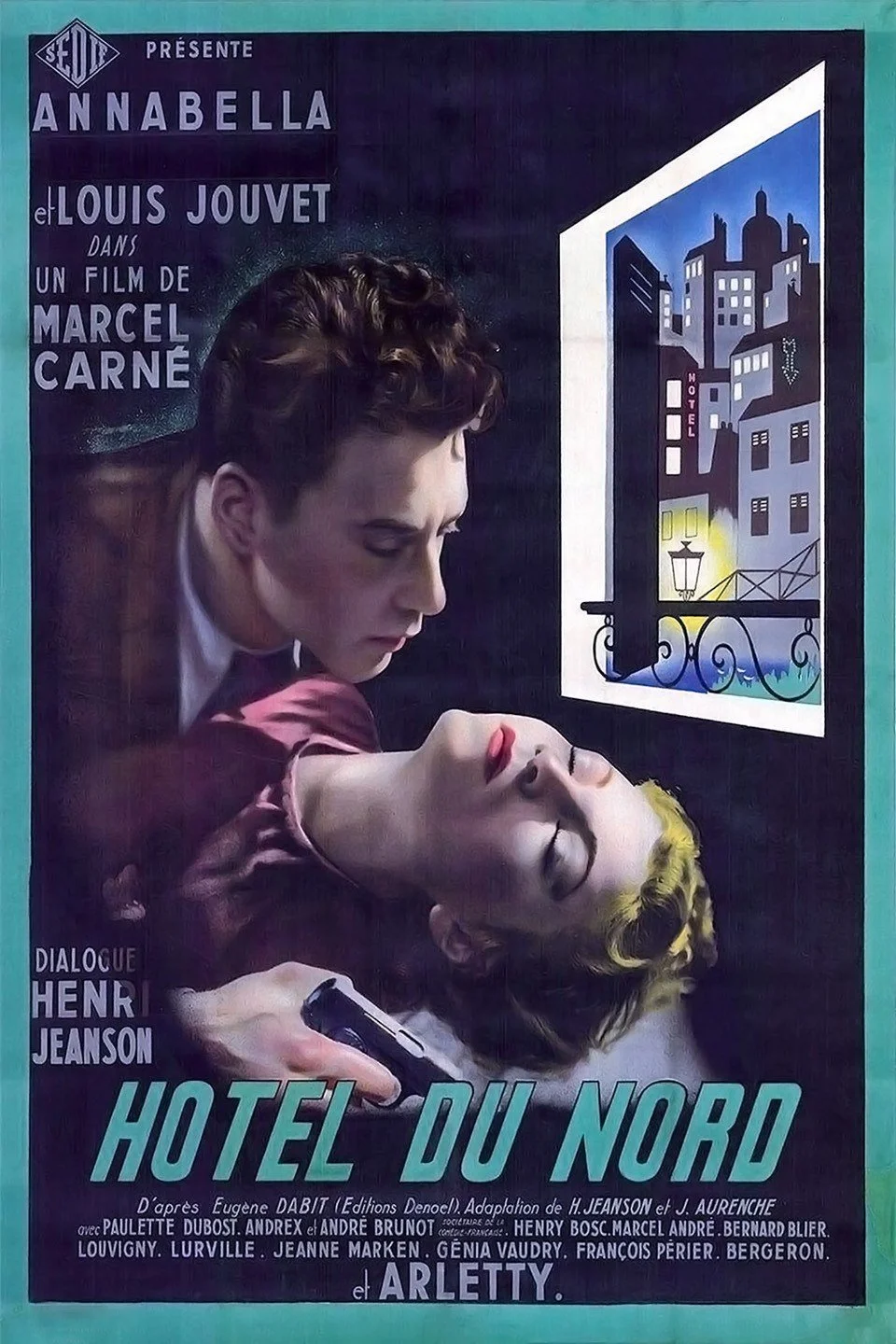
The credits of Hotel du Nord ripple on moving water; images of circulation and fluid connection flow through the film. It is set on the banks of the Canal St. Martin in Paris—not a river like those that run through Renoir’s work, but a quiet backwater, a workaday artery that offers passage and movement but not escape or purification. In the film’s opening scene, guests at a dinner party talk about blood transfusions, a subject brought up by Prosper (Bernard Blier), an overweight and comically self-serious man who picks up extra money by selling his blood. One woman says she would be disgusted by the thought of her blood in someone else’s body, while another retorts that blood is blood. With heavy irony, a third person objects that the topic is inappropriate conversation for a First Communion celebration. The communion hints at something no one in the film ever quite achieves: transformation.
The characters in Hotel du Nord (1938), all residents of the eponymous boarding house, are frustrated dreamers in cramped, confining quarters. But their lives and identities have fluidity and mutability; despite their tendencies toward suicide and romantic passivity, they’re not automatons of fate. Neither are they independent agents or authors of their own lives. They just muddle along.
At the center of the film lies a bungled double suicide. While the First Communion party grows livelier, a morose young couple, Pierre and Renée (Jean-Pierre Aumont and Annabella), check into the hotel intending to die together. Pallidly beautiful, they lie on the bed in an ecstasy of morbid romanticism, imagining their deaths as a honeymoon trip, an escape to freedom, a crossing over to “the other side.” Throughout the film, characters dream of travel and departure, but never go anywhere. The prostitute Raymonde (Arletty) says that the happiest day of her life was when she “embarked” on a boat ride on the Seine. Later, when she and her lover Edmond (Louis Jouvet) are packing for a trip to Toulouse, she tells the maid in lavish detail about the pleasures of traveling with Edmond—then reveals that she’s never been anywhere with him. Much later, Edmond travels to Marseilles with Renée, who survived the botched suicide attempt, and as they plan to take a boat to Port Saïd, she repeats the speech about escape and crossing over that her lover made before shooting her.
Pierre, a self-confessed coward, loses his nerve after shooting Renée, and believing that he’s killed her, flees the hotel. Despite his shame and self-loathing, he can’t bring himself to leap off a railway bridge either, and he turns himself in to the police. (The bridge scene, with its tangle of rails shining in the dark and steam from a locomotive engulfing the thwarted jumper, is a template for similar scenes in Act of Violence and Night has a Thousand Eyes.) Renée is surprisingly ready to forgive his failures, pointing out sensibly that it is easier to be shot than to shoot yourself. It’s Pierre who can’t live down the incident, telling her through the wire mesh of the prison visiting room that “It takes two to forget.”
Renée returns to the Hotel du Nord as a maid, and is pursued by Edmond, the film’s most complex and mysterious character. At first he seems sinister and repellent: a selfishly fastidious man who abuses (and lives off) his long-suffering girlfriend; sleeps with a plain, simple-minded chambermaid; and sadistically kills chickens, dogs, and rats. But he tells Renée that his identity is a disguise to evade vengeful criminal associates from his past. He has made himself over as the opposite of his former self, a slovenly, guitar-playing bohemian who was afraid of blood. With Renée, he proves unexpectedly decent and gentle; in the end, after she has abandoned him to return to Pierre, he commits suicide by disregarding a warning about the enemies waiting to ambush him. Raymonde complains earlier than Renée has “infected” Edmond with her suicidal mania—another image of transfusion and fatal intimacy. Raymonde, for her part, winds up with the worshipful Prosper, who gave his blood to save Renée. The film comes full circle with another celebration, this time a street dance for Bastille Day—commemorating a mass escape from prison. The revelers perform a communal dance in which they circulate and kiss one another, while Edmond meets his death upstairs. “Life goes on,” and a graceful crane shot mirroring the one that opened the film follows Pierre and Renée as they take their leave of the neighborhood, walking along the canal.
If Hotel du Nord has a lighter tone and less fatalistic outlook than other poetic realist films by Marcel Carné, this is probably because the script is not by Carné’s most famous collaborator, Jacques Prévert, but by Henri Jeanson. I saw the film with a French friend, who kept laughing when I couldn’t see anything funny in the subtitles: he told me afterwards that the dialogue is filled with salty old Parisian slang. The film’s most famous lines poke fun at the lofty way people talk in other poetic realist works. “I need a change of atmosphere,” Edmond tells Raymonde, “And my atmosphere is you.”
“Atmosphere? At-mos-PHERE?” she snaps back, Arletty’s working-class skepticism making each syllable as hard as cobblestone. “Do I look like an atmosphere?”
by Imogen Sara Smith