
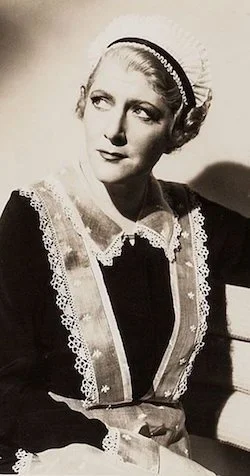
Thirties films had a unique sympathy with the older woman. Films today barely represent the menopausal or post-menopausal at all, and if they do, it’s in the form of a few stars who are usually holding the aging process back by any means possible.
But the forty-something woman was invaluable in old movies, as the voice of skeptical experience. Older men were frequently buffoonish goats of the Guy Kibbee persuasion, probably because that was obviously more amusing than towing the patriarchal line. But older women could snipe from the sidelines, seeing through the lies of leading men and the folly of women who love them.
Like Jean Dixon, perennial romantic-cynic with her putty face alive with eyes that have seen it all and a smile that forgives without forgetting. It’s startling that she made so few films (13 in a career of just 9 years), her presence is so indelible, whether as Joan Crawford’s prostitute pal in Sadie McKee, maid to William Powell’s butler in My Man Godfrey, or best pal in most of the rest (which include Cukor’s matchless Holiday and the criminally underrated Swing High, Swing Low).
Dixon yearns after Powell, and seems far more deserving of him than Carole Lombard, but My Man Godfrey has all kinds of romance and cynicism mixed up together: it’s a dream of happiness and a redemption of capitalism from the Depression, but it’s commercially-minded enough to know that the two leads must end up wed, and yet canny enough to leave us feeling a little uneasy about this.
In Swing High, Swing Low, Dixon actually marries Charles Butterworth, world’s limpest schnook, a guy usually brought in to woo the heroine insipidly and make the hero look good by contrast. That Dixon settles for him, quite aware of his shortcomings, speaks volumes about her place in the movie universe and also her tolerant, world-weary awareness of it.
Maybe this soft-centered cynic seemed omnipresent because Ruth Donnelly could sub for her, and Donnelly really did make a lot of films, fifty-two in the thirties alone. Warners seemed out to work her to death, as they tried to do with all their valuable assets. A touch more brittle than Dixon, with whom you knew you’d be OK, Donnelly could be shrewish or sharp, an adversary for the arrogant male, a foil for a Cagney. A Girl Friday like Donnelly, or Aline McMahon sometimes, could assist the amoral male leads of the era with their devilry, while still somehow being ethically and intellectually pure and above it all, wise to what was going on and seeing the fellow’s inner workings far more clearly than he did himself. Women dispensed wisdom as wisecracks in the thirties, and they embodied sanity. Maybe the leading ladies had to be ditzy or dreamy or romantic, because these are movies, after all, and intended largely to inspire hope and a love of life. But these supporting women, sidelined from the big story arcs, could do without illusions: they were, in their sardonic way, commercial cinema’s best claim to realism.
by David Cairns