
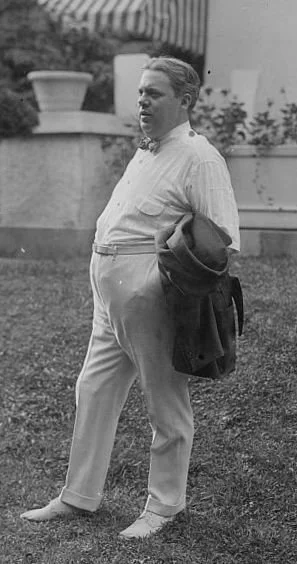
Between 1905 and 1928 tenor Harry Haley McClaskey topped the pop charts under the stage name Alfred Alexander. In that same period, he also topped the charts as Carl Ely, Irving Gillette, Harry Barr, Lou Forbes, Harry Haley, Robert Rice, Al King, Henry Gillette, Frank Knapp, and Shamus McClaskey, among many others. But his greatest fame came under his original stage name, and the one he’s best remembered for today, Henry Burr.
The singer behind early twentieth century hits like “The Song That Stole My Heart Away,” “I’m Forever Blowing Bubbles,” “Till We Meet Again,” “Beautiful Ohio,” “There’s a Little Spark of Love Still Burning” and “A Baby’s Prayer at Twilight” had such a unique and, at the time, ubiquitous voice—what you might call a strident trill—it’s hard to believe that array of pseudonyms ever fooled anyone. But from Burrs perspective it’s likely the only people he was out to fool were record company executives.
If you hear a cylinder recording of an early twentieth century ballad today, regardless of the name attached to it, there’s a roughly one in four chance you’re hearing Burr, who in later years claimed, by his own reckoning, to have produced some 12,000 records, though the actual number seems to be a bit closer to 5,000.
Born in New Brunswick, Canada, in 1882, McClaskey’s vocal talents were evident early. The son of a candy store owner was singing publicly in area churches by the time he was five, had been named the musical mascot of a local bicycle club by the time he was ten, and by thirteen he was singing with the St. Jogn Artillery Band.
In September of 1901, a then-19-year-old McClaskey was performing at the St, John Opera House when someone suggested Metropolitan Opera star Giuseppe Campanari, in town to give a recital, take a listen to the young local tenor.
Well, Campanari was so smitten with McClaskey’s talents he insisted the young singer drop everything and immediately go to New York, where he could receive some proper professional training. McClaskey, who was working in his father’s candy store at the time and had apparently never seriously considered singing professionally as any kind of viable career choice, did as he was told, arriving in New York in 1902.
Along with studying under vocal instructor Kate Stella Burr (who would inspire McClaskey’s stage name), he also began singing with the Grace Methodist Episcopal Church choir, where he soon enough became lead tenor. That same year he also recorded his first cylinder for Columbia under the name Henry Burr. Despite all those years singing choral arrangements in churches, and despite enthusiastic advice from a Met baritone who clearly thought the lad had a bright future singing high opera, Burr quite easily plunged headlong into the cheap emptiness of pop music.
In 1904, under the name Irving Gillette, he started recording with Edison. His first big hit, “In the shade of the Old Apple Tree,” came in 1905 on a recording he’d made for the then-fledgling Victor label.
Along with Columbia, Edison and Victor, over the next two decades Burr (or whatever the hell he was calling himself at the time) would record for Pathe, Harmony, Diva, Velvetone, Apex, Leeds Talk-O-Phone, Angelophone, the American Record Company , Cameo, Aurora, Vim, Empire, Emerson, Operaphone, Perfect, Crown, and perhaps a dozen others, spreading the pseudonyms around as he could. Given artists at the time were generally paid a flat fee per recording with no thought of any kind of royalties down the line, it was a necessary move to make a living.
As a crooner, by 1910 Burr had become not only the first Canadian recording artist to crack it in the States, but a national phenomenon who would remain at the very pinnacle of the American pop music scene until the end of the decade. He had hits as a solo act, part of duos or trios, and especially with The Peerless Quartet, which had started life as The Colunbia Male Quartet in 1906 before moving on to Victor. Buy 1915 or so, the music business had changed considerably, thanks in no small part to pressure put on the record companies by artists who expected fair compensation when they had a big hit. In 1920, recognizing what a sensation Burr had become, not only with the Peerless Quartet but as a solo act as well—you couldn’t go anywhere near a Victrola without hearing his distinctive voice—Victor offered him a lucrative seven-year contract.
Given that save for the touring, all of Burr’s work was based in New York City, he took some of that money and settled down in Mount Vernon, NY.
In 1911, Burr teamed up with singer Alvert Campbell, and as a duo through the mid Twenties, they recorded a long string of big hits, like “The Trail of the Lonesome Pine.” By the time he and Campbell split up in 1925 , Burr was already starting to get the sense his days as a recording artist were numbered. The emergence of motion pictures and radio was one thing, but the very nature of popular music was changing around him. His kind of balladry was falling out of style in favor of a new kind of jazz. Even The Peerless Quartet, which had been his bread and butter for over two decades, the group that had made him a very wealthy man, had to call it quits in 1928, after his contract with Victor ran out. Noting other young crooners with a new sound were suddenly all the rage while Burr’s own sales numbers were cooling fast, the label wasn’t much interested in drafting a new contract.
Not quite three decades into the twentieth century, Burr was smart enough to recognize that as a performer he was a dinosaur. After the Victor contract ran out and the Peerless Quartet dissolved, he essentially walked away from singing. But that was okay, as he had always been, he believed, a shrewd investor and side-operator, always keeping an eye open for the next big thing.
As early as 1915, while at the top of his game as a recording artist, he’d gone into business with a man named Fred Van Eps, who had an idea for a new way to make records. It’s unclear exactly how his vertical cut technique of pressing records was superior to the standard method, but he talked a good enough game that Burr was convinced. Together they formed the Paroquette Record Manufacturing Company, which folded two years later when it turned out no one was interested. He also went in with Van Eps on a banjo factory which didn’t do much better.
The one good guess Burr made early on was that radio was going to be big. As early as 1920 he was toying around with the potentialities of the new medium. He even made what is considered to be the first transcontinental radio broadcast when, as a publicity stunt, he sang into a telephone in New York and could be heard, more or less, by people with special headphones who’d gathered at a San Francisco restaurant for the event.
With the promise of radio becoming a reality and eager to get involved, shortly after retiring from performing in 1928, Burr set up his own production company and began producing radio shows for an array of independent networks. Things were going quite well, at least until the Stock Market crashed the next year. Burr, who had most of his wealth invested in the market, lost nearly everything.
A few short months later, however, the brass at CBS radio, who’d been aware of his production company, hired Burr to head up their new Artist’s Bureau.
After six years with CBS, Burr ventured back into singing, this time on a Chicago-based country music show on NBC. Pretty well forgotten by the masses already, Burr remained a member of the chorus for a few years before eventually working his way up to featured performer. He left the show in 1940, and died of throat cancer in 1941 at age 59.
The obituaries that followed Burr’s death went to great lengths to remind readers that, just a quarter-century earlier, he had been the most insanely popular and inescapable singer in America. Those who were old enough may have remembered him for a few minutes while reading the obit, but then quickly forgot again.
by Jim Knipfel