
Don’t I Know You?: DARK PASSAGE
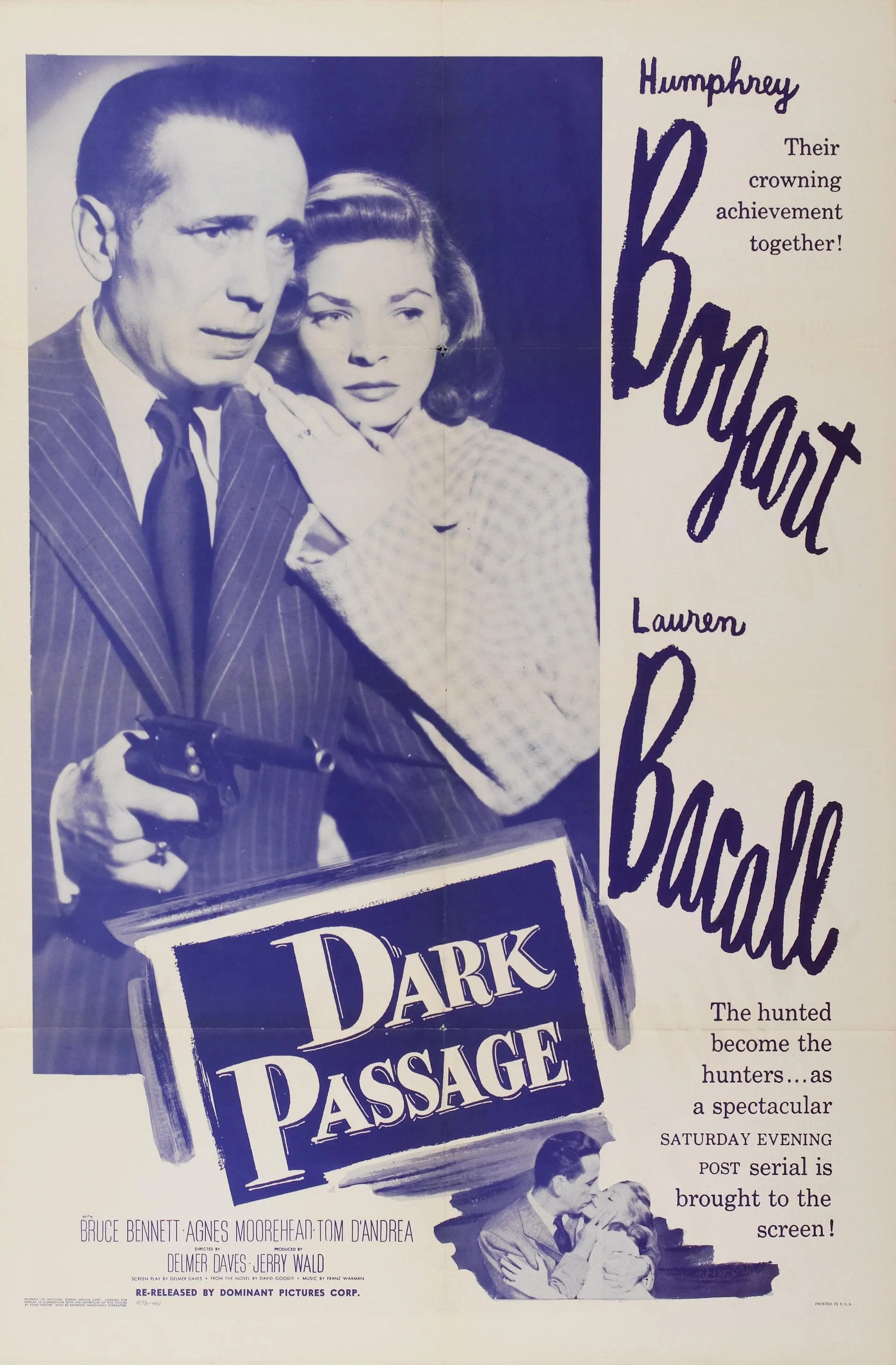
Dark Passage is as uneven as the streets of San Francisco. A hallucinatory series of vignettes, it induces a disorientating unsteadiness, like vertigo. The largely faceless hero, whose character is almost as much a tabula rasa as his visage, encounters a handful of malicious predators and an equal number of selfless benefactors. The only thing he never encounters is indifference; no one ever just ignores him and lets him alone. When he hides in the apartment of a woman he has just met, the first person to come and knock on the door is his arch nemesis, the woman who framed him for murder. Even a guy who passes in the street and asks for a light peers at him with undue interest, demanding, “Say, don’t I know you?”
Dark Passage might be the most stylized, fantastical version of this type of noir city: a claustrophobic dreamscape where nothing is random, accidental or insignificant. Anyone who lives in a large city knows that crowds and close quarters make people shut each other out; the freedom from scrutiny is one advantage that draws people to urban life. Yet Vincent Parry (Humphrey Bogart) just can’t escape notice. Delmer Daves’s film, with a script by David Goodis (from his own novel), is unusual in that it creates this paranoiac mood within a real city rather than a hermetic studio set. Perhaps only in San Francisco, where Hitchcock would achieve a similar effect in Vertigo, could an actual metropolis look so much like the inside of someone’s mind.
Falsely imprisoned for killing his wife, Vincent Parry escapes from San Quentin curled up inside a barrel. First we see his fingers hooked over the rim; then we see, from his point of view, the world spinning in the barrel’s mouth as he rolls down a hill. The first-person or subjective camera used off and on throughout the first half of the film serves the purpose of keeping Parry’s face unseen, and creates an uncomfortably trapped feeling for the viewer. Daves works hard to avoid the plodding quality to which the subjective camera was prone: he throws in lots of zipping pans and fast action, as when it feels like YOU, the audience, are pummeling the nosy jerk in a convertible who picks up Parry and then asks too many questions. Mainly, though, the gimmick serves as usual to prove how different human vision is from the camera’s eye.
But the artificiality of the style suits the bizarre twists of the story, which proceeds with dreamlike illogic. The first big twist to swallow is Parry’s rescue by Irene Jansen (Lauren Bacall), a stranger who formed a conviction of his innocence at his trial (because his case resembled that of her father, who was wrongfully imprisoned for killing his wife) and who conveniently manages to find and pick him up. Irene is a guardian angel with 200 G’s, who calmly accepts Parry’s explanations of three murders he looks guilty of but really didn’t commit. She doesn’t bat an eye when he tells her that the real murderer, Madge Rapf (Agnes Moorhead) fell out of a high window while he was alone in a room with her. “That’s not all you called to tell me, is it?” Irene prompts him, as if he’d just told her he had a dentist appointment.
Madge is not just Irene’s opposite number but easily the most insufferable character in whole of film noir, if not all of cinema. Amid all of Dark Passage’s implausibilities, the hardest to credit is that someone didn’t push Madge out a high window years before. She’s so shrill, nosy, pushy, and hysterical that it’s easier to believe that she bashes people over the head with blunt objects when they get in her way, than to believe that any man could ever have thought for five minutes that he wanted to marry her.
Most of the characters in Dark Passage follow this dichotomy of extremes. Another pair is Sam, the kind, lonely cabby, and Baker, the nasty, pig-faced, dogged crook who tracks Parry and blackmails him. At first Sam (Tom D’Andrea) seems kind of nosy and annoying too: he insists on jabbering despite his fare’s curt insistence that he doesn’t want to chat. The cabby patiently but stubbornly explains that he gets lonely—picking up people on their way to parties and night spots, dropping them off, never seeing them again—and he’s going to talk whether his passengers like it or not. He tells a long, weird story about driving a man with a bowl full of goldfish up and down the steep hills of Frisco—then, when you think he’s just a slightly nutty bit of local color, he casually identifies Parry and suggests he have his face altered to avoid recognition.
The scene when he visits a back alley plastic surgeon is the best in the film: the quick pan to the crinkle-faced, grimy-looking doctor (Houseley Stevenson), puffing on a cigarette, is both a joke and a shock. Thumbing a razor, chortling as he terrifies his patient with tales of what a botched job could do, he makes you squirm; but he also turns out to be skillful, wise, and a true artist with a knife. The surgery sequence becomes a delirious nightmare, as faces multiply and spin, grotesquely distorted, in the hero’s drugged brain.
Movies about plastic surgery usually address the question of whether changing a person’s face can change his or her personality. In A Woman’s Face, the scarred heroine (Ingrid Bergman in the Swedish original, Joan Crawford in the Hollywood remake) loses her criminal tendencies when her hideous deformity is erased. In A Stolen Face, a doctor operates on female career criminals with confidence that once they look normal they will become harmless members of society, but when he gives a cockney thief the gorgeous appearance of his lost love, and marries her to boot, she remains just as nasty a low-life as ever. Dark Passage, curiously enough, doesn’t even raise the issue. Vincent Parry doesn’t seem to be changed by his new face, or by the name he adopts, Allan Linnell. The character is most poignant when his face is swathed in white bandages and he can’t talk; Bogart’s dark eyes, peering through the slits, are pleading and vulnerable. He’s like something from a monster movie—especially in the wonderful sequence when he staggers, swaddled and panting, up the endless flights of steps to Irene’s building on top of Telegraph Hill. (The Malloch Apartments, adorned with silver art deco murals, still stand, and a cut-out of Bogart graces the window of one apartment.) After the phantasmagoric under-the-knife scene, he’s like the victim of a mad scientist; a bewitched beast trying to signal his hidden humanity, under a spell from which he’s finally released by the nurturing Beauty.
We never know much about Parry’s past. His wife hated him—but why? Madge pursued him, and though he apparently rejected her, he spent four hours with her the night before his wife was murdered. What were they doing? All of this is very cursorily sketched in, and Vincent’s alarming habit of touching off deaths wherever he goes is never deeply explored. The idea that Bogart’s beat-up, “lived-in” face is the result of the plastic surgeon’s art is perhaps the film’s central joke, but it also signals the strange plasticity of the hero. Despite all of his travails, there’s a sense in which he only looks as if he’s lived.
On the other hand, his friend George (Rory Mallison) is a strikingly well-drawn character despite appearing (alive) in only one scene. Parry describes the shy, lanky Southerner as a simple soul: “all he ever wanted to do was play the trumpet.” But then George, initially wary of helping out his on-the-lam pal, agrees to let him stay, explaining matter-of-factly: “You’re the only person who ever liked me.” Even more than Sam the cabby, George is a haunting personification of urban loneliness, a guy who lives alone, who has only ever had one friend (and lost that one to jail), and who winds up beaten to death with his own trumpet. It’s the sheer, compelling oddness of these minor characters that gives the film its life. Just about everyone in Dark Passage is alone and desperate, talking too much and asking inappropriate questions the way people do when they don’t get out enough.
Not only does plastic surgery have no evident effect on the hero’s inner self, it doesn’t even help much to throw off pursuit. Almost as soon as he leaves the safety of Irene’s apartment, he’s picked up by a cop, for no good reason. In a diner at the crack of dawn, the detective happens to overhear Parry make a slip, referring to the races at a track that has closed for the season, and he sidles over and begins peppering him with questions, then arrests him simply for not having his identification. Parry manages to lose the cop and holes up in a seedy hotel, only to have his room invaded by Baker, the cheap chiseler who has been following him ever since he picked up the convict and got knocked out for his pains. Baker talks too much too, gloating and grinning in his loud checked suit, so boneheaded he lets his victim drive him to a desolate spot and stop short so he smacks his head on the windshield.
Baker ends up crumpled on the rocks below Golden Gate Bridge; Madge ends up flattened on the sidewalk outside her building, having mysteriously succeeded in falling out of her own window. Vincent—now Allen—and Irene get a fairy-tale finish, meeting up in that little spot all hunted men dream of, a dot on the map in South America where there’s nothing to do but drink cocktails and watch the surf and listen to the band play Latin rhythms. A place where no one cares who you are or asks you any questions. But back in San Francisco, lonely cabbies still insist on talking to fares who keep their faces in shadow, and back-alley doctors still stroke their razors and ask patients, “Got the money?” Cops still hang out in diners at dawn buttonholing hapless customers, and heavy-set, worried looking guys still pace the streets in the wee hours, asking for a light for they can peer into a stranger’s face and demand, like an accusation: “Hey—don’t we know each other?”
by Imogen Sara Smith