
Sympathy for the Devil: “The Hitler Gang”
Nearly seventy years after his death, Adolf Hitler has become a one-man nedia empire bigger than Oprah Winfrey, inspiring countless books, articles, analyses, TV shows, feature films, documentaries, comedies, toys, cartoon references, and songs. One would have to imagine that Hitler wouldn’t find this at all surprising. He might have been surprised, however, to see the first feature drama to take a serious look at his rise to power released while he was still alive.
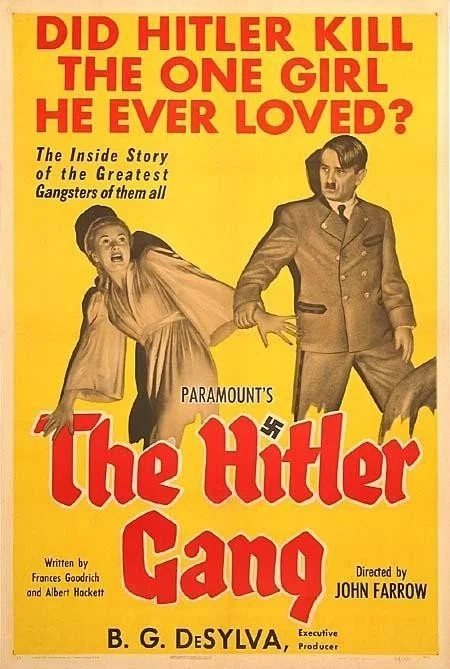
Directed by John Farrow (Tarzan Escapes, The Big Clock) and released by Paramount in 1944, The Hitler Gang remains one of the most fascinating films made about Hitler for several reasons. Opening at the close of WWI with a blind and bedridden Hitler in an army hospital following a gas attack, the film immediately (via two army doctors) establishes him as a paranoid with a persecution complex. Within five minutes we see where the famous Charlie Chaplin mustache came from, and watch as he becomes a military snitch in order to support a coup to overthrow the new republic. Five minutes in and we already have a clear and unsavory portrait of who Hitler is and how he operates. From that point on the film, at an equally brisk clip, follows Hitler’s rise (with a blend of charisma, deception, blackmail and blunt force) through the ranks of both the ragtag NSDAP and the German political scene at large. Along the way we’re introduced to Hess, Himmler, Goering and Goebbels. We see how Nazi ideology was formed, the Beer Hall Putsch, his stretch in prison, how he finally grabbed supreme power, all the highlights. The pace of the film slows only briefly at the halfway point to take an uncomfortable look at Hitler’s unwholesome sexual obsession with his niece, and how members of his inner circle tricked him into killing her in order to get his mind back on the business at hand.
The first thing that fascinated me about the film given when it was made was how historically accurate it was. Although ultimately it may operate like one, this is by no means a traditional propaganda film, and certainly bears no resemblance to the other anti-Hitler films of the time. There is no exaggeration, no overt editorializing, no myths or outright lies (though some events and back room discussions—as well as the fate of Hitler’s niece—are still the object of some debate among historians). Only at the very end does the stentorian voiceover appear to announce that Hitler is a very bad man who must be destroyed. Prior to that, it’s merely an historical drama and the audience is left to make up its own mind based on the story. No, it’s not a sympathetic portrait — the film makes it perfectly clear that Hitler was an insane, delusional, and dangerous man. But Scarface, Little Ceaser, and Public Enemy weren’t intended to be sympathetic portraits either. Not in so many words, anyway.
That’s the other fascinating thing about Farrow’s film. Any resemblance between The Hitler Gang and the gangster films of a decade earlier is wholly intentional. The title itself tells us that. Hitler is Scarface, an unbalanced nobody with dreams of glory who uses his personal charisma to surround himself with conniving thugs and snatches power by whatever means are handy. (And along the way he also fosters an unhealthy obsession for a younger female relative). Farrow plays this out beautifully, even filming a number of scenes that directly echoed the gangster classics. He must have been very grateful that the historical record played into his hands so well. The only thing the record didn’t offer him was the requisite comeuppance at the end, though he would have had it had he waited a few months. As things stand the film was forced to close with the tide of the war turned in Europe and Allied forces closing in on Berlin, with a Hitler who was (like any proper cinematic gangster) clearly doomed, but still defiant.
Although it was supposed to be another wartime low-budget quickie, Farrow and his crew made it much more than that by putting such care into the detail work, going so far as to hire lookalikes to play the more well-known figures. The real coup was hiring Bobby Watson, an actor who was both blessed and cursed by bearing such an uncanny resemblance to Hitler. It’s a little unnerving to see him here, actually, but he gives a remarkable and believable performance. He had already played Hitler in a handful of comedies but this was his first straight drama in the role, and resists the rug-chewing performance called for in the likes of The Devil With Hitler. After this he would go on to play Hitler in six other films. Likewise The Hitler Gang’s Joseph Goebbels, Martin Kosleck, had previously played Goebbels as early as 1939, and thanks to his cold and severe features, would go on to play Nazis of all kinds over the years.
Although mostly forgotten or simply ignored today as just another bit of Hollywood wartime propaganda, looking at it again, it strikes me that The Hitler Gang might make for a much more effective teaching tool than most straight documentaries when it comes to the question of how, exactly, a phenomenon like Hitler could come about. There is that added risk that certain audience members, as with Scarface, might take things the wrong way, but perhaps that explains the closing voiceover, which fills in for Scarface’s cautionary crawl.
by Jim Knipfel