
Trader Horn
In the 1930s and 1940s, legions of black Hollywood extras put on loincloths and bone jewelry to portray Africans in countless adventure pictures like the long-running Tarzan series. Their role was usually just to make the white actors look noble, brave, God-fearing and intelligent, in stark contrast to their own bestial, cowardly, and cannibal ways. If they were carrying the whites’ luggage, they were always ready to drop everything and run away at the slightest sign of trouble. If they were attacking the whites, they were ever prepared to give themselves up by the score to varieties of grisly deaths; no African adventure flick was complete without at least one black savage coming to an ignoble, screaming end in the jaws of a lion or crocodile, or under the foot of an elephant, or in the embrace of a python or in a pit of quicksand. These films were the inspiration for the then ubiquitous racial slur “spearchucker.”
MGM released the first Tarzan film, Tarzan the Ape Man, in 1932. It was directed by W. S. Van Dyke, a veteran who’d shot dozens of movies since his start in 1917. Curiously, just the year before Tarzan, MGM had released the one African adventure film that deviated in significant ways from the spearchucker norm: Trader Horn, the Godfather of Great White Hunter movies. And it too was directed by Van Dyke.
Unlike the Tarzan series and countless other B-movies set in Africa, Trader Horn was shot on location in Africa – in Kenya, the Republic of Congo, Uganda and elsewhere. It was the first Hollywood film ever made on the African continent. At the time, hard as it is to believe now, parts of the continent’s interior were still unknown to and uncharted by whites, making this the one African adventure film of the era that actually was an African adventure.
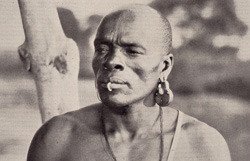
The film’s Africans are all real Africans. Van Dyke lavishes his camera on them in documentary travelogue style. Noble Masai warriors stare inscrutably, bare-breasted young women giggle shyly, elders with saggy earlobes and teats bicker with one another in front of their grass huts. It was also surely the first Hollywood film to recruit a tribe of Pygmies as extras. If it’s still all too stagey to look quite real, in terms of preserving their dignity Van Dyke’s Africans were light-years ahead of the potbellied fake-Africans who ooga-boogaed among the potted jungle plants in so very many pictures.
Given all the trouble and expense MGM went to in providing an authentic setting, it’s surprising what a Saturday-matinee fantasy the story is. Grizzled old Trader Horn (Harry Carey, in one of his more than 250 films) shows the ropes to his protégé, Peru (a very young Duncan Renaldo, later TV’s Cisco Kid). They meet various native tribes, of whom Peru remarks, “You’re wrong about these people. They’re not savages, they’re ignorant children.” When any of the natives is killed – as several are, usually screaming hysterically – Horn lights his pipe and shrugs it off with stoic nonchalance.
That is, except for his trusty native gunbearer, Rencharo, who is sternly, almost silently and very buffly played by the Kenyan Mutia Omoolu in his only film appearance. Their relationship is the film’s central love affair. You don’t have to be a professor of Queer Theory to be struck by the scene where the faithful African servant takes a spear intended for his crusty white boss and dies in his arms while they hold hands and Horn sheds a tear. Horn’s affection for Rencharo doesn’t mark him as a humanitarian. He explicitly states that the great mass of Africans are worthless savages; Rencharo is unique among them for being as good as any white man.
The trio comes upon a tribe whose leader turns out to be a gorgeous blonde, the White Goddess, sort of a female Tarzan. Sadly, starring in the film proved to be bad juju for Edwina Booth. She contracted a near-fatal infection while on location, referred to as “jungle fever” at the time. Which is funny when you consider that Booth was a Mormon, for whom jungle fever was a very definite no-no. Instead of being her big break, Trader Horn almost killed her, and while she survived her long bout with the disease, her career did not.
When Van Dyke filmed Tarzan, he used rear projections of some of his Trader Horn footage to give it an authentic look. Tarzan was actually shot in and around Los Angeles, and at Silver Springs in Florida – where, according to lore, some of the rhesus monkeys used in the film escaped and formed a colony that still exists there. Van Dyke went on to direct dozens more films right up to his death in 1943. He made no more Tarzan pictures, but he did do Thin Man, Andy Hardy and Dr. Kildare films.
Another film called Trader Horn came out in 1973, starring Rod Taylor. Its terrible pastiche of a plot bears no resemblance to the original, and it comes off more as a very bad take on King Solomon’s Mines. There was also a softcore sex romp in 1970 called Trader Hornee, shot on a shoestring in the Hollywood Hills.
by John Strausbaugh