
WANTED MAN: On “The Fugitive”
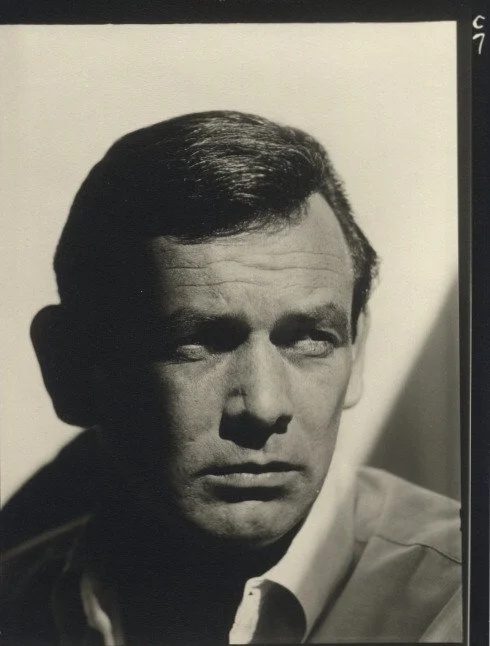
The road at night is home to one of America’s perennially romantic figures: the man who’s on the lam. The escaping slave wading in the water to throw off the dogs; the western outlaw with his face on a Wanted poster and a price on his head; the Depression-era bank robber gunning his stolen V-8 toward the state line. Guilt or innocence is almost incidental; it’s the race to stay free, and the need to keep on the move, that lend such dark luster to the fugitive. The double meaning of “wanted man” is inherent, never stated more succinctly than in Nightfall (1957), when just before they kiss Anne Bancroft tells Aldo Ray, who is pursued by both cops and criminals, “You’re the most wanted man I know.”
With all due respect to Aldo Ray, the most wanted man of all was surely David Janssen, who carried one hundred and twenty episodes of the television drama The Fugitive (1963-1967) with a charisma deeply rooted in the unease, alienation, and desperation of the man on the run. As Dr. Richard Kimble, who escapes en route to the death house after being falsely convicted of killing his wife, Janssen imbued the show with a hunted, haunted, hellhound-on-my-trail mystique. His might be called a one-note performance, but that note is a suppressed intensity that never slackens for an instant; he never forgets or lets us forget that he’s under sentence of death. The fear of being caught is in his husky, constrained voice; the nervous smile that twitches one side of his mouth; his darting, plaintive eyes; the way he stands with his shoulders slightly hunched, as if against a cold wind. Every woman wants to give him aid and comfort. Who could resist a strong, quiet, kind, yet just possibly dangerous man who is also as lost, alone, and in need of help as the bedraggled stray kitten he fleetingly bonds with at the end of the series debut? Because Kimble is a mensch, at times perilously close to a saint, it’s all the more important that Janssen has a dark, gritty edge to his presence. While the scripts place him again and again in the position of risking his safety to help someone in trouble, Janssen brings out Kimble’s exhaustion and bitterness, his reflexive distrust of authority, his lonely and self-punishing stubbornness.
Every episode of The Fugitive ends with Kimble alone, walking down the highway, thumbing a ride, huddling in the back of a truck, skulking through a railyard, or slumping in the gloom of a Greyhound bus—disappearing into the no-man’s-land of the American night. The look and mood of the series are relentlessly drab and melancholy. “Another shabby room, another lonely night,” the narrator intones; another dreary town that looks just like the last, another cheap hotel, another menial job where the stranger must put up with bullying bosses and needling co-workers, another toxic web of resentments and desires waiting to trap the newcomer. The Fugitive paints the life of a drifter as a dismal and repetitive slog. In this it forms a perfect counterpoint to Route 66, another popular television show with which it overlapped. (Route 66 ran from 1960 to 1964, and Janssen was a guest star on the show just before The Fugitive began its run.) Buz and Todd, footloose buddies zipping around the country in a Corvette, are troubadours for the philosophy of moving on; at each stop they help release people trapped in emotional ruts, then motor on, restless searchers for some ultimate true home.
These contrasting shows nicely illustrate the two kinds of travel that haunt the American imagination: exploration and flight, discovery and escape. To be on the road is to be free, unfettered by emotional bonds or confining routines, going to the next new place. To be on the lam is to have no safe haven, no-one to trust, just a desperate and dwindling hope of eluding capture. In The Fugitive, Richard Kimble wants nothing more than to settle down, to return to the stable and wholesome life he once had as a pediatrician in the fictional small town of Stafford, Indiana. He roams (rather than fleeing the country) in the far-fetched hope of tracking down the one-armed man he saw running from his home the night his wife was murdered. He stubbornly pursues the dream of clearing his name—a determination that is part of the machinery required to keep the series in its perpetual holding pattern of flight and pursuit. The paradox of the show is that it depicts all the horrors of being a fugitive—the constant fear of betrayal, the impossibility of forming ties, the need to remain in a sub-legal twilight—yet also creates an irresistible glamour around the figure of the fugitive, who is strangely purified by his shadowy existence outside society, and who unintentionally seduces or provokes the masses gnawing at their private traps.
The show’s machinery is also kept running by Kimble’s dedicated hellhound, Lieutenant Gerard (Barry Morse). Writer Stanford Whitmore confessed to deliberately giving the character a name similar to Javert, the monomaniacal policeman obsessed with capturing Jean Valjean in Les Misérables. Gerard, who comes within a whisker of catching Kimble in roughly every third episode, is robotic in his idée-fixe; inhuman in his refusal to respond emotionally or change his mind. The keynote of his character is his peculiar refusal to state that he personally believes his quarry to be guilty. Every time the question comes up, Gerard smugly states that it doesn’t matter what he thinks. “The law pronounced him guilty. I enforce the law. Whether the law is right or wrong is not my concern. Let others debate and conclude. But when I begin to doubt, to question—I can’t permit it.” In a sense, Gerard is not a person at all, but a personification of authority at its most rigid and unimaginative. Often, people encountering Gerard remark that now that they have met him, they hope Kimble gets away. Even more often, the thwarted Gerard complains that he can’t understand why so many people, especially women, side with the fugitive and help him escape.
Kimble is a litmus test. Every plot turns on the way people react when they learn who he really is. Some help him because they believe he’s innocent; or because they’re grateful for something he’s done; or for some obscure personal reason, like a desire to get back at someone else who wants to turn him in. Some people betray him because they figure it’s their duty under the law, some for gain, some out of spite. Carrying his own story with him like a personal storm-cloud, Kimble continually stumbles into situations involving crime, injustice, mistaken identities, false accusations, and deceptive schemes. The whole country is filled with wrongly accused ie. nnocents and villains with law-abiding fronts. In “Come Watch Me Die,” Kimble helps a young man who is accused of murder but proclaims his innocence escape lynching, only to learn that he did commit the brutal killing and is a remorseless sociopath. Frequently Kimble is torn between his need to testify to things he’s witnessed, and his fear of coming forward and risking police attention. He’s a supremely ethical, conscientious man for whom the law and all its trappings is the enemy. “Come Watch Me Die” ends with a rare moment of humor, when a sheriff, favorably impressed by the way Kimble has captured the killer, asks if he has ever considered a career in law enforcement. The fugitive responds with a nervous, queasy smile.
Flung from one moral dilemma to the next, he is constantly caught between his societally-imposed guilt, which forces him to hide his identity, and his innate goodness. “Wings of an Angel” incisively illustrates the way he is caught between the forces of law and crime. Wounded when he (yet again) helps capture an escaping convict, he’s taken to the nearest place for treatment—which happens to be a prison hospital. He’s a hero to the guards whom he fears and a villain to the inmates, who sneeringly call him “cop-lover.” When some inmates recognize him, they blackmail him into stealing morphine for the prison’s junkies. Being a doctor adds to Kimble’s trials, as he often feels obligated to help the injured despite the risks of revealing his medical knowledge.
Though he always resists serious moral compromise, his life is constructed of lies and deceptions: in every town he assumes a new name, invents a back-story and a home town, fills job applications with phony references. He’s quite ready to knock people down to make an escape, steal a wallet when he needs identification, or fake his own death. His surprising competence at living outside the law is a large part of his attraction. In “See Hollywood and Die,” when he is held hostage by two young thugs along with a woman whose car they steal, Kimble convinces them that he’s a cool professional crook, and plays the part of a fast-working seducer to forge an alliance with his fellow hostage. The sense that this man could be dangerous, if he wanted to be, keeps him from seeming too idealized—or rather, it idealizes him in a different and more appealing way.
Much has been written about the transference of guilt in Hitchcock’s wrong-man stories. But being a fugitive, even with all the attendant ethical snares, does not tarnish Kimble’s conviction of his own innocence and his right to stay free and alive. (The one exception comes when, inevitably, he contracts amnesia, and on learning his identity, can’t be sure of his innocence.) The moral dilemmas so elaborately constructed in each episode can sometimes feel contrived or repetitive or strain credulity, but the show is driven by this basic, burning core of Kimble’s desperation, his raw fear and profound depression whenever he’s cornered or fingerprinted or locked in a cell. The suspense is superficial yet sure-fire: watching each episode, I know perfectly well that he’s not going to get caught, because if he did the show would be over, yet I respond with dutiful Pavlovian reflexes. Oh no! How’s he going to get out of it this time?
The Fugitive has the ritualistic, same-time-next-week quality of classic television, so different from today’s mandatory novelistic arcs. Each episode opens with a re-cap of the premise, which grows tiresome, though it comes in the deliciously portentous voice of William Conrad. (The credits were changed, very much for the worse, at the start of the second season; the season one credits include wonderful noirish footage of Kimble’s escape from a train wreck, and Conrad somberly intoning, “Richard Kimble ponders his fate as he looks at the world for the last time, and sees only darkness. But in that darkness, fate moves its huge hand…”) The Fugitive was the creation of Roy Huggins, the veteran writer and producer who was also behind Maverick, 77 Sunset Strip, Run for Your Life, and The Rockford Files. According to his obituary in the New York Times, Huggins taught himself to write by copying Chandler’s Farewell, My Lovely in longhand, which is enough to put him in my good books. He got into movies when his novel Too Late for Tears was adapted into a taut and terrific 1947 film noir with Lizabeth Scott and Dan Duryea. A member of the Communist Party until 1939, he was called before HUAC in 1952 and pragmatically named names—but only of those who had already been named. Presumably, he knew something about moral compromise.
The Fugitive was both a critical and popular success, though only for one season did its ratings break into the top five TV shows. Famously, the show’s finale (a two-parter called “The Judgment”) was watched by more people than any previous television program—72% of all households that owned TV’s tuned in. For the record, I have not yet seen the final episode, since I am still working my way through season three. I have an idea how it might go, though: I imagine Kimble will capture the one-armed man and be exonerated, at which point all of the scores of women who fell in love with him over the course of 120 episodes will appear, saying, “At last we can be together!” Then an enormous fight will break out, and he’ll be torn to pieces like Orpheus by the Maenads.
But seriously…
The enduring power of The Fugitive lies precisely in its unresolved tension, the way it portrays being a fugitive as a universal and eternal condition. Richard Kimble has nothing. He often carries a small suitcase, but since he’s regularly forced to flee with only the clothes on his back, the suitcases can’t hold anything that he’s attached to. He has no identification, just whatever petty cash he earned at his last job. He works as a mechanic, a farm laborer, a handyman, a lifeguard, a truck driver, a hospital orderly—always something faceless and expendable. He goes by whatever name he pulls off the top of his head. But his own identity clings to him as an inescapable threat: his fingerprints and his face inform against him, yet he never tries plastic surgery or burning his fingertips with acid. (He does dye his hair, but this fools no-one—though it vastly improves his appearance, and neatly distinguishes his fugitive identity from his previous square self.)
The scripts may insist that Dr. Kimble yearns to go back to being a solid citizen, with his medical degrees hanging proudly on the walls of his office, but those who love the show just want to see him in another shabby room, for another lonely night. He’s the eternal drifter; the hitch-hiker with the worried face; the guy keeping to himself in the corner of a boxcar; the stray that every woman wants to take in and console; the friendless stranger turning up his collar against the cold wind; the man who is from everywhere but here, and who’ll be from here soon.
by Imogen Sara Smith