
What Would Orwell Think?
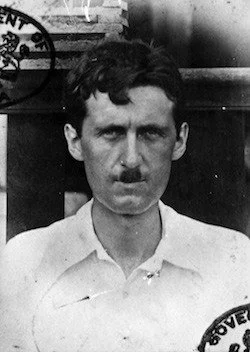
In his “As I Please” Tribune column of February 4, 1944, George Orwell wrote: “The really frightening thing about totalitarianism is not that it commits ‘atrocities’ but that it attacks the concept of objective truth: it claims to control the past as well as the future."
The "atrocities” thing was a bit of as bugbear for him. A few months earlier he’d written: “So far as it goes, the distinction between an atrocity and an act of war is valid… Nevertheless, a world in which it is wrong to murder an individual citizen and right to drop a thousand tons of high explosive on a residential area does sometimes make me wonder whether this earth of ours is not a looney-bin made use of by some other planet.” In other words, he believed, correctly, that “war guilt” was in the eye of the victorious beholder.
Regarding the totalitarian attack on truth, I don’t know that this is the first seed of Nineteen Eighty-Four he planted in public, but he is clearly working out one of its core ideas.
D-Day was still a few months from execution in February 1944, but everyone in England could see the massive build-up to it. The tide had turned sufficiently against the Germans in Russia and the Mediterranean by then that the inevitable end was coming into view. That’s why Orwell could go on to write: “There is some hope, therefore, that the liberal habit of mind, which thinks of truth as something outside yourself, something to be discovered, and not as something you can make up as you go along, will survive.” My emphasis.
That’s an odd note of optimism from Orwell. It makes me wonder: if he’d been able to look ahead thirty-odd years past 1984, what would he think now?
by John Strausbaugh